
Synthesia vs DeepVideo: AI Video Translation & Dubbing Compared (2026)
AI Dubbing
Lip sync
Avatars
Unit cost
Local vs cloud
Executive summary
Synthesia and DeepVideo are not in the same product category, but they overlap directly on one job — turning an existing video into another language — which is why they are worth comparing. Synthesia is a cloud enterprise video platform: its core is generating training and compliance videos from a script, slide deck or document using AI avatars, and it also ships AI Dubbing — upload any video or paste a YouTube link and get it translated and dubbed into 130+ languages with optional lip sync. DeepVideo is a local desktop video translation and dubbing client that does one thing: move a finished video into another language, with the entire pipeline running on the user’s own machine.
- The overlap is “multilingual dubbing + voice cloning”; the widest gap is lip sync. Synthesia’s AI Dubbing supports optional lip sync; DeepVideo does not offer lip sync at all — whenever a real person’s face is talking on screen, DeepVideo simply cannot take the job. This is the same shortfall it shows against HeyGen.
- This time the cost gap is large — and reversed. DeepVideo works out to about $0.17/min (Std plan, down to $0.138 on annual); Synthesia’s dubbing converts to roughly $1.09–1.76/min (without lip sync), and doubles to about $2.19–3.53/min with lip sync. In the pure-dubbing overlap, DeepVideo is roughly 6–10× cheaper. That is the opposite of how it fares against HeyGen and Rask AI, whose pure-dubbing prices both undercut it.
- Language coverage remains Synthesia’s runaway advantage. Synthesia supports 140+ languages and voices (130+ on the AI Dubbing spec); DeepVideo’s public claim is voice cloning across 30+ languages with 100+ preset voices, with no published per-language list.
- Privacy is DeepVideo’s structural advantage. DeepVideo processes 100% locally and the video file never leaves the device; Synthesia is a pure cloud platform, personal data may be transferred outside the UK / EEA, and uploaded voice samples are used to fine-tune the model that generates that user’s avatar.
- Ecosystem and scale are Synthesia’s moat. It has an API (from the Pro plan), team collaboration and seats, and Enterprise-grade SAML/SSO, SCORM export and Brand Kits — none of which DeepVideo offers.
- Overall. On this report’s weights, Synthesia leads narrowly at 7.7 : 7.2, driven by language, lip sync and ecosystem; DeepVideo leads absolutely on privacy and by several times on cost. Raise the privacy/compliance weight to 28% and DeepVideo flips ahead at 7.6 : 7.3; weight “multilingual at scale + lip sync required” heavily and the gap widens to 8.7 : 5.7 (see sensitivity check, 4.6).
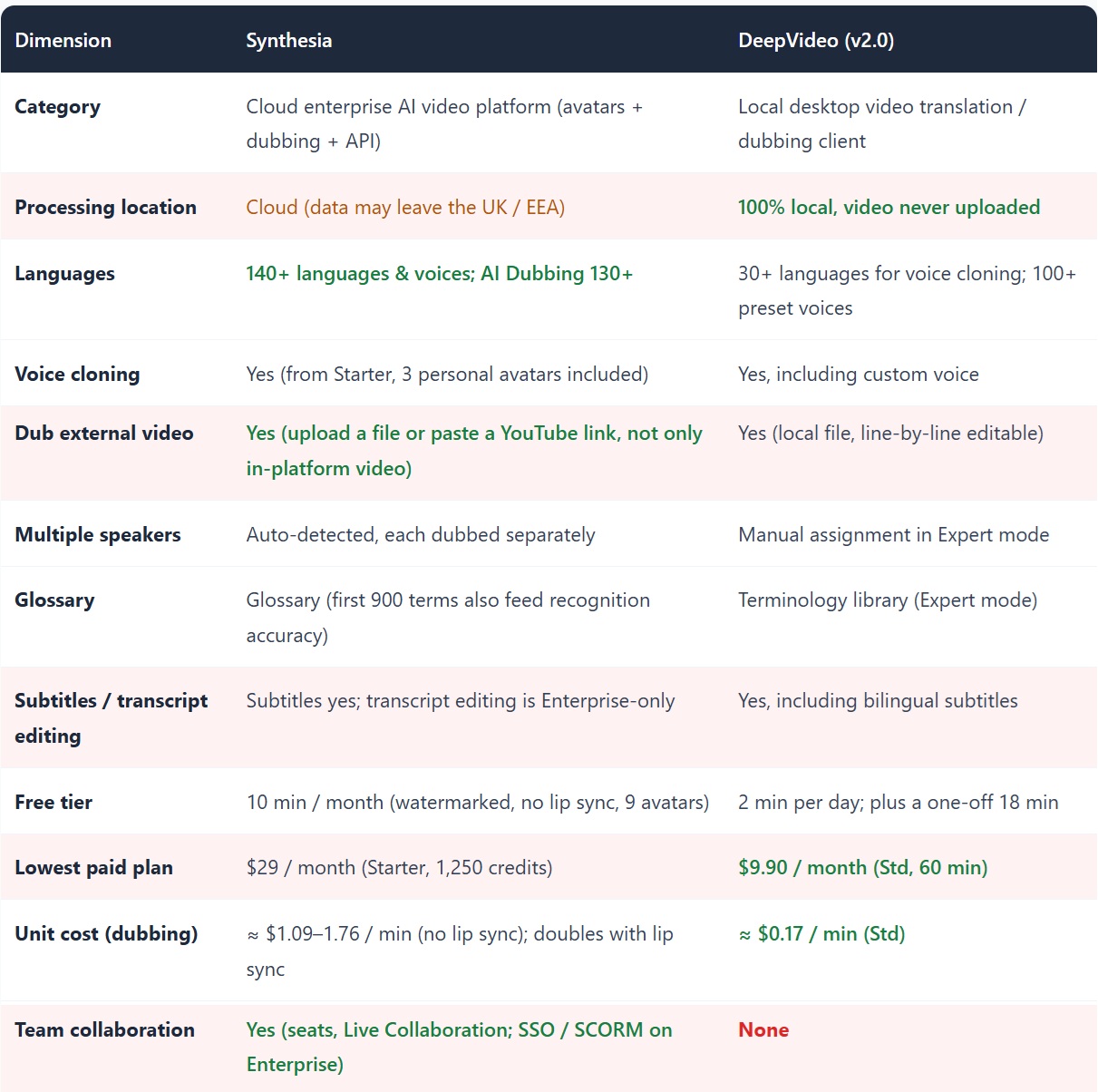
I. At a glance: two routes in one table
| Dimension | Synthesia | DeepVideo (v2.0) |
|---|---|---|
| Category | Cloud enterprise AI video platform (avatars + dubbing + API) | Local desktop video translation / dubbing client |
| Processing location | Cloud (data may leave the UK / EEA) | 100% local, video never uploaded |
| Languages | 140+ languages & voices; AI Dubbing 130+ | 30+ languages for voice cloning; 100+ preset voices |
| Voice cloning | Yes (from Starter, 3 personal avatars included) | Yes, including custom voice |
| Lip sync | Yes (optional, costs double credits; not on Basic) | Not supported |
| Avatars | Yes (9 → 240+ stock avatars, Personal Avatar) | Not supported |
| Generate from scratch | Yes (script / PPT / document to video, AI assistant) | No (only processes existing video) |
| Dub external video | Yes (upload a file or paste a YouTube link, not only in-platform video) | Yes (local file, line-by-line editable) |
| Multiple speakers | Auto-detected, each dubbed separately | Manual assignment in Expert mode |
| Glossary | Glossary (first 900 terms also feed recognition accuracy) | Terminology library (Expert mode) |
| Subtitles / transcript editing | Subtitles yes; transcript editing is Enterprise-only | Yes, including bilingual subtitles |
| Free tier | 10 min / month (watermarked, no lip sync, 9 avatars) | 2 min per day; plus a one-off 18 min |
| Lowest paid plan | $29 / month (Starter, 1,250 credits) | $9.90 / month (Std, 60 min) |
| Unit cost (dubbing) | ≈ $1.09–1.76 / min (no lip sync); doubles with lip sync | ≈ $0.17 / min (Std) |
| API / integration | Video & Sessions API (from Pro plan) | None |
| Team collaboration | Yes (seats, Live Collaboration; SSO / SCORM on Enterprise) | None |
| Client | Browser only (no desktop app) | Windows / macOS desktop (no mobile) |
| Commercial use | Paid plans yes; Basic is watermarked | Paid plans yes |
II. What each product actually is
Synthesia
Cloud · enterprise platform
Synthesia is one of the most established commercial AI-avatar video platforms, claiming 1M+ users and compliance audits passed at 90% of the Fortune 100. Its capability splits into two lines: “build a video from a script” — AI avatars, Personal Avatars, PowerPoint/PDF import, an AI video assistant (Syren) — and the line that overlaps with DeepVideo, “translate and dub an existing video.” The latter comes in two forms: in-platform videos use 1-Click Translation, while external videos (any .mp4/.webm/.mov, or a YouTube link) go through AI Dubbing — which auto-detects and preserves each speaker’s voice, can add lip sync, and produces a downloadable file or a single multilingual player link.
Its billing is a classic platform credit system: video, dubbing, avatars, API and generated images all draw on one pool, but at different burn rates — finished video 100 credits/min, AI dubbing 76 credits/min, lip sync double at 152, API rendering 75 credits/min. Every plan is a credit pool plus a free 10 minutes/month allowance, and credits do not roll over. So “10 minutes a month” only holds if you never localize anything — once dubbing starts, it eats the pool at a faster rate.
Strengths
- One of the few options with lip-synced dubbing — real talking-head footage can be localized as-is
- 140+ languages and voices, enough to cover global markets in one pass
- Avatars / Personal Avatar / script-to-video: can generate content from scratch, not only translate
- Accepts external videos and YouTube links, not only in-platform output
- Video & Sessions API, team collaboration, SSO / SCORM / Brand Kits for enterprise use
- SOC 2 / GDPR / ISO 42001 compliance passed, clears most legal and security reviews
Weaknesses
- Cloud-only: footage and voice samples enter its cloud; personal data may leave the UK / EEA
- Uploaded voice samples are used to fine-tune the AI model that generates the user’s avatar
- Complex credit system with 2–3× burn-rate differences and no rollover — hard to forecast
- High entry price ($29/mo); per-minute cost is several times DeepVideo’s in pure dubbing
- Basic plan cannot use lip sync, watermarks output, and offers only 9 avatars
- Transcript editing, SSO and SCORM are locked behind Enterprise
DeepVideo
Local · privacy-first
DeepVideo takes the opposite route: the whole pipeline (audio extraction, vocal separation, speech recognition, translation, TTS, subtitle alignment, muxing) runs on the user’s own computer, and the video file never leaves the machine. Two things follow directly — because it does not rent metered cloud compute, the price drops to about $0.17/minute; and data sovereignty stays entirely with the user. v2.0 offers two modes: Quick Translation for one-click output, and Expert Video Translation with multi-speaker assignment, Voice Cloning, a terminology library and emotion recognition for projects that need line-by-line control.
The trade-offs are equally clear: no lip sync, so real talking-head footage cannot be used directly; no API, no team seats, no avatar capability, so it cannot be embedded in an automated pipeline or generate content from scratch. Language coverage is the voice-cloning figure of 30+ languages, with no published list. On external video dubbing the two are close in capability (DeepVideo handles local files; Synthesia also takes YouTube links), but DeepVideo adds line-by-line editing and single-line re-renders. One easily missed point: the monthly “minutes” are a processing quota, counted separately per language — dubbing one 10-minute video into 5 languages consumes 50 minutes on the Std plan.
Strengths
- ≈ $0.17/min with a $9.90/mo entry price — a predictable bill
- 100% local processing: no cross-border risk, no voiceprint leakage
- Genuinely usable free tier: 2 min/day plus a one-off 18 min, no card required
- Expert mode adds a terminology library and emotion recognition for controlled output
- Line-by-line editing and single-line re-renders keep the cost of fixes low
- No dependence on network or cloud quota — works offline
Weaknesses
- No lip sync: talking-head video needs a separate third-party lip-sync tool
- Narrow language coverage (30+) versus Synthesia’s 140+
- No API / SDK — cannot be driven programmatically at scale
- No avatar capability, cannot generate video from scratch
- No team collaboration or seat management
- Monthly quota counts each language separately, so it drains fast when scaling
III. Pricing and the real cost of a finished minute
Both advertise a monthly fee, but the monthly fee is not comparable — Synthesia sells a credit pool that does not roll over, DeepVideo sells a processing-minute quota. To compare them you have to convert both to cost per finished minute. Synthesia’s plans and credit rates come from its official pricing page; DeepVideo’s plans come from its pricing page.
3.1 Synthesia plans and credit maths
| Plan | Monthly | Annual-implied | Credits | Avatars | Seats | Key difference |
|---|---|---|---|---|---|---|
| Basic | $0 | — | 500 / mo | 9 | 1 | Watermark · no lip sync |
| Starter | $29 | $18/mo ($216/yr) |
1,250 / mo (15,000 / yr annual) |
125+ | 1 + 3 guests | No watermark · 3 personal avatars |
| Pro | $89 | annual tier available | 6,000 / mo | 180+ | 1 + 5 guests | Includes API access |
| Enterprise | Custom | Custom | Custom (unlimited video minutes) | 240+ | Custom | SSO · SCORM · Brand Kit |
The key number is the credit price: Starter monthly $29 ÷ 1,250 = $0.0232/credit; Starter annual $216 ÷ 15,000 = $0.0144/credit; Pro monthly $89 ÷ 6,000 = $0.0148/credit. In other words annual and Pro sit at almost the same credit price, while monthly Starter is the most expensive — the extra monthly cost buys “not paying a year up front,” not cheaper volume.
3.2 Synthesia credit burn per finished minute
| Feature | credits / min | @ Starter annual | @ Pro monthly | Note |
|---|---|---|---|---|
| AI dubbing · no lip sync | 76 | $1.094 | $1.127 | The overlap both products cover |
| AI dubbing · with lip sync | 152 | $2.189 | $2.255 | DeepVideo does not offer this |
| Finished video (avatar) | 100 | $1.440 | $1.483 | Content creation, unrelated to translation |
| API render | 75 | $1.080 | $1.113 | Cheaper than the web editor |
| B-roll asset with action | 230 / asset | $3.31 / asset | $3.41 / asset | Per asset, not per minute |
Two caveats matter here. ① The table above uses the rates inside Synthesia’s own pricing-page calculator (video 100, dubbing 76 credits/min); but several third-party monitors list dubbing at 25 credits/min (no lip sync) and 50 credits/min (with lip sync) — far lower. On that basis the dubbing price would drop to roughly $0.36–0.72/min — this report’s “DeepVideo is several times cheaper” conclusion still holds, but the multiple narrows. ② Synthesia’s pages show two different Basic credit figures (500 vs 1,200) and two Starter monthly prices ($19 vs $29) across captures, suggesting regional or experimental pricing. Confirm against the rates and prices shown inside your own account before buying.
3.3 DeepVideo plans (monthly / annual)
| Plan | Monthly price | Monthly minutes | Max length | Implied unit price | Annual price |
|---|---|---|---|---|---|
| Free | $0 | 2 min / day | 1 min | — | — |
| Std | $9.90 | 60 min | 15 min | ≈ $0.165/min | $99 / 720 min ≈ $0.138/min |
| Adv | $29.9 | 120 min | 30 min | ≈ $0.249/min | $299 / 1440 min ≈ $0.208/min |
| Pro | $149 | 60 min (site text) | unlimited | unclear | $1499 / 7200 min ≈ $0.208/min |
DeepVideo’s cheapest annual conversion is Std annual ≈ $0.138/minute — the lowest unit price in this report. But the monthly Pro plan is listed at “60 minutes / unlimited length” for $149, which is inverted against Adv’s “120 minutes / $29.9” — almost certainly a page text error. This report records the site’s wording verbatim; confirm with the vendor before ordering.
3.4 Cost example: one 10-minute video dubbed into 5 languages
| Option | Quota used | Cost | Note |
|---|---|---|---|
| DeepVideo Std | 50 / 60 min | $9.90 | 83% of the monthly quota, nearly maxed |
| Synthesia Pro · dubbing only | 3,800 / 6,000 credits | $56.4 | 63% of the monthly pool |
| Synthesia Starter annual · dubbing only | 3,800 / 15,000 credits (yr) | $54.7 | 25% of the annual pool |
| Synthesia Starter monthly · dubbing only | 3,800 / 1,250 credits | Pool too small | 1,250 credits covers only ~16 min of dubbing — needs an upgrade |
| Synthesia Pro · with lip sync | 7,600 / 6,000 credits | Pool too small | Exceeds a single month; needs two cycles or Enterprise |
The headline of this table: in the pure-dubbing overlap, DeepVideo costs about 1/5.5 of Synthesia ($9.90 vs $56.4 for the same 10-minute video in 5 languages) — and DeepVideo does it “in one plan,” whereas Synthesia burns roughly 60% of a month’s pool on a job where much of that pool can also fund other things. Flip to the lip-sync scenario: Synthesia’s Pro plan at 6,000 credits cannot even fit the task (7,600 needed), so it requires two cycles or Enterprise, while DeepVideo abstains entirely on that row. Put another way: for users who do not need lip sync and produce in small monthly volumes, DeepVideo’s effective cost per job is far lower; for users who need lip sync, or who want to run multilingual output as a large pipeline, Synthesia is the only one of the two that can do it end to end.
IV. Scoring and head-to-head
The scoring below is a custom weighting scheme created for this report, not any official benchmark. Dimension scores are integers 0–10 and the total is Σ(score × weight) ÷ 100. It scores only the “translate / localize an existing video into multiple languages” job — if Synthesia’s avatar generation, enterprise training production and API pipeline were folded in, its lead on ecosystem would be larger still.
4.1 Dimensions and weights
| Dimension | Weight | What it measures |
|---|---|---|
| Language & regional coverage | 15% | Number of target languages and richness of regional variants |
| Translation & dubbing quality | 20% | Voice-clone fidelity, multi-speaker handling, terminology consistency, editability |
| Lip sync & video handling | 12% | Whether lip sync is supported and how well it matches |
| Unit cost & billing transparency | 23% | Real spend per finished minute, and how predictable the bill is |
| Privacy & data security | 15% | Processing location, data usage, cross-border transfer, compliance |
| Platform, ecosystem & integration | 10% | API / SDK, team seats, integrations, professional services |
| Scale & ease of use | 5% | Time to first output, batch throughput, cross-device availability |
4.2 Overall scores
| Product | Weighted total | Distribution | Stars | One line |
|---|---|---|---|---|
| Synthesia | 7.7 | ★★★★★ | Widest capability, runaway lead on languages and lip sync, complete ecosystem — at the cost of cloud, price and an opaque bill | |
| DeepVideo | 7.2 | ★★★★★ | Cheap, private, predictable — several times cheaper on cost in this report’s scenario — but no lip sync and no ecosystem |
4.3 Score breakdown
| Dimension | Weight | Synthesia | DeepVideo | Leader | Key basis |
|---|---|---|---|---|---|
| Language & regional coverage | 15% | 9 | 6 | Synthesia | 140+ languages & voices (130+ dubbing) vs 30+ (voice-cloning claim) |
| Translation & dubbing quality | 20% | 9 | 8 | Synthesia | Speaker voice preserved + per-speaker dubbing + glossary + optional lip sync vs emotion recognition + glossary + line editing |
| Lip sync & video handling | 12% | 9 | 3 | Synthesia | Optional lip sync (not on Basic) vs none at all |
| Unit cost & transparency | 23% | 5 | 9 | DeepVideo | $1.09–1.76/min vs $0.17/min; Synthesia credits do not roll over and burn at different rates |
| Privacy & data security | 15% | 6 | 10 | DeepVideo | Local vs cloud + possible cross-border transfer + voice samples used for fine-tuning |
| Platform, ecosystem & integration | 10% | 10 | 4 | Synthesia | API / SSO / SCORM / seats / collaboration vs none |
| Scale & ease of use | 5% | 9 | 7 | Synthesia | Browser-based, batched 10 at a time, collaborative vs install + local compute |
| Weighted total | 100% | 7.7 | 7.2 | Synthesia (+0.5) | 7.73 vs 7.18, rounded |
4.4 Dimension winners
140+ languages and voices (130+ for dubbing), including RTL scripts and regional variants; DeepVideo’s 30+ is a voice-cloning figure with no published list.
Preserves every speaker’s voice, and the first 900 glossary terms also improve recognition accuracy; DeepVideo pulls back with emotion recognition, line editing and local re-renders — the gap is small.
AI Dubbing can add lip sync so mouth movements match the new language. DeepVideo does not support it at all — the moment a real face is on screen talking, this row is an automatic loss.
$0.17/min, $9.90 entry, fixed quota with no black box; Synthesia dubbing converts to $1.09–1.76/min (double with lip sync), and its credits neither roll over nor burn at one rate.
100% local processing — neither footage nor voiceprints leave the device; Synthesia is cloud-only, its data may leave the region, and voice samples feed model fine-tuning.
Video & Sessions API, team seats, Live Collaboration, SSO / SCIM, SCORM export and Brand Kits — ready to slot into an enterprise content pipeline.
Works in a browser with batch dubbing of up to 10 videos and multi-user collaboration; DeepVideo needs a local install and local compute.
4.5 Head-to-head
Synthesia’s AI Dubbing can add lip sync so the mouth matches the translation (except on Basic); DeepVideo offers none. Synthesia wins — this is its least replaceable capability and the gap DeepVideo cannot close in the near term.
DeepVideo Std ≈ $9.90 (50 of 60 minutes), Synthesia Pro ≈ $56.4 (3,800 credits). DeepVideo wins — in the shared scenario its unit price is about 5.5× lower.
DeepVideo keeps footage and voiceprints on the device; Synthesia is a cloud platform whose personal data may be transferred outside the UK / EEA and whose uploaded voice samples are used for fine-tuning. DeepVideo wins — compliance usually vetoes the latter outright.
Synthesia covers 140+ languages with workspaces, seats, guest review and SSO; DeepVideo is 30+ with zero collaboration features. Synthesia wins — coverage and organizational capability are not in the same league.
Synthesia has the Video & Sessions API with pay-as-you-go calls (API render at 75 credits/min, cheaper than the web editor); DeepVideo has no API and no team features. Synthesia wins — DeepVideo is eliminated for automated pipelines.
A few dozen minutes a month fits DeepVideo Std at $9.90, plus 2 free minutes a day; Synthesia starts at $29 with credits that neither roll over nor burn at one rate. DeepVideo wins — at the low end its effective unit cost advantage is widest.
4.6 Sensitivity check
The total score is a function of the weights, so the key assumptions must be laid out. Recomputing under two typical scenarios:
| Weighting scheme | Synthesia | DeepVideo | Result |
|---|---|---|---|
| Report default (language 15 / quality 20 / lip sync 12 / cost 23 / privacy 15 / ecosystem 10 / scale 5) | 7.7 | 7.2 | Synthesia +0.5 |
| Privacy & compliance first (language 8 / quality 12 / lip sync 12 / cost 25 / privacy 28 / ecosystem 10 / scale 5) | 7.3 | 7.6 | DeepVideo flips ahead +0.3 |
| Multilingual at scale + lip sync required (language 30 / quality 15 / lip sync 25 / cost 8 / privacy 5 / ecosystem 15 / scale 2) | 8.7 | 5.7 | Synthesia +3.0 |
The results do not contradict each other: the winner depends entirely on whether you rank “coverage and lip sync” or “privacy and cost” first. Under the default weights (close to how most commercial content teams actually rank things) Synthesia leads narrowly; raise the privacy/compliance weight to 28% (healthcare, legal, unreleased products, internal training) and DeepVideo flips ahead; and if the job is “one film into dozens of languages, with lip sync,” the gap widens to 3.0 points — no longer a same-league comparison. Note that under the default the two are only 0.5 apart, which says the answer is driven by your scenario rather than by any absolute superiority.
V. Scenario guide
Talking-head video that needs matching lips
A real face speaks on screen, and mismatched lip movement is immediately noticeable.
Create from scratch / avatar presenter
Produce video without filming anyone — product demos, training modules, batch voiceover.
One asset into 30+ languages
Global marketing or internal training where language coverage is the hard requirement and teams need shared asset and permission management.
Enterprise training / compliance video line
Needs SSO, SCORM into an LMS, brand kits, reviewer seats and audit-ready compliance.
Confidential / privacy-first (client footage, internal training)
The material cannot leave the country or reach a third-party cloud; compliance requires processing to stay on the local device.
Low budget / low volume, predictable bill
A few dozen minutes a month or less, no appetite for credit black boxes or a $29 entry barrier.
Voiceover-style video with no talking head (dubbing only)
Landscapes, graphics, product close-ups — no lip sync needed, price is all that matters.
Drive it via API at scale
Embed translation and dubbing into your own product, programmatically triggered and pay-as-you-go.
VI. Decision framework
Find your profile
Profile A · Low-volume, budget-sensitive solo creator — under a few dozen minutes a month, no sensitive material, no real face talking on screen: pick DeepVideo. Use the free tier (2 min/day plus a one-off 18 min) to test, then move to Std ($9.90 / 60 min). This is the widest cost gap in the report.
Profile B · Corporate training / global content team — producing and localizing training and compliance video systematically, needing avatars, lip sync, SSO, SCORM, seats and audit: pick Synthesia. Here the real gates are “does it cover that language,” “do the lips match,” and “will it clear security review” — not the per-minute price.
Profile C · Confidential or high-compliance scenarios — material cannot leave the country and voiceprints cannot enter a third-party model: go straight to DeepVideo. This is not about price; Synthesia’s processing location and “voice samples used for fine-tuning” terms fail most compliance frameworks outright.
Profile D · You want all of it — the pragmatic answer is two-track: use DeepVideo for privacy-sensitive material and day-to-day output that needs no lip sync (pushing marginal cost to the floor), and switch to Synthesia only when you need rare languages, lip sync or the API. Synthesia’s free tier (10 min/month) lets you evaluate, and DeepVideo gives 2 free minutes a day — run one job on each, then decide where the bulk belongs.
VII. Data caveats and boundaries
Read this before you read the numbers
- Pricing and features are as of 2026-10 and will change. Either vendor may reprice or restructure at any time — check current pricing on the official site before committing.
- Synthesia’s credit rates conflict between its own site and third parties. The calculator on its pricing page gives video 100 credits/min and dubbing 76 credits/min (used in this report); several third-party monitors give video 120 and dubbing 25 / 50 (without / with lip sync). Both point the same way on “DeepVideo is cheaper,” but the multiple differs — watch the official help center for the latest rate table.
- Synthesia’s own plan figures differ across captures. Basic credits appear as both 500 and 1,200; Starter monthly as both $29 and $19 (annual $18/mo); Pro (called Creator in some sources) at $89 monthly and $64/mo annual. Likely regional or A/B pricing — trust what your account shows.
- Synthesia’s language count has several versions. The homepage and pricing page say “140+ languages and voices,” the AI Dubbing page and docs say “130+,” and one Enterprise description says 1-Click Translation covers “80+ languages.” This report treats it as “130+ for dubbing, 140+ platform-wide.”
- Synthesia’s plan-comparison row “video length: up to 3 minutes” is not the dubbing duration limit. That row lists every tier at “Up to 3 minutes,” apparently referring to in-platform avatar video, while AI Dubbing accepts source files up to 5GB / 2.5 hours / 4K. The two apply to different things — do not conflate them.
- Synthesia’s AI Dubbing is a paid add-on on Enterprise, while on Basic / Starter / Pro it draws from plan usage limits; Basic cannot enable lip sync; transcript editing (Review transcript) is Enterprise-only. Align your plan choice with these limits.
- Synthesia credits do not roll over, and upgrading mid-cycle does not carry unused credits from the previous plan; overage does not produce a bill but halts generation until renewal. “X minutes a month” is a hard ceiling, not an accumulating budget.
- DeepVideo’s monthly Pro plan is inconsistent. Pro lists “60 min / unlimited length” at five times Adv’s price, contradicting Adv’s 120-minute tier — likely a page text error. This report records the wording verbatim; confirm with the vendor before ordering.
- DeepVideo’s lip-sync status needs product-side confirmation. Its homepage lists lip sync among the technologies it covers, and an in-site article claims lip sync is included, but this conflicts with the v2.0 feature list. This report is written on the basis that v2.0 does not include lip sync — if the product now supports it, the lip-sync dimension and the total score must be revised upward.
- Whether DeepVideo counts source or finished minutes is unspecified. This report uses the finished-minute basis (each language output counted), consistent with its earlier reports; if it actually counts source minutes, DeepVideo’s cost advantage grows materially — worth confirming with the vendor.
- All prices are pre-tax and exclude FX movement, cross-border fees and payment-channel costs — non-trivial when settling in multiple currencies.
VIII. Key findings
- It is not “which is better” but “does your need fall inside the overlap.” Synthesia is the broadest cloud enterprise video platform; DeepVideo is the most private local option. Their only overlap is “translate and dub an existing video into several languages,” and there Synthesia adds lip sync and far wider language coverage.
- Cost is DeepVideo’s strong suit here, and by a wide margin. In pure dubbing DeepVideo is $0.17/min against Synthesia’s $1.09–1.76/min — roughly 6–10× cheaper; for one 10-minute video in 5 languages, $9.90 versus $56.4. That is the reverse of how it fares against HeyGen and Rask AI, whose pure-dubbing prices both undercut it.
- Lip sync remains an uncloseable capability gap. Same story as against HeyGen: whenever a real face is talking, DeepVideo must bolt on a third-party lip-sync tool, and that budget and schedule have to be planned separately.
- Privacy is the one non-negotiable dimension. Every other dimension can be traded off with money or time, but hard constraints like “footage cannot leave the country / voiceprints cannot enter a third-party model” leave exactly one option standing.
- Synthesia’s credit pool is a hidden cost. Video 100, dubbing 76, lip sync 152, API 75 credits/min — four rates sharing one non-rolling pool. Mixing “making video” and “dubbing” in the same pool is the easiest way to blow the budget.
- The score is highly weight-sensitive, and the default gap is small. Under the default Synthesia leads by only 0.5; raise privacy to 28% and DeepVideo flips ahead by 0.3; weight languages and lip sync heavily and the gap widens to 3.0. Decide what matters most to you before reading the totals.
IX. Related reading
This report is part of a series of third-party comparisons of DeepVideo; the rest of the benchmarks and reviews can be found on DeepForgeHub’s DeepVideo category:
- ElevenLabs vs DeepVideo: AI Dubbing & Translation Compared (2026)
- HeyGen vs DeepVideo: Avatars and Video Translation Compared
- DeepVideo v2.0 vs v1.0: Speed, Memory, Features & Stability
- DeepVideo 2.0 Performance Report: End-to-End Video Translation Benchmark
- DeepVideo Video Translation: User Guide (2026)
Send your video into every market
If this video needs to land on more platforms and regions, the first step is translating, dubbing and localizing it properly.
Download DeepVideo for desktop
Realistic AI Video Dubbing at Just $0.17/minHigh quality · Low price · Local client · Security
Sources: Synthesia pricing / AI Dubbing docs / Privacy Policy / Trust Center | DeepForgeHub pricing page | third-party price monitors · Pricing as of 2026-10 and subject to change
Scoring scheme (dimensions and weights) is custom to this report | Produced by DeepForgeHub Research