
Video-to-Prompt: Which Multimodal LLM Best Reverse-Engineers Generation Prompts?
6 reverse-prompting scenarios
7-dimension scoring
Weight-sensitivity check
Not an official benchmark
Executive Summary
- Whether reverse-prompting is possible at all comes down to one binary condition: can the model watch video directly? Neither GPT-5.5 nor Claude Opus 5 lists video input among its supported modalities (Claude supports no audio either), so both are limited to frame sampling. Camera movement, pacing and cut points are exactly the information that only exists between frames — sampling removes the hardest half of the task before it starts.
- The leaderboard changed hands in 2026. Google’s Gemini 3.1 Pro remains the strongest overall experience (3-hour video, native audio, the deepest cinematography vocabulary), but ByteDance’s Doubao Seed 2.1 Pro posts VideoMME 89.2 (Volcano Engine’s own figure) and bills by video duration at ¥0.002 per 15 seconds — a cost structure that fits a task where the model must watch the whole clip.
- This is not a “who is best” question, it is a “which half matters more” question. Under default weights Gemini 3.1 Pro (8.5) leads Doubao Seed 2.1 Pro (8.2). Raise the combined weight of video input and temporal fidelity from 37% to 47% and the gap widens to 8.7 : 8.3, while GPT-5.5 drops from 6.4 to 6.0 and Claude Opus 5 from 4.9 to 4.5. The more your use case depends on reading actual motion, the faster the two Western flagships fall.
- A recovered prompt is never copy-paste ready. A video file contains pixels, frames and audio — not the text that produced it. Every model returns a reconstruction, not the original string. Seeds, negative prompts and sampler settings were never rendered on screen and cannot be recovered by any model.
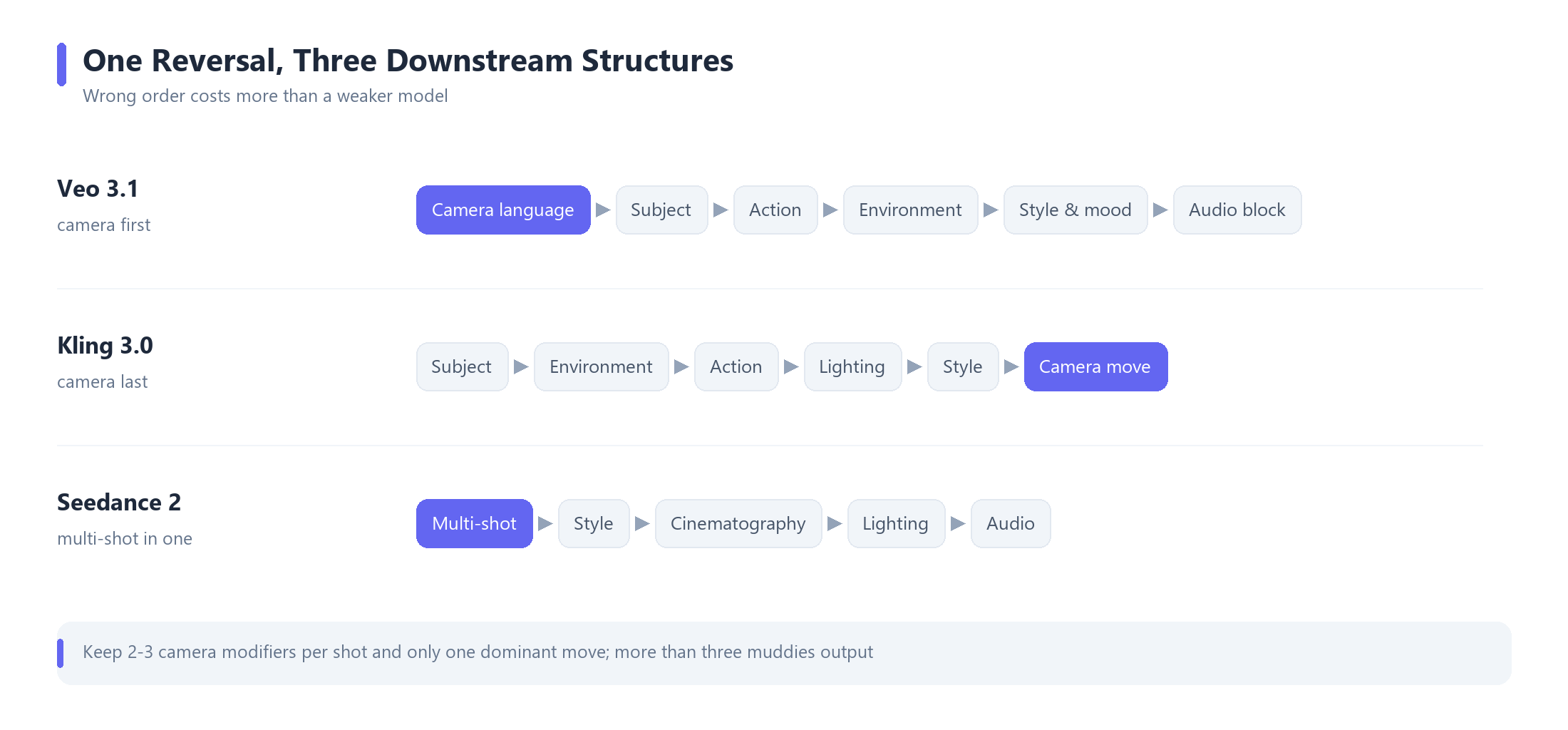
- The downstream model’s dialect must be handled separately. Veo 3.1’s official structure puts cinematography first; Kling’s puts the camera instruction last; Seedance 2 accepts a multi-shot breakdown inside one prompt. Pasting the same recovered text into all three costs more quality than upgrading models would gain.
(Gemini 3.1 Pro / 3.5 Flash)
(Doubao Seed 2.1 Pro, vendor figure)
(Doubao Seed 2.1 Pro)
(beyond 3, output turns muddy)
native video vs frames only
I. First, Clarify What Is Actually Being Recovered
Before comparing models, one fact has to be stated plainly: there is no prompt inside a video file.
An MP4 holds pixels, a frame sequence and an audio track. It does not hold the text that generated it. So “reverse-prompting” means asking a multimodal model to look at the finished result and reconstruct a description that could reproduce it. Published walkthroughs describe the recovered artifact the same way: it is an approximation built from what the model sees, not the exact string the original creator submitted.
That framing yields two practical consequences:
| Information type | Recoverable? | Notes |
|---|---|---|
| Subject, wardrobe, set, props | ✓ Yes | Directly visible; description accuracy is high |
| Shot size, composition, light direction and colour temperature | ✓ Yes | Judgeable from a single frame — frame-sampling models handle this too |
| Camera move (push, pull, pan, track, crane, orbit) | △ Partial | Requires inter-frame displacement; frame-sampling models can only infer it |
| Edit rhythm, cut points, shot-length distribution | △ Partial | Needs timeline awareness; long-video models hold the advantage |
| Dialogue, SFX, ambience | △ Partial | Only for models that ingest audio natively; otherwise transcribe separately and merge |
| Seed, negative prompt, sampler steps | ✗ No | Never rendered on screen — unreadable by any model |
| The creator’s exact wording and weighting syntax | ✗ No | You get a semantically equivalent sentence, not the same one |
This report therefore does not score “who guesses the original prompt best” — that target does not exist. It scores four measurable things: can the model read the video at all (input capability), is the resulting shot language professional, is the temporal and camera reconstruction accurate, and does the output land cleanly on a downstream generation model.
1.1 The five stages of a reverse-prompting pipeline
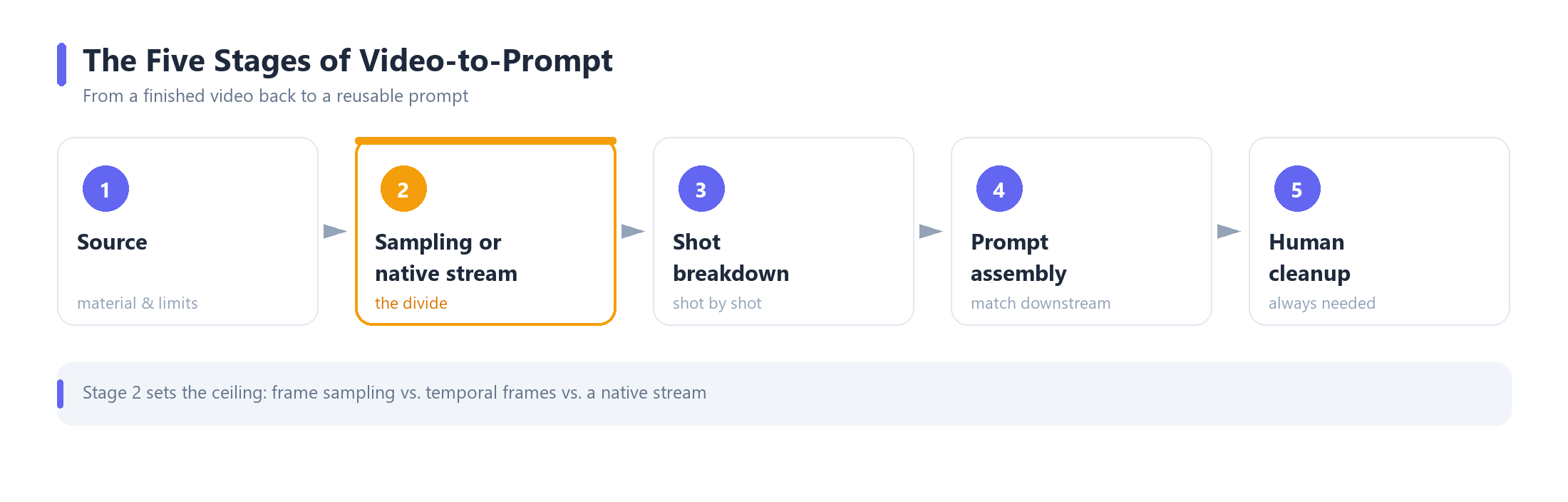
① Capture
Download, or screen-record where downloading is not permitted. Model-independent, but it sets your resolution and duration ceiling.
② Sample or stream
The watershed: sampled stills, a 1–2 fps temporal read, or a native video stream. Sampling configuration moves benchmark scores materially.
③ Break down
Split into shots and describe each: shot size, subject, action, lighting, mood. This is where model differences are most visible.
④ Synthesize the prompt
Compress observations into structured text. Whether it follows the downstream model’s format (see Section VI) decides usability.
⑤ Patch by hand
The most common failure in practice is a dropped detail — on-screen text, a scoreboard, a prop. Budget one editing pass after every recovery.
Video-MME’s benchmark scale is 900 videos, 254 hours, 2,700 QA pairs, spanning 11 seconds to 1 hour — see the arXiv paper. The “approximation, not the original string” framing and the recovery limits are from a reverse-engineering walkthrough.
II. The Dividing Line: Native Video, or Frames Only
Sort the nine candidates by how they accept video and the picture becomes immediate. The commonly missed point: both 2026 Western flagships sit outside this capability entirely.
| Tier | Input method | Models | Max video | Audio | Effect on reverse-prompting |
|---|---|---|---|---|---|
| Tier A | Native video + native audio | Gemini 3.1 Pro / 3.5 Flash Doubao Seed 2.1 Pro Qwen3.5-Omni-Plus |
3 h / 2 h / 1 h | ✓ Included | Camera, pacing and dialogue read in one pass — best results |
| Tier B | Native video, audio separate | Qwen3.8-Max / 3.7-Plus Kimi K2.5 / K2.6 MiniMax M3 GLM-4.6V Flash |
2 h / — / — / 1 h | △ Separate | Picture and camera readable; dialogue needs a separate speech model |
| Tier C | Sampled frames only | GPT-5.5 Claude Opus 5 |
Whatever you extract | ✗ None | Temporal information compressed; camera and pacing inferred — largest error |
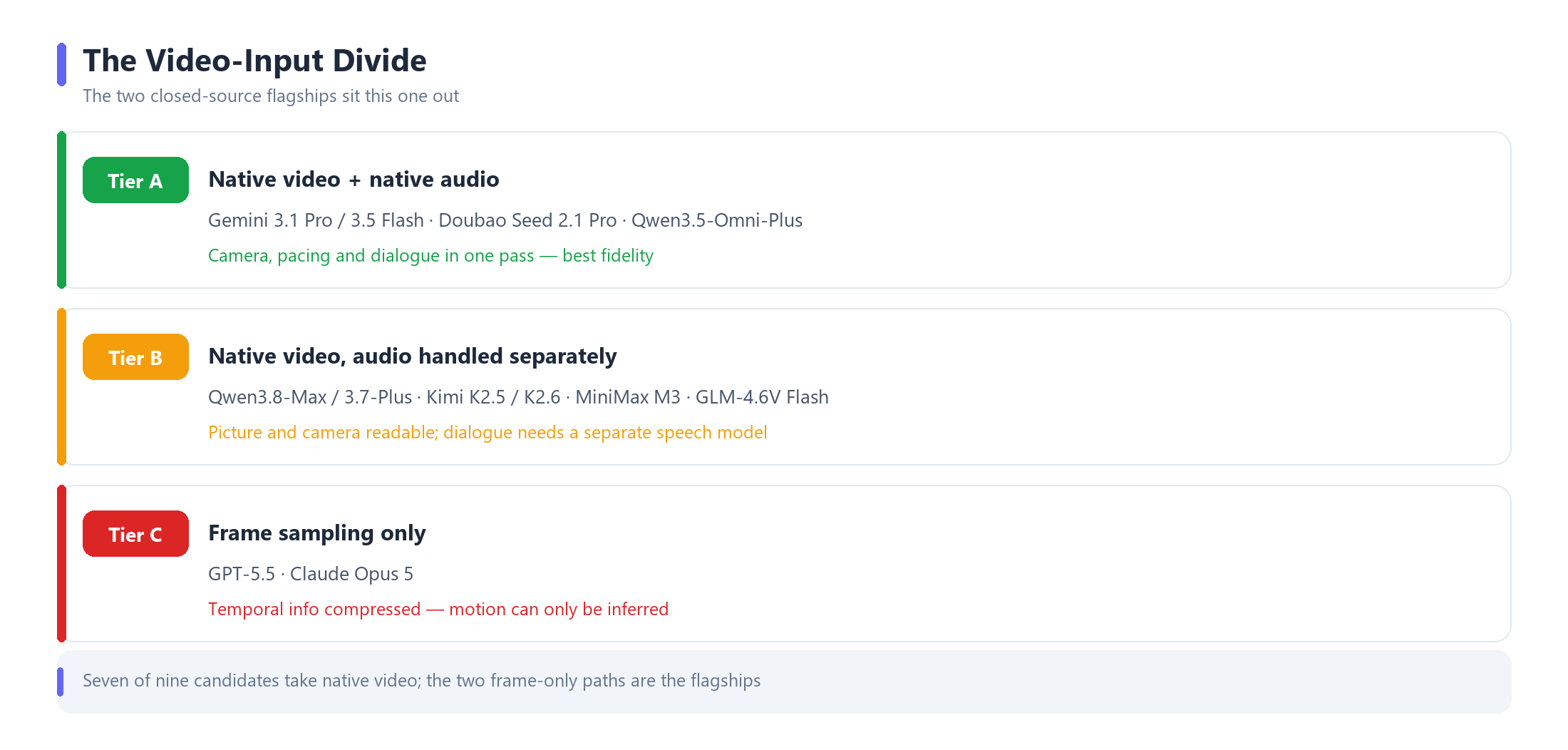
Why Tier C is a structural problem. Sampling collapses three dimensions — time plus two of space — into a stack of flat images. Shot size, composition and lighting survive intact. Camera movement (is the lens moving or the subject?), acceleration, and cut points do not: those can only be pinned down by watching continuously. OpenAI’s model page lists GPT-5.5 input as text and images; Anthropic’s documentation likewise confirms Claude accepts text, images and PDFs only, with no video path and no native audio.
If your goal is to replicate a camera move, Tier C starts at a disadvantage. If your goal is to replicate a look — grade, composition, lighting character — sampling is acceptable. That is precisely why Section V routes by scenario.
One more detail worth internalising: every model degrades with video length, long video is the field’s shared weak point, and published scores move with frame-sampling settings. Treat any leaderboard number as a guide, not a guarantee.
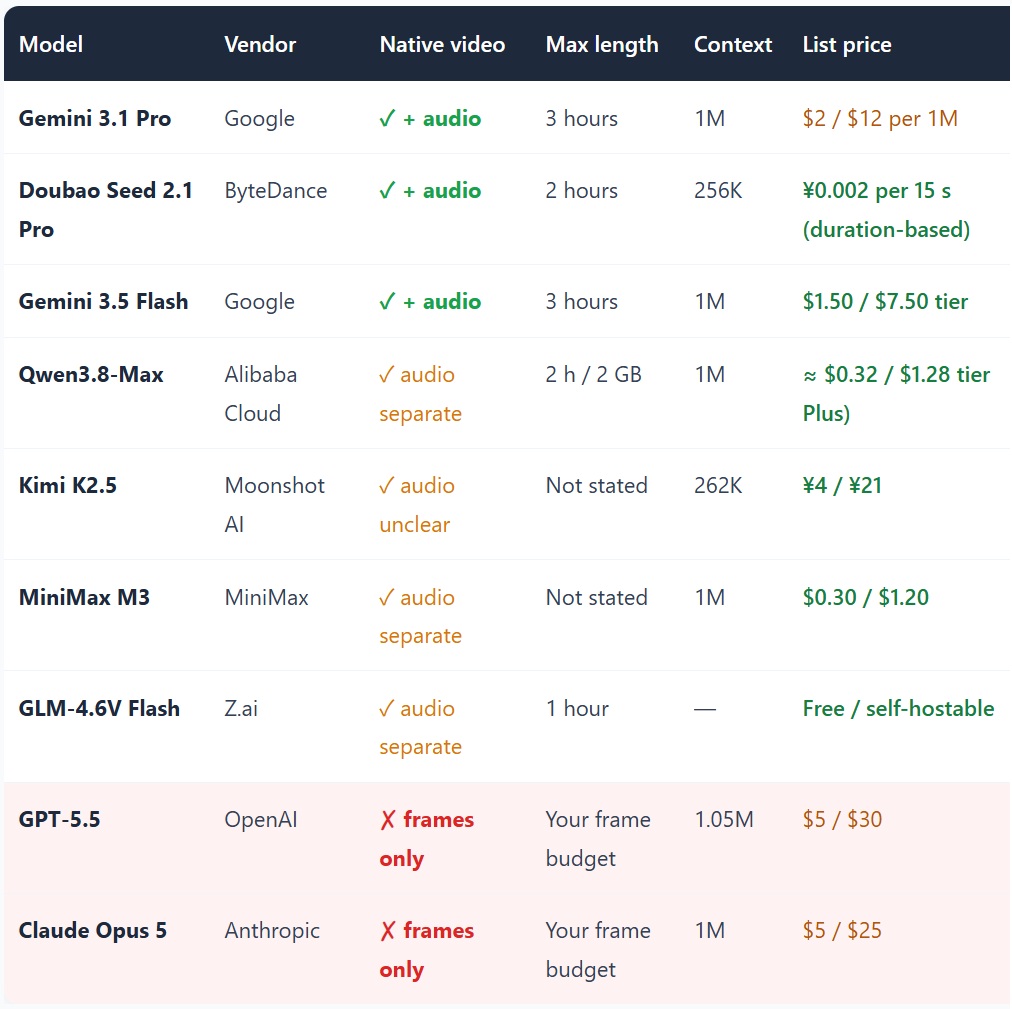
III. Nine Models at a Glance
| Model | Vendor | Native video | Max length | Context | List price | Open | Best role |
|---|---|---|---|---|---|---|---|
| Gemini 3.1 Pro | ✓ + audio | 3 hours | 1M | $2 / $12 per 1M tokens | ✗ | Quality ceiling | |
| Doubao Seed 2.1 Pro | ByteDance | ✓ + audio | 2 hours | 256K | ¥0.002 per 15 s (duration-based) | ✗ | Best value + Chinese |
| Gemini 3.5 Flash | ✓ + audio | 3 hours | 1M | $1.50 / $7.50 tier | ✗ | High-throughput batches | |
| Qwen3.8-Max | Alibaba Cloud | ✓ audio separate | 2 h / 2 GB | 1M | ≈ $0.32 / $1.28 tier (3.7-Plus) | ✗ | Chinese long video + JSON output |
| Kimi K2.5 | Moonshot AI | ✓ audio unclear | Not stated | 262K | ¥4 / ¥21 | ✓ Open weights | Balanced, self-hostable |
| MiniMax M3 | MiniMax | ✓ audio separate | Not stated | 1M | $0.30 / $1.20 | ✗ | Closed loop with Hailuo |
| GLM-4.6V Flash | Z.ai | ✓ audio separate | 1 hour | — | Free / self-hostable | ✓ Open weights | Zero-cost triage |
| GPT-5.5 | OpenAI | ✗ frames only | Your frame budget | 1.05M | $5 / $30 | ✗ | Great structured output, no video path |
| Claude Opus 5 | Anthropic | ✗ frames only | Your frame budget | 1M | $5 / $25 | ✗ | Strong prose and fidelity, video absent |
Pricing: Gemini 3.1 Pro figures are the ≤200K input tier; above 200K the rate moves to $4 / $18. Doubao Seed 2.1 Pro bills video analysis by duration, in 15-second units, per Volcano Engine’s documentation. Cost per video hour varies enormously across the field — from free to roughly $4.32/hour — and the third-party video-understanding ranking is useful for magnitude, though some of its scores inherit a predecessor or family estimate. Treat it as directional only.
The current leading group on VideoMME (sources disagree on exact figures — do not compare across sources): Doubao Seed 2.1 Pro 89.2, Qwen3.7-Plus 88.0, MiMo-V2.5 87.7, Kimi K2.5 87.4, MiniMax M3 85.4. The front of the video-understanding field is now held largely by Chinese vendors — and that capability is precisely the first gate for reverse-prompting.
IV. Model by Model
Gemini 3.1 Pro
Native video · strongest overall
Strengths
- The only candidate that reads three hours with audio in a single call — no slicing needed for long footage
- Deepest cinematography vocabulary: dolly, crane, tracking, 35mm. Recovered prompts land close to Google’s own ecosystem
- Temporal and camera reconstruction currently best in class
Trade-offs
- Most expensive at this tier — its estimated cost per video hour is several times Doubao’s
- Input above 200K tokens doubles the rate; long video at high frame density hits that quickly
- Third-party reviews note more call-to-call variance than OpenAI or Anthropic, so batch production needs a validation step
Source: Google’s Gemini API documentation for video understanding and video generation; pricing and per-hour figures cross-checked against third-party aggregators.
Doubao Seed 2.1 Pro
Native video · best value
Strengths
- Duration-based billing fits a task that must watch the whole clip: ¥0.002 per 15 s works out to roughly ¥0.48 for an hour
- VideoMME 89.2 is the highest publicly cited figure; 256K context covers a 2-hour lecture or VOD
- Most natural Chinese camera and style phrasing — shorthand terms survive translation intact
Trade-offs
- Vendor explicitly lists unsuited cases: real-time low-latency analysis, 4K/10 Mbps-plus frame-level work, high-accuracy speech-only recognition
- Video must be a public URL or platform-hosted file — no local file paths, so batch work needs an upload step
- Accuracy drops roughly 15% below 720p; poor for low-resolution reposted material
- English camera vocabulary is less rich than Gemini’s
Source: Volcano Engine’s Doubao-Seed-2.1-pro video analysis guide (billing rule, duration ceiling, precision tiers and measured latency).
Gemini 3.5 Flash
Native video · high throughput
Strengths
- Shares 3.1 Pro’s video and audio path — engineering can switch between them without rework
- Roughly a quarter of Pro’s unit price, about 37% of Pro’s cost per video hour
- Ideal for a two-pass flow: cheap first pass, then re-run only the clips worth refining
Trade-offs
- Shot terminology and narrative structure are noticeably thinner; complex multi-shot pieces flatten into prose
- Weaker on Chinese-language idiom than the domestic models
Source: Google Gemini model pricing and multimodal documentation; per-hour figure from third-party aggregation.
Qwen3.8-Max / Qwen3.7-Plus
Native video · audio separate
Strengths
- Same 2-hour ceiling as Doubao at a low price — strong value among Chinese options
- Native structured output means a recovered breakdown can drop straight into JSON fields (shot no., size, move, light, duration) and feed a pipeline
- Qwen3-VL and Qwen3-Omni are open-weight, so teams with data-residency rules can self-host
Trade-offs
- Audio is not in the same input path; dialogue and SFX need a separate speech model and a merge step
- On temporal and camera reconstruction, public evaluations still show a visible gap to Gemini
- Rapid version cadence (3.5 / 3.6 / 3.7 / 3.8 coexist) means locking a snapshot for production
Source: Alibaba Cloud Model Studio vision documentation (per-model video ceilings, context and structured-output support). Open-source repositories: QwenLM on GitHub.
Kimi K2.5 / K2.6
Open weights
Strengths
- Open weights plus a hosted API — a practical answer to “private but convenient”
- Cheap cache hits make repeated follow-ups on the same clip (shot list first, camera phrasing second) inexpensive
- Natural Chinese phrasing, with VideoMME 87.4 in the leading group
Trade-offs
- Audio input capability is not clearly documented; SFX and dialogue may need external handling
- Maximum video length is not published — very long footage needs test-and-slice
- Selection trap: the newer flagship Kimi K3 upgraded reasoning and coding but narrowed modalities to vision only. Do not assume newer means better here
Source: Moonshot AI API pricing; modality support per its model documentation. Open-source organisation: MoonshotAI on GitHub.
MiniMax M3
Native video · in-house loop
Strengths
- Reverse-prompting and generation sit in one vendor’s ecosystem, so prompt style aligns with the training distribution of its own Hailuo models
- Very low unit price with a 1M context window — friendly to long footage
- Chinese phrasing tracks short-video idiom closely
Trade-offs
- Shot language is less structured; professional camera terms are less consistent than Gemini or Qwen
- Priority and long-context tiers carry surcharges, so real cost exceeds list price
- Cross-vendor adaptation (especially into Veo or Kling) requires rewriting
Source: MiniMax official API pricing and model documentation; published benchmark figures from third-party aggregation.
GLM-4.6V Flash
Open weights · zero cost
Strengths
- Undisputed cost winner — free, and self-hostable so footage never leaves the machine
- Well suited to triaging which clips deserve an expensive full recovery, cutting the call volume on premium models
Trade-offs
- Sits in the bottom group of third-party video-understanding rankings; complex shots get generic descriptions
- Camera movement and timing are not dependable — do not paste its output straight into a generator
- Either needs publicly reachable footage or your own deployment; the hosted tier raises questions for confidential material
Source: Z.ai model catalogue and pricing; capability positioning cross-checked against third-party video-understanding comparisons.
GPT-5.5
Frame sampling only
Strengths
- Best-in-class prose and structuring: hand it observations and the phrasing it returns is excellent
- Mature tool ecosystem (file search, code execution) suits embedding recovery into automation
- Sampling is fully controllable — raise the density if you want
Trade-offs
- No video path in the official modality list — camera and pacing reconstruction is a structural gap, not a tuning problem
- No audio input; dialogue and SFX require an external speech model
- Most expensive of the candidates, and more frames means more tokens
- The Sora consumer app has shut down and the API has been discontinued, so building a library around Sora-specific syntax is not durable
Source: OpenAI’s GPT-5.5 model page (modality list and pricing).
Claude Opus 5
No video path
Strengths
- Best at not inventing: give it pre-extracted frames and it tends to describe accurately rather than fill gaps
- Stable long-context handling — good for rewriting a shot list plus prompt template together
- Restrained, readable prose at the text layer
Trade-offs
- The official modality list includes neither video nor audio. Recovery depends entirely on frame sampling — the most input-constrained of the nine models here
- Priced at the top tier while economising on exactly the part of the job that matters least
- Using it for video reverse-prompting means deploying the best writing engine available to compensate for a dimension it cannot see
Source: Anthropic’s Claude model documentation (input modalities and pricing); absence of video and audio support is stated there explicitly.
V. Choosing by Scenario
Reframe the question from “which model is best” to “which model for this shot” and the answers separate immediately. Each scenario below carries a recommendation and the prompt detail that decides success.
Scenario 1 · UGC / creator-style product video
The signals are handheld micro-movement, jump cuts, natural room light, deliberate imperfection. Reverse-engineering this like a studio commercial pushes the generator to render something far too clean.
Pick: Doubao Seed 2.1 Pro / MiniMax M3
Scenario 2 · Brand film / cinematic look
The signal is the shot language itself: size, focal length, stabilisation, light direction, depth, colour relationship. “Cinematic” is useless unless you say which technique creates it.
Pick: Gemini 3.1 Pro
Scenario 3 · Anime / stylised animation
The hard part is naming the style anchor — cel-shaded, thick-paint, 2D-look 3D. Get the term wrong and the generator drifts toward photorealism.
Pick: Qwen3.8-Max / Kimi K2.5
Scenario 4 · Long video (courses, VODs, features)
Anything over an hour needs the whole clip in one context, or cross-segment causality and pacing break. This is a hard ceiling, not a tuning knob.
Pick: Gemini 3.1 Pro (3 h) / Doubao Seed 2.1 Pro (2 h)
Scenario 5 · One prompt, several generators
Extract a model-agnostic creative core (subject, action, environment, composition, camera, light, timing, style, audio), then write an adapter per target. Copy-paste is the biggest waste here.
Pick: Gemini 3.1 Pro for the core + GPT-5.5 to reformat
Scenario 6 · Batch production (dozens per day)
The bottleneck shifts from quality to cost per video hour times achievable concurrency. Split the work: cheap triage, expensive refinement.
Pick: GLM-4.6V Flash to triage + Gemini 3.5 Flash / Doubao to refine
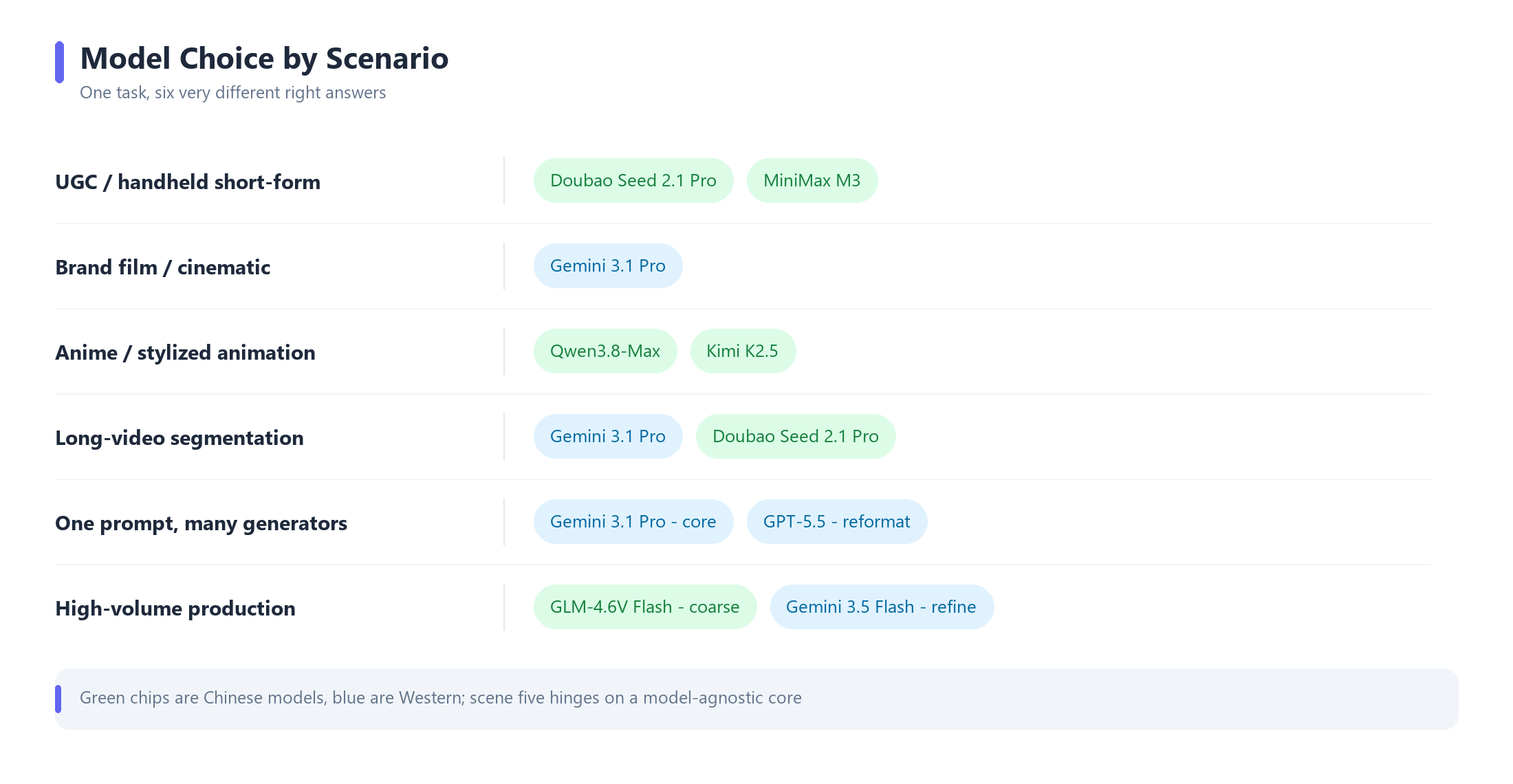
Scenario breakdowns and prompt checkpoints follow a reverse-prompting guide that gives layered templates for ads, UGC, cinematic and product scenes, and proposes the “model-agnostic core plus adapter” approach.
VI. After Recovery: Adapting to the Target Generator
This is where many recovery pipelines quietly fail. No matter how accurate the recovered text is, skipping the target model’s structure costs more quality than upgrading models would gain.
6.1 Three structures, three orders
| Generator | Recommended structure | Order | Special requirement |
|---|---|---|---|
| Veo 3.1 | Cinematography + subject + action + context + style & ambiance (+ audio block) | Camera first | Native audio is its biggest differentiator — omitting the audio block wastes the capability |
| Kling 3.0 | Subject + environment + action + lighting + style + camera movement | Camera last | Vendor rationale: build the scene first, then move through it. Keep context to 3–5 elements |
| Seedance 2 | Multi-shot breakdown + style + camera + lighting + audio in one prompt | Single prompt, multiple shots | One prompt can carry a five-beat shot list, so recovery should output shot structure directly |
6.2 Two hard rules
Rule one: one dominant camera move per shot. Google’s guidance recommends choosing one primary camera move per clip, and an internal test of 200 prompts puts the sweet spot at two to three camera modifiers with a single dominant move. Past three, the model averages between conflicting instructions and the output turns muddy.
Rule two: separate the creative core from the format adapter. Extract subject, action, environment, composition, camera, light, timing, style, audio and constraints into one model-agnostic list, then write an adapter layer per target. That way, a downstream model being discontinued or rebuilt does not invalidate your prompt library — which matters in 2026 specifically: the Sora consumer app shut down in April and the API was retired on September 24, so any Sora-specific syntax has to be migrated.
Source: a Veo and Kling camera-prompt comparison covering the five-part Veo order, the rationale for Kling’s camera-last order, and the 2–3 modifier finding.
VII. Scoring: Seven Weighted Dimensions plus a Sensitivity Check
Important disclosure: the scores in this section are a subjective quantification by this report, based on public documentation and third-party comparisons. This is not an official benchmark and is not a claim about any model’s general capability. It evaluates the specific task of reverse-prompting video, nothing more.
7.1 Dimensions and weights
| Dimension | Weight | What it measures |
|---|---|---|
| Video input capability | 20% | Native video, duration ceiling, audio included or not |
| Shot-language professionalism | 18% | Accuracy and richness of shot size, focal length, stabilisation, lighting terminology |
| Temporal and camera fidelity | 17% | Reconstruction of move direction, speed change, cut points, pacing |
| Cross-generator adaptation | 15% | Does output land directly in Veo / Kling / Seedance structure |
| Hallucination control and fidelity | 12% | Accurate description versus inventing what is not on screen |
| Chinese and multilingual phrasing | 8% | Accuracy of native-language camera and style terms |
| Cost and batch availability | 10% | Cost per video hour, free or self-hosted paths |
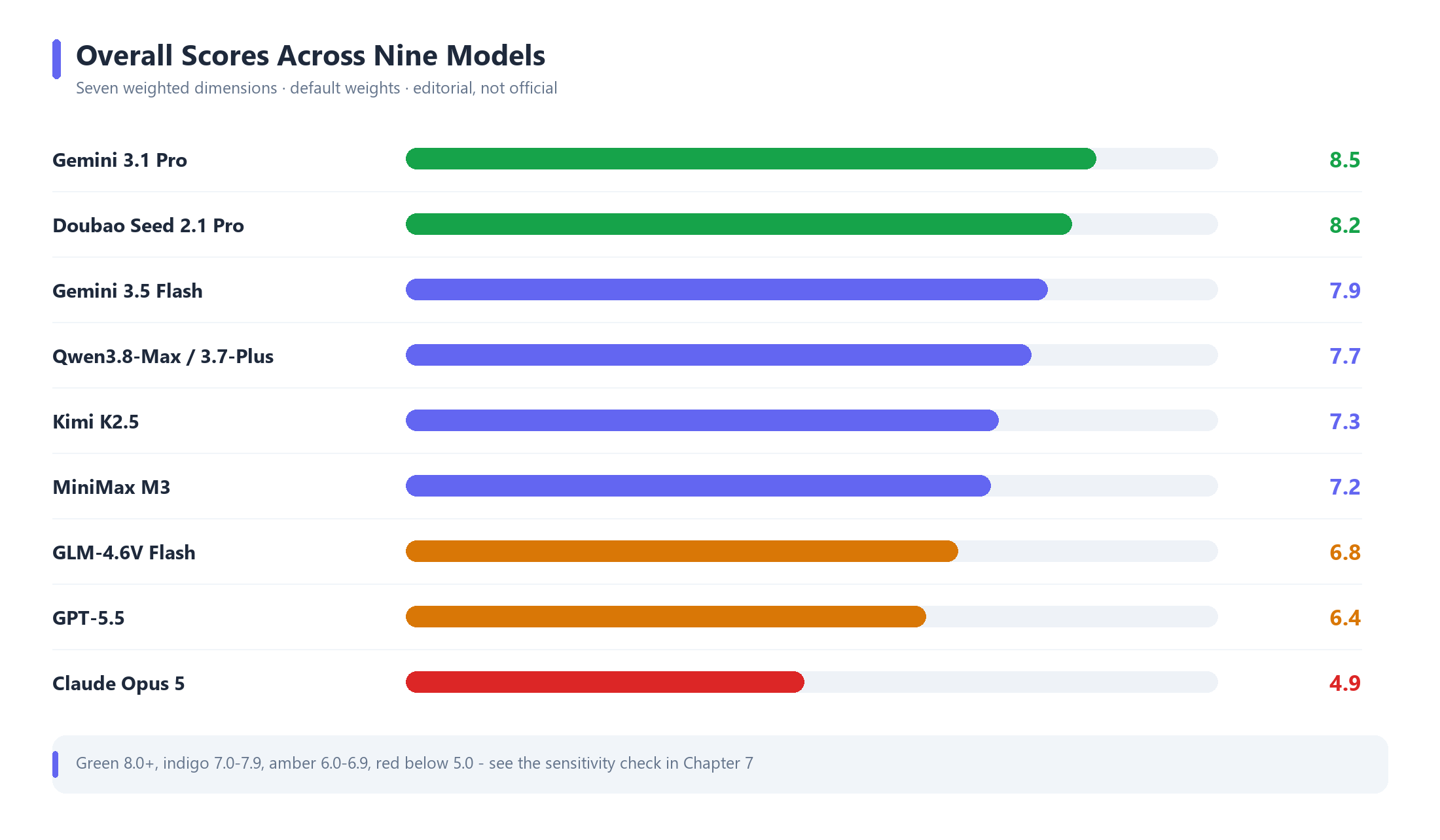
7.2 Overall scores
| Model | Weighted total | Distribution | Stars | One line |
|---|---|---|---|---|
| Gemini 3.1 Pro | 8.5 | ★★★★★ | Quality ceiling, at the highest price | |
| Doubao Seed 2.1 Pro | 8.2 | ★★★★☆ | Top benchmark plus duration billing — best value | |
| Gemini 3.5 Flash | 7.9 | ★★★★☆ | Full video pipeline at high throughput | |
| Qwen3.8-Max / 3.7-Plus | 7.7 | ★★★★☆ | Two-hour video, structured output, self-hostable | |
| Kimi K2.5 | 7.3 | ★★★☆☆ | Balanced open weights — do not pick K3 by mistake | |
| MiniMax M3 | 7.2 | ★★★☆☆ | Closed loop with Hailuo; rewrite for other vendors | |
| GLM-4.6V Flash | 6.8 | ★★★☆☆ | Free and local — good for triage, not final recovery | |
| GPT-5.5 | 6.4 | ★★★☆☆ | Best prose, blind to the dimensions that matter | |
| Claude Opus 5 | 4.9 | ★★☆☆☆ | Most faithful, but missing both video and audio |
7.3 Score breakdown
| Model | Video in 20% |
Shot lang. 18% |
Temporal 17% |
Adaptation 15% |
Fidelity 12% |
Chinese 8% |
Cost 10% |
|---|---|---|---|---|---|---|---|
| Gemini 3.1 Pro | 10 | 9 | 9 | 8 | 8 | 7 | 6 |
| Doubao Seed 2.1 Pro | 9 | 8 | 8 | 7 | 7 | 10 | 9 |
| Gemini 3.5 Flash | 9 | 8 | 8 | 7 | 7 | 6 | 9 |
| Qwen3.8-Max / 3.7-Plus | 9 | 7 | 7 | 7 | 7 | 9 | 8 |
| Kimi K2.5 | 8 | 7 | 7 | 6 | 7 | 9 | 8 |
| MiniMax M3 | 8 | 6 | 6 | 8 | 6 | 8 | 9 |
| GLM-4.6V Flash | 7 | 6 | 6 | 6 | 6 | 8 | 10 |
| GPT-5.5 | 4 | 8 | 5 | 8 | 7 | 8 | 6 |
| Claude Opus 5 | 2 | 7 | 3 | 5 | 8 | 8 | 4 |
Legend: ✓ clearly leading on this dimension | △ partially capable | ✗ missing | — not applicable. Sub-scores are subjective integers on a 0–10 scale.
7.4 Dimension winners
Three hours plus native audio — the only model here scoring full marks on both.
Shared vocabulary lineage with Google’s own Veo prompt guidance.
Best long-video temporal reasoning today, though the whole field remains weak here.
The former on structured output and tooling; the latter on its closed loop with Hailuo.
Describes rather than fills gaps — at the cost of never seeing the motion.
Most natural camera and style phrasing; shorthand terms survive intact.
Free and self-hostable, with Doubao’s duration billing a close second.
7.5 Weight sensitivity check
The default weights assume video input plus temporal fidelity matter 37% combined. Strengthen that assumption — video input to 25%, temporal fidelity to 22%, for 47% combined, while reducing cost and Chinese — and what happens?
| Model | Default weights | Temporal-weighted | Change |
|---|---|---|---|
| Gemini 3.1 Pro | 8.5 | 8.7 | +0.2 |
| Doubao Seed 2.1 Pro | 8.2 | 8.3 | +0.1 |
| Gemini 3.5 Flash | 7.9 | 8.1 | +0.2 |
| Qwen3.8-Max / 3.7-Plus | 7.7 | 7.7 | 0.0 |
| Kimi K2.5 | 7.3 | 7.4 | +0.1 |
| MiniMax M3 | 7.2 | 7.1 | −0.1 |
| GLM-4.6V Flash | 6.8 | 6.8 | 0.0 |
| GPT-5.5 | 6.4 | 6.0 | −0.4 |
| Claude Opus 5 | 4.9 | 4.5 | −0.4 |
The conclusion is clean: the more weight you place on genuinely reading motion, the more the four native-video models gain and the two frame-sampling flagships lose (−0.4 each). Conversely, if your recovery target is really a look rather than a movement, raise cost and Chinese weighting and Doubao and GLM climb quickly. There is no absolute winner — only a weighting choice.
7.6 Head-to-head
Gemini is more complete on shot language and long-video access, but its cost per video hour is in a different bracket. Doubao pairs the highest public benchmark with duration-based billing and a two-hour ceiling. Batch work goes to Doubao; a small number of high-value recoveries go to Gemini.
Neither accepts native video, so the contest starts from the same handicap. GPT-5.5 wins on structured output and tooling; Claude wins on fidelity and long-document stability. If forced to one, GPT-5.5 fits a pipeline better.
GLM-4.6V Flash is free, Qwen3-VL and Qwen3-Omni ship open weights, and Kimi K2.5 has an open release — three routes that keep footage on your own machine. The cost is a consistent step down in camera and temporal fidelity. Confidential material goes self-hosted; results-first work goes cloud.
VIII. Decision Framework
Pick by who you are
- Solo creator: validate the workflow for free with GLM-4.6V Flash or a hosted Doubao trial before paying for anything. Switch to Gemini 3.1 Pro only for the recovery worth refining.
- Ad or brand creative team: lead with Gemini 3.1 Pro for shot language, with Doubao Seed 2.1 Pro filling in native-language scenes. Always route output through the adapter layer in Section VI — never paste directly.
- Batch content operation (dozens per day): a tiered pipeline — GLM-4.6V Flash or Gemini 3.5 Flash to triage, Doubao or Gemini 3.1 Pro to refine, human pass to patch. The cost bottleneck is always the second step.
- Teams with data-residency constraints: take the self-hosted route (Qwen3-VL / Qwen3-Omni / Kimi K2.5) and accept one tier lower on temporal fidelity. Footage never leaving the machine is non-negotiable for client or unreleased material.
IX. Scope Limits and Risk Notes
Six things to know before using this report
- Video-understanding benchmark figures conflict across sources. For Doubao, Volcano Engine’s own documentation cites VideoMME 89.2, a third-party comparison reports 87, and another aggregator shows 95.4. Gemini figures similarly range across 83.6 / 84.8 / 85.2. These differences come from model version, frame-sampling density, subtitles and audio inclusion — they are not directly comparable across sources.
- Leaderboard scores move with frame-sampling settings. The same model can shift several points depending on tokens per frame and maximum frame count, so any ranking is a magnitude guide at best.
- Recovery is not forensic. Seeds, negative prompts and sampler parameters were never rendered on screen and no model can recover them. Any claim of “100% original prompt recovery” is false.
- Copyright is a separate boundary from technical capability. Recovery reproduces style and structure; it grants no rights to the source footage, likenesses or music. Whether your input and output are usable depends on how you obtained the material and the platform’s terms — not on which model you used.
- Downstream models get discontinued; keep prompt assets portable. The Sora consumer app stopped on 26 April 2026 and the API was retired on 24 September 2026. Do not build a library around one vendor’s proprietary syntax.
- The scores here are a subjective quantification. Dimension weights and sub-scores reflect this report’s reading of public documentation and third-party comparisons. They are not an official benchmark, not a claim about model performance, and not a purchasing recommendation.
X. Key Findings
- The gate for this task is “is there a video path”, not “how smart is the model”. The two strongest writing models of 2026 both lack the single most important input for reverse-prompting. That is structural, not a version lag.
- The leading group has been redrawn by Chinese vendors and Google. ByteDance posts the highest public video-understanding figure with the billing model best matched to the task; Google retains the deepest shot language and longest video access; Alibaba and Moonshot hold the middle with two-hour ceilings and open weights.
- Cheap and capable are not in conflict here. Doubao’s duration billing brings an hour of analysis to roughly ¥0.48 while holding the top benchmark — the opposite of the usual “cheaper means worse” intuition on AI workloads.
- The durable output of reverse-prompting is the vocabulary, not any single prompt. Camera terms, lighting descriptors and shot structures transfer across projects; one recovered prompt does not. Filing recovered fragments by purpose is where the compounding value sits.
- Cross-model adaptation is systematically underrated. Veo camera-first, Kling camera-last, Seedance multi-shot in one prompt — the same description in a different order is a different result. A good adapter layer beats a more expensive model.
- Reverse-prompting is turning from a trick into a pipeline stage. At roughly 25 seconds for a ten-minute clip at high precision, it now behaves like upstream material processing rather than a one-off inspiration tool.
XI. Related Reading
This report is part of DeepVideo’s ongoing content research. Related technical and market reports are collected here:
- The full DeepVideo report series
- DeepVideo Video Translation: User Guide (2026)
- Global Short-Video Platforms 2026: Creator Opportunity by Country & Platform
- Open-weight options referenced above
Take the idea you reverse-engineered, into every language
Prompts decide the picture; dubbing and subtitles decide how many people ever understand it. When a finished asset needs to ship across markets, localise it properly first.
Explore DeepVideo
Realistic AI Video Dubbing at Just $0.17/minHigh quality · Low price · Local client · Security
Data as of 2026-10-13. Pricing and model capabilities change frequently — verify against vendor documentation before purchasing.
This report is an independent compilation; scores are subjective and not an official benchmark. ·
deepforgehub.com