
AI Software Directories Deep-Dive: Traffic, Effectiveness & ROI, Worldwide
One-line conclusion: AI directories got revalued in 2026 — not because they send much direct traffic (most send very little), but for three reasons: 1) a permanent search long tail (listings don’t expire; a TAAFT page can drip 15–30 visitors/day from Google for months); 2) absurdly cheap acquisition (one D+30 field pilot blended CAC down to $8.44 per signup — an order of magnitude below the $80–250 of B2C paid ads); 3) a new GEO role — roughly 15% of AI-assistant recommendations come straight from structured directories, with Toolify cited 5.3k times, the highest tracked.
How to spend: Submit to every free tier first (SaaSHub, AlternativeTo, OpenFuture, AI Valley, Dang — 30–45 minutes, $0). Then test Toolify at $99 (6+ dofollow links from a DR-73 domain, live in 48 hours — the SEO asset alone pays for it). Add the TAAFT $49 basic plan once real signals appear. The $437 / $497 “maximum exposure” tiers are only for consumer-grade, try-in-one-minute products. Audit a directory’s own traffic before submitting — across 42 AI directories the correlation between DR and real traffic is just 0.01, and more than half are dead sites under 30 visits a month.
1. The Landscape: Why Directories Got Revalued in 2026
AI software directories aren’t new — but the structure of their value changed in 2026, along three lines:
- Paid media keeps getting more expensive; compounding assets keep getting more valuable. A paid listing is “buyout” pricing: TAAFT listings never expire, so $49 buys an indefinite search entry point, not one impression.
- GEO (Generative Engine Optimization) turned directories into citation sources for AI. Third-party research estimates ~15% of AI-assistant recommendations come directly from business directories, 58% from website content, and 27% from mentions in reputable media — directories are the cheapest and most structured of the three paths.
- Launch platforms (Product Hunt et al.) lost efficiency, forcing a distribution rethink. PH’s featured rate has dropped to roughly 10%, and the front page increasingly favors teams with built-in audiences; indie makers need cheaper, more deterministic entries.
Directories fall into three types, each with different mechanics and evaluation criteria:
| Type | Representatives | Traffic source | Core value | Typical price |
|---|---|---|---|---|
| AI-native directories | TAAFT, Futurepedia, Toolify, Aixploria | Task-based search + newsletters | High-intent audience + permanent listings + AI citations | Free ~ $497 |
| General software directories | AlternativeTo, SaaSHub, G2/Capterra | “alternative to” search intent | Switching-intent traffic + long-lived backlinks | Free ~ $5 |
| Launch platforms | Product Hunt, Uneed, BetaList, HN | Editorial/community feeds | One-day burst + badge credibility | Free ~ $30 |
2. Platform Overview: Traffic, Pricing & Link Attributes
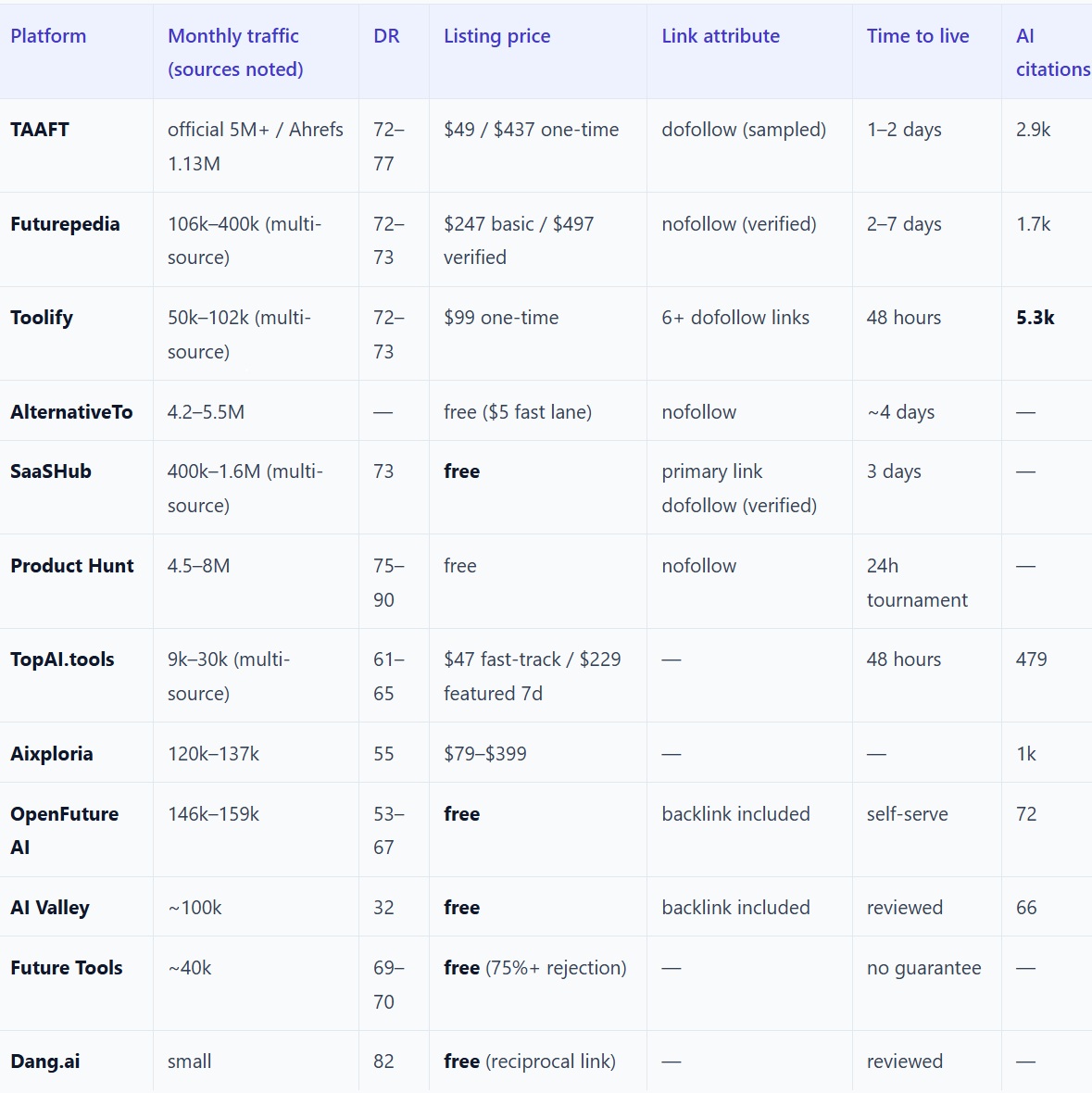
| Platform | Monthly traffic (sources noted) | DR | Listing price | Link attribute | Time to live | AI citations¹ |
|---|---|---|---|---|---|---|
| TAAFT | official 5M+ / Ahrefs 1.13M | 72–77 | $49 / $437 one-time | dofollow (sampled) | 1–2 days | 2.9k |
| Futurepedia | 106k–400k (multi-source) | 72–73 | $247 basic / $497 verified | nofollow (verified) | 2–7 days | 1.7k |
| Toolify | 50k–102k (multi-source) | 72–73 | $99 one-time | 6+ dofollow links | 48 hours | 5.3k |
| AlternativeTo | 4.2–5.5M | — | free ($5 fast lane) | nofollow | ~4 days | — |
| SaaSHub | 400k–1.6M (multi-source) | 73 | free | primary link dofollow (verified) | 3 days | — |
| Product Hunt | 4.5–8M | 75–90 | free | nofollow | 24h tournament | — |
| TopAI.tools | 9k–30k (multi-source) | 61–65 | $47 fast-track / $229 featured 7d | — | 48 hours | 479 |
| Aixploria | 120k–137k | 55 | $79–$399 | — | — | 1k |
| OpenFuture AI | 146k–159k | 53–67 | free | backlink included | self-serve | 72 |
| AI Valley | ~100k | 32 | free | backlink included | reviewed | 66 |
| Future Tools | ~40k | 69–70 | free (75%+ rejection) | — | no guarantee | — |
| Dang.ai | small | 82 | free (reciprocal link) | — | reviewed | — |
¹ AI citations = count of directory citations by AI assistants per position.digital (2026), a proxy for GEO value. DR = Ahrefs Domain Rating. “—” = not verified; omitted rather than guessed.
3. Platform by Platform
There’s An AI For That (TAAFT) Overall Champion
The price history is a warning: the basic tier went $299 (early 2025) → $99 (Jun 2025) → $49 (Sep 2025–now); “Maximum Exposure” rose from $347 to $437 in August 2026. The $437 option is pre-selected on the payment form — you must manually switch to $49. The link attribute was verified as dofollow direct links via a third-party sample of 58 live listings (though robots.txt blocks Ahrefs/Semrush bots, so backlink tools won’t show it). Review takes 1–2 days; rejected tools get an automatic full refund, but no refund after publication. Rule red lines: AI must be the core of the product (a general app with one AI feature is a weak fit), and you must reply to user inquiries within 48 hours.
Real results (two independent cases): Vidsembly paid $347 (at the then-price) for a launch and got 9,000+ video views, 509 profile opens, 312 outbound clicks and 57 signups in 24 hours, plus a $300 ad credit. In TrustGrowth’s D+30 pilot, TAAFT was the only paid channel still sending signups after launch week (4 more in the final week). A separate 90-day tracker found TAAFT traffic converted 3x better than Product Hunt’s.
- Permanent listing + search long tail; $49 amortizes to under ~$0.50 per click
- Rejection = automatic refund; transparent 1–2 day review with email notice
- Official “5M+ monthly visitors” vs third-party estimates (1.13–1.6M) diverge widely; click promises are loosely worded
- Audience is “tool seekers” — long-sales-cycle B2B products struggle to earn it back
Toolify.ai SEO & GEO Champion
Official site: toolify.ai
Toolify’s math splits in two: as a traffic channel it is mid-tier (50k–100k monthly visits across sources), but as an SEO asset it’s the best deal in the category — 6+ dofollow links at market rates ($50–150 each for DR 72) are worth $300–900 out of the gate, so the $99 fee pays for itself on link value alone. It also has the highest AI-citation count of any platform in this report (5.3k, 1.8x TAAFT), which in GEO terms means a higher chance of being cited by ChatGPT-class assistants. In any free-vs-paid decision, this is the default first paid test.
- $99 buys 6+ dofollow links + top AI citations — deterministic asset value
- Live in 48 hours; free basic listing also exists
- Direct referral volume is moderate — don’t benchmark against TAAFT’s launch spikes
- Huge, cluttered catalog; dense same-category competition
AlternativeTo Switching-Intent King
Official site: alternativeto.net
Its traffic pool dwarfs every AI directory, and visitors arrive with explicit “replace my tool” intent. But both field tests flag the same thing: big traffic ≠ good conversion — one 90-day tracker logged ~8 visitors/day from AlternativeTo with terrible conversion (users comparison-shop, glance at your pricing page, and leave). The right framing is “defensive position”: if your category has known competitors (“Rask AI alternative”, “HeyGen alternative”), you must be listed or all that search traffic accrues to competitors. Rankings require real users to vote, so cold start is slow.
- Free + massive switching-intent traffic; the must-have defensive listing
- Live in about 4 days
- Poor conversion — awareness, not signups
- Rankings can’t be bought; need real user votes to climb
SaaSHub Best Free-Tier Play
Official site: saashub.com
The most important conclusion of the seven-channel pilot: $118 bought three paid fast lanes, and 30 days later the only surviving dofollow link came from free SaaSHub. Its business model — grow the catalog free, monetize ads — makes it unusually friendly to submitters. Every AI tool should submit on day one.
- Zero cash cost, live in 3 days, durable dofollow primary link
- “Alternative to” search structure similar to AlternativeTo
- Direct traffic is hard to attribute (outbound links carry no tracking parameters)
- Audience smaller than AlternativeTo
Futurepedia Expensive Verified Tier — Careful
Official site: futurepedia.io
$497 ÷ 1,000 clicks = a $0.50/click floor — decent on paper, but note three things: traffic estimates vary wildly across sources (106k–400k/month, a 4x spread); the link is nofollow, so zero SEO value; and its 200k newsletter audience skews toward “professionals exploring AI” with weaker purchase intent than TAAFT’s task-searchers. Worth it for B2B products that need the editorial badge for credibility; not worth it if you expect volume.
- 1,000 clicks contractually guaranteed + pro-rata refund caps the downside
- Editorial review and badge add B2B credibility
- $0.50/click floor isn’t cheap, and nofollow means no SEO return
- Traffic estimates conflict across sources (106k–400k/month)
Product Hunt Tournament Format — Don’t Bet Everything
Official site: producthunt.com
PH has two faces: with a heavy launch investment (two weeks of warm-up, 30 seed supporters, Tuesday morning) you can log 847 upvotes, 2,100 visitors, 340 signups; but another case with 247 upvotes at #4 on the day produced just 11 signups. That variance is inherent to the tournament — your result depends on that day’s competition and the algorithm, not the product. Traffic is a spike, not a stream: near-zero within a week. Use it as an amplifier during launch week, never as the only distribution channel.
- Free + badge credibility + the highest single-day traffic ceiling of any channel
- Best 30-day tail among launch platforms (per the tracker)
- Extreme variance (11–340 signups); nofollow means no SEO value
- 1–2 weeks of prep; structurally rewards teams with existing audiences
TopAI.tools & Aixploria Mid-Tier Paid Substitutes
Official site: topai.tools
Both earn their keep in comparison scenarios: TopAI.tools’ stacks pull listings into real buyers’ shortlists, and Aixploria’s rankings get secondary distribution. But their absolute traffic only justifies bench status — submit after the primary slate (TAAFT/Toolify/free tier) is done and budget remains, ideally when your category isn’t crowded.
Free Long Tail: OpenFuture / AI Valley / Future Tools / Dang.ai Zero-Cost Coverage
Official site: futuretools.io
Set expectations correctly: individual small directories send almost nothing (for any directory under 50k monthly visits, “your listing will sit in a void”), but 30–45 minutes of submissions buys 30–50 permanent backlinks + structured-data coverage — a net win for a cold-start domain. One field case: an AI marketing tool combined dozens of free directories with PH and communities to sign 40 clients in 5 days at $0 ad spend — the free tier’s value is in the combination, not any single site.
4. Free vs Paid: A Decision Table
| Dimension | Free tier (SaaSHub / AlternativeTo / OpenFuture etc.) | Paid basic ($49–$99) | Paid exposure ($347–$497) |
|---|---|---|---|
| Cash cost | $0 (~30–45 min of labor) | $49–$99 | $347–$497 |
| Time to live | 3–40 days (queue-based) | 1–2 days | same-day – 7 days |
| Direct traffic | mostly unattributable, but persists | 50–100 clicks week one (TAAFT’s own estimate) | 700–10,000 clicks or a 1,000-click guarantee |
| SEO value | SaaSHub primary dofollow; most others nofollow | Toolify 6+ dofollow; TAAFT dofollow | Futurepedia nofollow; TAAFT $437 same as basic |
| GEO / AI citations | coverage value | TAAFT 2.9k / Toolify 5.3k | newsletter may enter training corpora |
| Best for | everyone, on day one | products with a landing page ready to catch traffic | consumer-grade, try-in-one-minute products |
A third-party pilot’s decision rule is worth copying directly: pay for a skip-the-line listing once per channel, only at ~$40 or less, only when the free queue exceeds ~90 days, and only if the listing carries a permanent tracked link; judge by cost per signup/activation, not by whether you “bought a listing”; never buy boosts or a second listing on the same channel.
5. Field-Result Case Library (Benchmarks You Can Check Against)
Vidsembly (AI video tool): within 24 hours — 9,000+ video views, 509 profile opens, 312 outbound clicks, 57 signups, 36,640 search impressions, plus a $300 ad credit. Works out to $1.11/click and $6.09/signup. (Source: Vidsembly’s own blog postmortem; original URL no longer resolves, hence no link.)
AI transcription tool: most of 23 directories sent zero meaningful traffic; TAAFT delivered a steady 15–30 visitors/day for months and converted 3x better than PH; AlternativeTo ~8 visitors/day with poor conversion; a heavily-invested PH launch logged 2,100 visitors / 340 signups that decayed to near-zero within a week. Six months later domain authority rose from 12 to 31 — backlink compounding is the real return. (Source: Tool Atlas)
Three paid fast lanes cost $118.11 total and returned 14 first-touch signups and 5 activations — blended $8.44/signup (TAAFT $8.26, PeerPush $5.85, Uneed $12.30); paid traffic concentrated in the first days, and 30 days later the only surviving dofollow link came from free SaaSHub. (Source: TrustGrowth; n=1 tiny sample — the author explicitly warns against treating it as an industry rate.)
An async standup tool launched on three channels the same week: HN 9,340 visits / 587 signups but 3.6% paid conversion; PH 4,820 / 312 / 6.1%; Reddit 1,610 / 84 but 13.1% paid conversion and 22% of paid revenue. Volume and quality frequently invert. (Source: WeLaunch)
6. ROI Math: Converting Promises into Cost per Click
Dividing each plan’s promised clicks by its price yields a nominal CPC (low/high bounds), checked against field results:
| Plan | Price | Promised clicks | Nominal CPC | Field calibration |
|---|---|---|---|---|
| TAAFT basic | $49 | 50–100 week one; 100+ long term | $0.49–0.98 (week one) / ≤$0.49 (long term) | Vidsembly field: $1.11/click including burst |
| TAAFT maximum exposure | $437 | 700–10,000+ | $0.04–0.62 | high variance — trust the floor, not the ceiling |
| Toolify | $99 | no click promise | — | 6 dofollow links worth $300–900 at market rates; pays for itself on links |
| Futurepedia verified | $497 | 1,000 (contractual) | $0.50 floor | pro-rata refund if missed — downside capped |
| AlternativeTo | free / $5 | none | — | field: ~8 visitors/day, ~2,900/year annualized |
| Benchmark: Meta US ads | — | — | ~$0.5–1.5 per click | directory nominal CPC is comparable — but buyout, never expires |
How to read this: nominal CPC is on par with paid search, but a listing is one-time payment, permanently live, amortizing downward — and it carries dofollow links plus GEO value. The real question isn’t CPC, it’s landing conversion: directory audiences are tool-collectors; observed free-signup conversion ranges from single digits (TrustGrowth) to Vidsembly’s 57/312 ≈ 18% — landing-page quality and a free-quota hook decide it. At a 5% free-to-paid estimate, Vidsembly’s math implies ~$122 CAC per paying user, already better than most B2C paid channels; TrustGrowth’s math is even lower at double digits, but with one product over one month it must not be extrapolated into an industry rate.
Applying this to your own numbers: before computing CAC, map your own pricing and quota structure — DeepVideo’s pricing page is a complete sample of “free quota + per-minute subscription”.
7. The DR Trap: Why Picking Directories by Domain Rating Is Wrong
zplatform plotted DR against estimated traffic for 42 AI directories and found a Spearman correlation of just 0.01 — more than half of “high-DR” directories get under 30 visits a month, and a submission there buys a page nobody will ever open. The industry’s working red line: don’t bother submitting (certainly don’t pay) to directories under 50,000 monthly visits — unless it’s free and takes five minutes.
8. GEO: The Directory’s Second Job — Citation Source for AI Assistants
The new 2026 variable: users increasingly ask ChatGPT/Claude directly for “the best video translation tool”, and AI recommendations flow through three channels — website content (58%), mentions in reputable media (27%), and structured business directories (15%). A directory page’s structured data (categories, pricing, feature fields) is exactly the format models parse and cite most easily. position.digital’s counts show huge gaps: Toolify 5.3k > TAAFT 2.9k > Futurepedia 1.7k > Aixploria 1k > TopAI.tools 479 > OpenFuture 72. That makes “AI citations” a dimension fully independent of traffic when picking directories — it determines whether your product shows up inside AI answers, not how many humans visit the directory page.
For a live example of the “directories + AI citations” compounding effect, read our own DeepVideo 2.0 release notes.
9. Effectiveness Index (Unofficial Scoring)
Six weighted factors: intent quality 25 / long-term compounding 20 / link SEO value 15 / GEO citation value 15 / cost friendliness 15 / ramp speed 10. Each dimension 0–10; composite = Σ(dimension × weight) ÷ 100, rounded half-up to one decimal.
| Platform | Intent 25 | Compound 20 | SEO 15 | GEO 15 | Cost 15 | Speed 10 | Composite |
|---|---|---|---|---|---|---|---|
| TAAFT | 8 | 9 | 8 | 8 | 8 | 9 | 8.3 |
| Toolify | 7 | 7 | 9 | 9 | 8 | 8 | 7.9 |
| AlternativeTo | 8 | 8 | 6 | 5 | 9 | 7 | 7.3 |
| SaaSHub | 6 | 7 | 9 | 4 | 10 | 6 | 7.0 |
| Futurepedia | 8 | 7 | 5 | 6 | 6 | 7 | 6.7 |
| Product Hunt | 7 | 3 | 3 | 6 | 10 | 10 | 6.2 |
| TopAI.tools | 6 | 5 | 7 | 5 | 7 | 7 | 6.1 |
| Free long tail | 4 | 4 | 6 | 4 | 10 | 4 | 5.2 |
Weight Sensitivity Check
- Raising GEO weight from 15 to 25 (your goal becomes “get recommended by AI assistants”): Toolify (7.9→8.35, rounds to 8.4) nearly catches TAAFT (8.3→8.3) — effectively co-first.
- Raising cost weight to 30 and cutting intent to 15 (a bootstrapped solo founder): SaaSHub rises to ~7.7, the free long tail to ~6.2, while Futurepedia drops out of the first tier — zero-cost coverage gets amplified.
- Raising ramp speed to 25 (timed to a launch week): Product Hunt (6.2→7.3) and the TAAFT $437 tier move up; AlternativeTo slips back due to its ~4-day queue and slow voting.
10. Submission Strategy: A Three-Stage “Directory Stack”
| Stage | Timing | Actions | Budget |
|---|---|---|---|
| ① Free foundation | Week 1 | Submit to SaaSHub, AlternativeTo, OpenFuture, AI Valley, Dang; write different copy for each (duplicate-content penalties, different character limits); use a domain email; after going live, re-check rel attributes and tracking parameters | $0 |
| ② Paid test | Weeks 2–4 | Toolify $99 (48h live + 6 dofollow — the most deterministic asset) → if attributable signups in 2–4 weeks meet your bar, add TAAFT $49 basic; do not start with $437/$497 | $99–148 |
| ③ Amplify & launch | Weeks 5–8 | After accumulating 100–200 real users, launch on Product Hunt (directory traffic is a seed-supporter source); consumer products may consider TAAFT $437 for the newsletter burst; keep collecting reviews (on review-based directories, review count directly drives ranking) | $0–437 |
Listing-level conversion optimization (shared conclusion across cases): lead with the outcome, not the technology (“transcribe any meeting in 30 seconds” beats “AI-powered multi-language transcription”); use real UI screenshots with real data; state your pricing (listings with clear pricing get more clicks because they filter out tire-kickers); pick the narrowest category (you’re #500 in “AI writing tools” but #3 in “AI product description generators”); keep the listing updated (active listings rank higher).
For a full walkthrough of listing copy and landing-page setup, see our video translation user guide.
Quick Decision Guide
- 10 minutes of budget? Submit to SaaSHub + AlternativeTo. Done. Free, fast — one gives you a dofollow link, the other switching intent.
- Only $100? Toolify $99. You’re buying 6 dofollow links + the highest AI-citation count — no traffic gamble.
- $150 and you want traffic? Toolify $99 + TAAFT $49. Toolify first, then let its attribution data decide whether to continue.
- Consumer product, launching now? TAAFT $437 is defensible (guaranteed newsletter + $300 ad credit + priority review) — but only for products a user can try within one minute.
- Long-sales-cycle B2B? Skip every exposure tier; put budget into G2/Capterra review operations (don’t touch them before 20 organic reviews).
- Never, under any circumstances: pay a directory under 50k monthly visits; buy a boost or second listing on the same channel; accept a free tier that requires a permanent reciprocal badge (the Fazier pattern).
Key Findings
- A directory listing’s real return structure is “long tail + backlinks + AI citations”, not launch bursts. In every case, paid-listing traffic concentrated in the first days, then dribbled at 15–30 visitors/day from search; over 12 months, the $49 tier’s nominal CPC falls below ~$0.50.
- The free tier isn’t a downsized option — it’s mandatory. In TrustGrowth’s pilot, the only surviving dofollow link at D+30 came from free SaaSHub; one real case signed 40 clients in 5 days at $0 ad spend on a free-directory matrix.
- DR is the most misleading metric in this market. DR-to-traffic correlation is 0.01; 12 of 42 directories are high-DR dead sites. Check SimilarWeb/Ahrefs monthly visits first (red line: 50k), then DR.
- Big traffic ≠ good conversion. AlternativeTo’s traffic is 4x+ TAAFT’s, yet field conversion is poor; TAAFT’s task-searchers convert 3x better than Product Hunt’s. Intent structure beats traffic scale.
- GEO is the new battleground: ~15% of AI-assistant recommendations come from business directories. Toolify leads with 5.3k citations — a dimension fully independent of traffic when choosing where to list.
- Prices move fast. TAAFT’s basic tier went $299→$99→$49 in 18 months, and Maximum Exposure rose from $347 to $437 in Aug 2026; all prices here were verified October 2026 — re-check official pages before buying.
DeepVideo 2.0 — Realistic AI Video Dubbing at Just $0.17/min
High quality · Low price · Local client · Security
DeepForgeHub Research · Independent third-party research. All traffic and pricing figures cited from public third-party sources and verified against the original pages; the scoring system is the author’s own (unofficial), with weight sensitivity checks attached. Conflicting data scopes are flagged explicitly.