
How Text-to-Video Models Work 2026
Latent space & VAE
DiT architecture
Temporal consistency
Distillation & speedups
Output impact
User impact
Executive Summary
This article answers two questions: what is actually happening inside a text-to-video model, and what exactly each generation of technology changed — about the output, and about you as the user. Not a paper survey, but twelve years of technical evolution translated into creator-visible terms.
- The core of text-to-video is a “diffusion model”: turning pure noise into video, one denoising step at a time. In 2014, GANs generated images through adversarial play between two networks, but training was unstable and modes collapsed. In 2020, diffusion (DDPM) took another route — add noise, then learn to remove it — and jumped a full tier in both stability and quality. It has been the mainstream ever since.
- Latent diffusion was the watershed for user pricing. In 2022, Latent Diffusion (LDM / Stable Diffusion) compressed images 8× before generating, cutting compute by an order of magnitude — consumer GPUs could finally run it, and API prices could finally fall. Today’s sub-$0.05/sec price war is built on that step.
- DiT (Diffusion Transformer) made “more compute = better” predictable. Sora’s 2024 technical report established video scaling laws; flagship models moved from “roll the dice” to “iterate on a roadmap,” making physically plausible motion and long shots possible.
- Filling in the time axis was the biggest jump in output quality. 3D VAE + spatiotemporal attention stopped frames from “flickering,” lifting subject consistency from ★★★★★ to ★★★★★ — video finally became footage, not an animated GIF.
- The biggest user-facing change wasn’t picture quality — it was wait time and price. Distillation cut sampling from 1,000 steps to 4–8; accelerated LoRAs and quantization multiplied inference speed. In 2026 a 5-second clip went from “make coffee and wait” to “click and it’s there,” and unit price fell from $0.75/sec to $0.02–0.15/sec.
- Two more leaps in 2025–26: native audio and camera language. Video models now output dialogue, sound effects, and score directly (starting with Veo 3), and understand cinematography commands like push, pull, and pan — the paradigm shifts from “generate a clip” to “direct a scene.”
- Iteration is also reshuffling the supply chain. Sora 2’s API was shut down on 2026-09-24 with no announced replacement, while both the blind-test champion and the price floor sit on Chinese platforms — vendor continuity risk and platform price gaps (up to 31× for the same model) must now be part of any selection.
Before You Read: Scope & Caveats
- This is a technical principles and evolution analysis, not a model ranking: no composite scores here. Model capability comparisons live in our text-to-video model research report, and pricing in our site-wide pricing report.
- All price and speed figures quoted here follow our published benchmark/research reports (data through September 2026), with sources linked; paper claims link to the original arXiv pages.
- “Output quality” star ratings are qualitative judgments (based on blind-arena reputation and our own tests) — not official benchmarks.
1. Seven Key Iterations on One Page
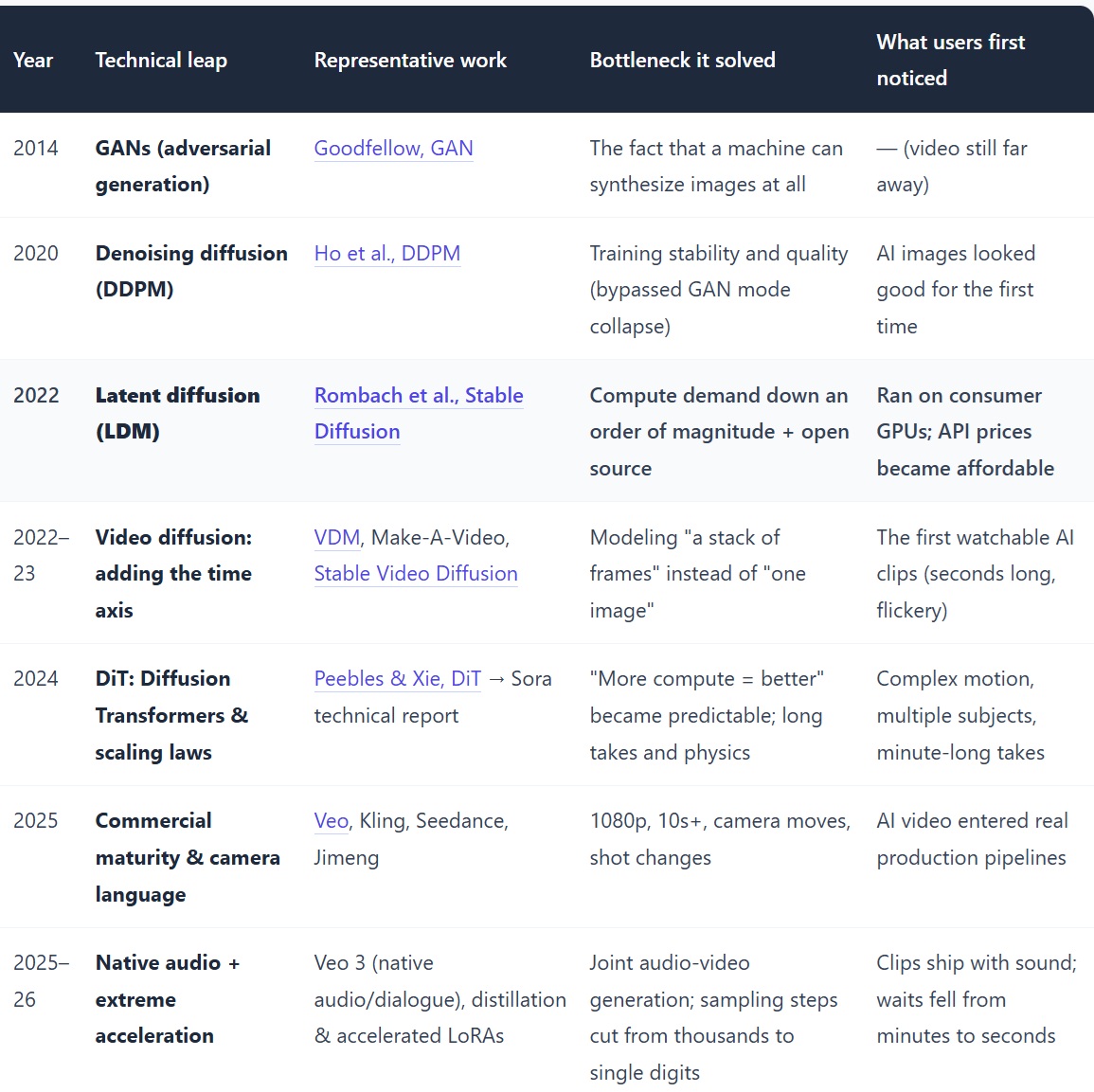
Twelve years of text-to-video history is really seven moments where a bottleneck broke. On the left of each row, the technical leap; on the right, what you actually felt as a user.
| # | Year | Technical leap | Representative work | Bottleneck it solved | What users first noticed |
|---|---|---|---|---|---|
| 1 | 2014 | GANs (adversarial generation) | Goodfellow, GAN | The fact that a machine can synthesize images at all | — (video still far away) |
| 2 | 2020 | Denoising diffusion (DDPM) | Ho et al., DDPM | Training stability and quality (bypassed GAN mode collapse) | AI images looked good for the first time |
| 3 | 2022 | Latent diffusion (LDM) | Rombach et al., Stable Diffusion | Compute demand down an order of magnitude + open source | Ran on consumer GPUs; API prices became affordable |
| 4 | 2022–23 | Video diffusion: adding the time axis | VDM, Make-A-Video, Stable Video Diffusion | Modeling “a stack of frames” instead of “one image” | The first watchable AI clips (seconds long, flickery) |
| 5 | 2024 | DiT: Diffusion Transformers & scaling laws | Peebles & Xie, DiT → Sora technical report | “More compute = better” became predictable; long takes and physics | Complex motion, multiple subjects, minute-long takes |
| 6 | 2025 | Commercial maturity & camera language | Veo, Kling, Seedance, Jimeng | 1080p, 10s+, camera moves, shot changes | AI video entered real production pipelines |
| 7 | 2025–26 | Native audio + extreme acceleration | Veo 3 (native audio/dialogue), distillation & accelerated LoRAs | Joint audio-video generation; sampling steps cut from thousands to single digits | Clips ship with sound; waits fell from minutes to seconds |
Chapter 2 breaks down the mechanics; chapters 3 and 4 answer “what it changed about the output” and “what it changed for you.”
2. Inside the Model: What Text-to-Video Actually Does
2.1 Two roads to creating something from nothing: adversarial vs denoising
Before 2020, the mainstream answer to “make something from nothing” was the GAN (Generative Adversarial Network): a generator fakes, a discriminator calls out fakes, and both improve through opposition. Elegant, but with three hard flaws — unstable training (any imbalance collapses it), mode collapse (the generator learns one trick and emits the same few faces forever), and poor scalability (bigger models were harder to train, not better).
DDPM (Denoising Diffusion Probabilistic Models, see the table above) took a completely different view: don’t learn how to generate — learn how to denoise. During training, a real image is gradually corrupted with Gaussian noise until it becomes pure static (the forward process), and a network learns at each step to predict the noise that was mixed in. Generation starts from pure noise and subtracts predicted noise step by step (reverse sampling) until an image emerges. The cost is many sampling steps (original DDPM: 1,000), but the payoff is two things GANs never had: extremely stable training and quality that scales smoothly with model size — the precondition for everything scaling-law related that followed.
In the GAN era, training a model was a lottery. Diffusion turned it into engineering. The direct user benefit: models now upgrade reliably month over month — today’s version is a bit better than last month’s, rather than differently broken.
2.2 The two costs of diffusion: steps and compute
The denoising paradigm works, but it’s expensive in two places:
| Cost | Where it comes from | Sense of scale | How it was solved |
|---|---|---|---|
| Sampling steps | Each clip requires dozens to thousands of forward passes | Original DDPM: 1,000 steps; video models start at 30–50 | Distillation (LCM / DMD) compressed to 4–8 steps — see chapter 5 |
| Pixel-space compute | Diffusing in raw pixel space; cost grows with the square of resolution | A 1024×1024 image is ~1M pixels; video multiplies by frames | Latent diffusion (next section) — the most consequential step from the user’s perspective |
2.3 Latent diffusion: compress 8× first, generate second
In 2022, Latent Diffusion Models (LDM — the base of Stable Diffusion) made the most “engineering” and most consequential decision in the field: don’t diffuse in pixel space — compress first. A VAE (variational autoencoder) compresses the image 8× per side into a latent space (64× fewer pixels); all diffusion happens in that compact space; the VAE decodes back to pixels at the end.
Text encoder→
Latent denoising (dozens of steps)→
VAE decoder→
Finished frames
The significance for users is hard to overstate: an order-of-magnitude drop in compute meant consumer GPUs could run generative models for the first time — and API marginal costs could finally come down. The 2026 sub-$0.05/sec price war, and the entire local-generation ecosystem (ComfyUI and friends), rest on this compression.
2.4 U-Net → DiT: making “add compute” predictable
Early diffusion models used U-Net (a convolutional network) as the denoising backbone. In 2023, DiT (Diffusion Transformer, see the table above) showed that swapping the backbone for a Transformer makes quality rise smoothly and predictably with compute (FID falls monotonically as GFLOPs grow). In 2024, OpenAI’s Sora technical report brought this scaling law into video: chop video into spacetime patches, feed them to a Transformer as tokens, scale parameters, data, and compute together — and capabilities climb in steps.
Before scaling laws, whether a model was good depended on inspiration; after, on budget. Top labs could finally iterate against a roadmap — the underlying reason flagship models have updated quarterly since 2025. For users: known weaknesses (physics glitches, garbled text) get fixed at visible speed, one by one.
2.5 From image to video: the time axis and 3D VAE
An image model produces one still frame; video needs a stack of frames that stay coherent. Three technical pieces:
- 3D VAE: compression extends from “one image” to “a block of spacetime” (time × height × width), so an entire clip is compressed at once and frame information naturally shares the latent space.
- Spatiotemporal attention: every DiT token sees both spatial and temporal position, so the model learns “what this person looks like next frame” and “how the background moves as the camera pans.”
- Progressive resolution & frame rate: generate content at low resolution first, then upscale to 1080p and high frame rate — the design that keeps inference costs manageable.
Video Diffusion Models (VDM, Google) and Make-A-Video (Meta) established this route in 2022–23: lean on massive unlabeled video plus a pretrained image model, then learn the time dimension. First-generation output looked like “two seconds, flickering, six-fingered hands” — but the direction was right.
2.6 How text steers the picture
Your prompt isn’t fed directly to the denoising network. A large language model (T5-class) or CLIP encodes the text into vectors; at every denoising step the network reads them via cross-attention, deciding which way to push the current step; and at inference, classifier-free guidance (CFG) computes both the “with prompt” and “without prompt” directions and extrapolates between them, so the result hugs your prompt. Every tuning trick you know — CFG strength, prompt phrasing — is really adjusting the signal-to-noise ratio of this control channel.
An order-of-magnitude compute cut that set the shape of every price curve since.
Turned “getting better” from luck into a budgeted engineering process.
Frame-to-frame coherence is what made video footage instead of a GIF.
3. What Iteration Changed About the Output: Six Dimensions
Twelve years of iteration on one table — typical output level per dimension in three eras (qualitative stars, based on blind-arena reputation and our own tests; not official benchmarks):
| Output dimension | 2022 · first video diffusion | 2024 · DiT flagships | 2026 · current flagships | Enabling technology |
|---|---|---|---|---|
| Resolution | ★★★★★ 576p | ★★★★★ 720–1080p | ★★★★★ 1080p standard / 4K optional | Progressive generation + latent upsampling |
| Clip length | ★★★★★ 2–4 s | ★★★★★ 10–60 s | ★★★★★ 10–15 s/shot × multi-shot stitching | Spatiotemporal patches, KV caching, continuation |
| Subject consistency | ★★★★★ drifts between frames | ★★★★★ stable within one shot | ★★★★★ consistent across shots | 3D VAE + reference-image/first-last-frame control |
| Motion & physics | ★★★★★ jitter, melting | ★★★★★ broadly right, details break | ★★★★★ splashes, cloth, collisions mostly credible | Scaling laws + high-quality motion data |
| Audio-visual sync | — no audio | — no audio | ★★★★★ native dialogue/SFX/score | Joint audio-video diffusion (Veo 3 onward) |
| Prompt adherence | ★★★★★ slot machine | ★★★★★ broadly controllable | ★★★★★ camera moves, framing, on-screen text by name | Stronger text encoders + CFG tuning + RLHF |
2022 output was an easter egg; 2026 output survives a rough cut — because subject consistency and motion credibility crossed the pass line. When your editing software can work with it, that’s the definition of “in production.”
On-screen text rendering, complex multi-character blocking, frame-accurate camera moves remain this generation’s known gaps. That’s exactly why first-last-frame, reference-image, and multi-shot controls became flagship-standard in 2026 — where the model isn’t stable enough, interfaces fill in.
Since Veo 3, a “video” ships as a complete segment with dialogue and sound, not silent frames. For downstream work like dubbing and SFX (for how TTS engines compare, see our TTS model comparison), this is structural: part of the post pipeline has moved forward into the generation model.
4. What Iteration Changed for the User: Wait, Price, Barrier, Failure Modes
4.1 Wait time: from “make coffee” to “just click”
Sampling steps are the direct source of waiting. Three stacked generations changed the wait for a 5-second clip:
| Era | Typical sampling setup | Wait for 5 s clip (cloud A100-class) | User experience |
|---|---|---|---|
| 2022–23 first video diffusion | 250–1,000 steps × per-frame denoising | 5–15 minutes | Submit, go do something else, come back and hope |
| 2024–25 DiT flagships | 30–50 steps + progressive generation | 1–3 minutes | Tolerable, but batch-and-queue |
| 2026 distilled / accelerated | 4–8 step distillation + quantization + LoRA speedups | Seconds to tens of seconds | What-you-see-is-what-you-get; re-prompt in seconds |
The wait didn’t just shrink the annoyance — it changed how you create: with minute-long waits you generate once and curate carefully (slot-machine mode); with second-level waits you iterate live (conversation mode). That shift is the direct technical cause of the interactive creation tools that appeared in 2026.
4.2 Price: the compound interest of latent space and distillation
The price curve is the product of three stacked layers: latent compression (2022, order-of-magnitude compute cut) → architectural efficiency (DiT: more quality per FLOP) → distillation & acceleration (same quality, fewer steps). Add Chinese platforms’ open-source push, and the 2026 landscape looks like this:
- Mainstream API prices span $0.02–0.75/sec, a spread of over 30× (full data in our pricing report).
- The price floor is on Chinese platforms: Jimeng 3.0’s 720P tier costs ¥0.28/sec (~$0.039); blind-test favorite Seedance 2.0 runs about $0.15/sec — 3–5× cheaper than the Western flagship Veo 3.1 Standard ($0.40/sec). Quality and price have decoupled.
- The same model can cost up to 31× more on a different shelf (Seedance 2.0/2.5 across channels: $0.022–0.682); Veo 3.1 spans roughly 13×. Iteration lowers production cost, but shelf markups don’t hand the savings to you — you have to comparison-shop.
- Cautionary tale: Sora 2’s API shut down on 2026-09-24 with no official replacement — however leading the technology, vendor continuity risk belongs to the user.
4.3 Barrier & workflow: from “spells” to storyboards
| Era | Barrier to entry | Typical workflow | Technology that enabled it |
|---|---|---|---|
| 2022–23 | High — results felt like a slot machine | Re-prompt endlessly, generate 20 clips, keep 1 | — |
| 2024–25 | Medium — camera language controllable | Write camera moves → batch generate → edit and select | Better text understanding, shot changes, 10s+ length |
| 2026 | Low — you work like a director | Storyboard → first/last frames & reference images → multi-shot generation → rough cut | Consistency controls, native audio, second-level retries |
Note the other side of the falling barrier: the competition barrier fell too. In 2022, knowing how to use the tools was a moat; in 2026 everyone can produce clips — scarcity has moved from “can operate the tool” to “can write the script, compose the shot, and pick the topic.”
4.4 How failure modes evolved: what got fixed, and what didn’t
| Failure mode | 2022–23 | Status in 2026 | Technical reason |
|---|---|---|---|
| Broken hands/limbs | constant | largely solved | Scale + curated data |
| Flicker / subject drift | guaranteed | rare within a shot | 3D VAE + spatiotemporal attention |
| Physics errors (splashes, floating, clipping) | guaranteed | mostly credible, details still break | Physical common sense learned from data, not a physics engine |
| Garbled on-screen text | guaranteed | short words OK, sentences still hard | Text rendering depends on training distribution |
| Randomness of results | same prompt, wildly different outputs | far more controllable | CFG / seeds / reference images |
| Model suddenly offline | — | has happened (Sora 2 shutdown) | A business problem, not a technical one |
5. Acceleration: Same Model, Different Experience
Acceleration techniques deliver 2–10× inference speedups on the same base model — the most active layer of the 2026 value-for-money battlefield:
- Consistency distillation: a student model jumps straight to the teacher’s “1,000-step endpoint” in one or a few steps. The landmark work, LCM (Latent Consistency Models), compressed Stable Diffusion sampling to 4–8 steps; DMD (Distribution Matching Distillation) showed one-step sampling can approach teacher quality. The cost is a small loss of diversity.
- Quantization: weights compressed from FP16 to INT8/INT4 cut memory and bandwidth proportionally, with quality loss usually imperceptible. Both cloud and local inference rely on it heavily (see the ONNX Runtime quantization guide).
- Accelerated LoRAs: low-rank adapters tuned for speed on a frozen base model. We tested this route in our MiniMax H3 accelerated LoRA report: in specific scenarios it buys double-digit percentage speedups at very low deployment cost.
- Engineering layer: KV-cache reuse, progressive generation (content at low resolution → upscale), cross-frame KV inheritance — pure efficiency work that changes no principles.
Cutting 50 steps to 8 doesn’t just lower the bill — it decides whether the product is “submit-and-wait” or “converse-and-iterate.” The same base model, accelerated differently, reaches different devices and different interactions. It’s also what makes local inference routes (like DeepVideo’s local-client approach) engineering-feasible.
6. What This Means When You Choose a Model
Principles, translated into selection rules — four questions that actually matter:
Match Your Creation Format
- Daily short-form / feed content: prioritize speed and unit price (well-distilled fast tiers, Chinese platforms’ low-price tiers). You don’t need 4K; you need “new version of the prompt in ten seconds.”
- Ads / brand work: prioritize consistency and control interfaces (reference images, first/last frames, multi-shot). Paying 3× more per second for control is cheaper than 10 more slot pulls.
- Narrative shorts: prioritize cross-shot consistency + native audio. Character-consistency interfaces and joint audio-video are this generation’s dividend — use them fully.
- Privacy-sensitive / bulk localization: consider local inference (quantized open-source base + accelerated LoRAs); data never leaves the machine, at the cost of a lower quality ceiling than cloud flagships.
Universal rule: check vendor continuity first (the Sora 2 lesson), then same-model cross-channel price gaps (up to 31×), and only then “which is strongest.” Channel-by-channel pricing in our site-wide pricing report; per-scenario capability differences in our scene-by-scene model comparison.
7. Key Takeaways
- The through-line of the whole evolution: make denoising cheaper. Latent compression (order-of-magnitude compute cut) → DiT (more quality per FLOP) → distillation (order-of-magnitude step cut) — three layers together lowered the cost of a clip by two orders of magnitude.
- The single most output-changing technology was spatiotemporal modeling. Resolution and length improved gradually; frame-to-frame coherence appeared “from zero” — and it’s what let editing software accept AI video at all.
- For users, the biggest change wasn’t picture quality — it was wait time. Second-level generation turned creating from “slot-machine” into “conversation,” a shift that matters as much as any model upgrade.
- Quality and price have decoupled. The blind-test favorite (Seedance line) and the price floor (Jimeng, Volcano) both sit on Chinese platforms; the Western flagship no longer automatically means “best.”
- Native audio starts the next reshuffle. With dialogue and SFX inside the model, dubbing and sound workflows are partially moving upstream into generation — structural, not incremental.
- Technical dividends don’t reach users automatically. A 31× cross-channel spread for the same model, and Sora 2’s unannounced shutdown, prove that “where you buy and whether it survives” matters more than “which is strongest.”
Generation Is Only Half the Pipeline
Once the clip exists, it still has to travel — market by market — through translation, dubbing, and localization. DeepVideo handles that pass locally.
Download the DeepVideo Desktop Client
Realistic AI Video Dubbing at Just $0.17/minHigh quality · Low price · Local client · Security
Produced by DeepForgeHub Research