
ElevenLabs vs DeepVideo: AI Video Dubbing & Translation Compared
Cost per minute
Language coverage
Local vs cloud
Voice cloning
Selection framework
Executive summary
These two products are not interchangeable substitutes, so the framing has to come first: ElevenLabs is a cloud audio-AI platform whose core business is speech synthesis, with video dubbing being just one of its many modules; DeepVideo is a local desktop video translation and dubbing client that does one thing — moving a whole video into another language. They overlap on “multilingual dubbing plus voice cloning” and diverge on how you are billed and where your data goes.
- The cost gap is an order of magnitude. DeepVideo works out to about $0.17/min. ElevenLabs’ cheapest dubbing tier is roughly $0.33/min (the v1 cascade model, watermarked), and its current-generation v2 quality tier runs $2.23–4.91/min.
- ElevenLabs’ language coverage is overwhelming. Dubbing v2 supports 90+ languages and accents, including regional variants such as Brazilian Portuguese and Castilian Spanish. DeepVideo’s stated figure is voice cloning in 30+ languages plus 100+ preset voices, without a published per-language list.
- Privacy is DeepVideo’s structural advantage. It processes 100% locally and never uploads your video to the cloud. ElevenLabs’ servers sit in the US, data is used to improve its models by default (opt-out only on Enterprise), and EU data residency excludes dubbing.
- Ecosystem is ElevenLabs’ moat. It offers APIs and SDKs, team seats, and a human-assisted Productions service. DeepVideo is desktop-only, with no API and no team features.
- Neither does lip-sync. This is the most easily overlooked shared gap — if there is a real face speaking on camera, both products require a separate third-party lip-sync tool.
- Overall orientation. Under this report’s weights, DeepVideo edges it 7.4 to 6.8, with the entire margin coming from cost and privacy. Raise the weight of language coverage and ElevenLabs overtakes immediately (see the sensitivity check in section 4.6).
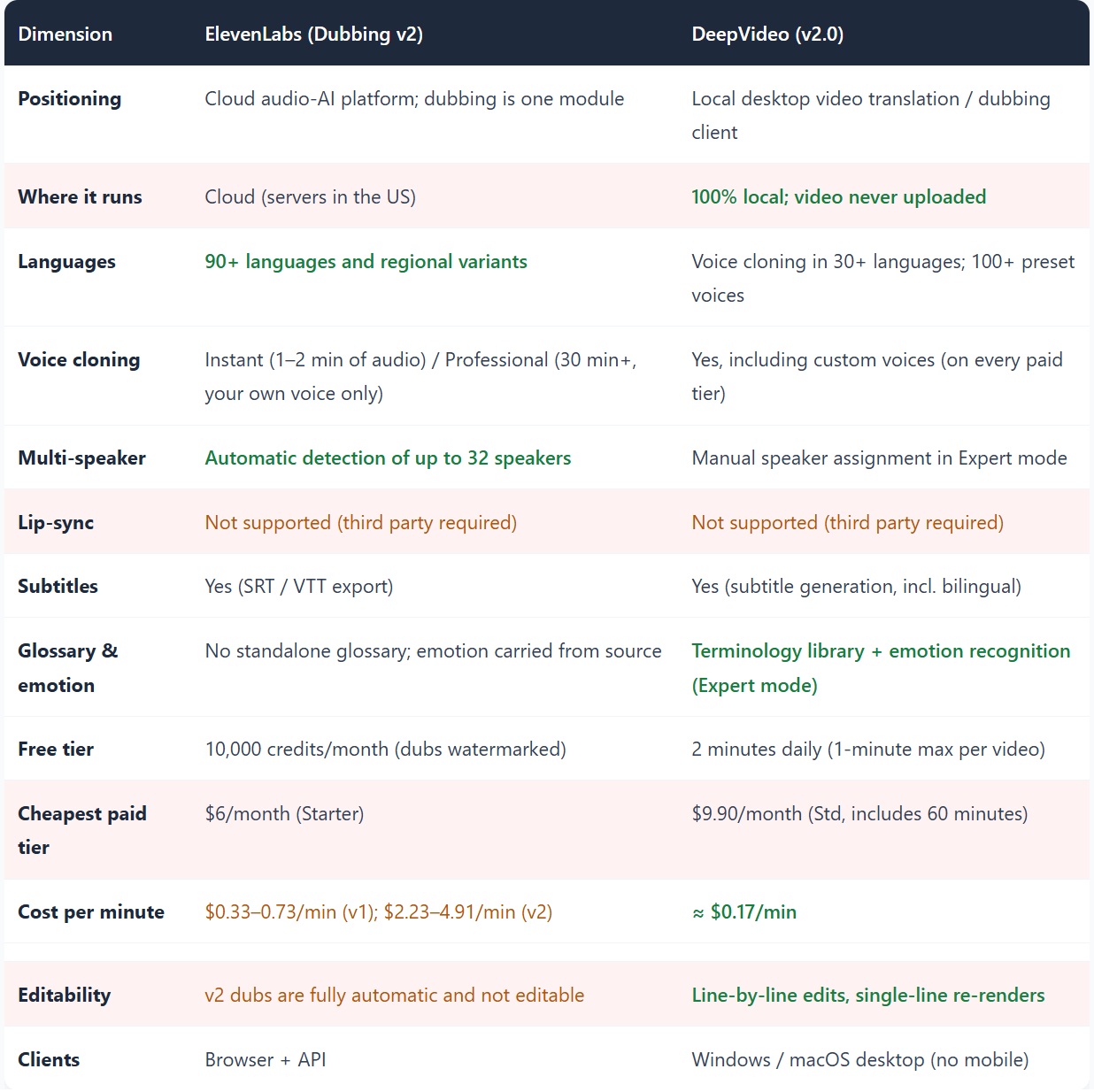
I. At a glance: two routes in one table
| Dimension | ElevenLabs (Dubbing v2) | DeepVideo (v2.0) |
|---|---|---|
| Positioning | Cloud audio-AI platform; dubbing is one module | Local desktop video translation / dubbing client |
| Where it runs | Cloud (servers in the US) | 100% local; video never uploaded |
| Languages | 90+ languages and regional variants | Voice cloning in 30+ languages; 100+ preset voices |
| Voice cloning | Instant (1–2 min of audio) / Professional (30 min+, your own voice only) | Yes, including custom voices (on every paid tier) |
| Multi-speaker | Automatic detection of up to 32 speakers | Manual speaker assignment in Expert mode |
| Lip-sync | Not supported (third party required) | Not supported (third party required) |
| Subtitles | Yes (SRT / VTT export) | Yes (subtitle generation, incl. bilingual) |
| Glossary & emotion | No standalone glossary; emotion carried from source | Terminology library + emotion recognition (Expert mode) |
| Free tier | 10,000 credits/month (dubs watermarked) | 2 minutes daily (1-minute max per video) |
| Cheapest paid tier | $6/month (Starter) | $9.90/month (Std, includes 60 minutes) |
| Cost per minute | $0.33–0.73/min (v1); $2.23–4.91/min (v2) | ≈ $0.17/min |
| API / integrations | API + SDK + team seats | None |
| Editability | v2 dubs are fully automatic and not editable | Line-by-line edits, single-line re-renders |
| Clients | Browser + API | Windows / macOS desktop (no mobile) |
II. What each product actually is
ElevenLabs
Cloud · deepest ecosystem
ElevenLabs is the current benchmark for voice cloning and synthesis, and Dubbing v2 is an audio-to-audio model — it works from the original audio rather than a transcript, so it can carry over the source speaker’s emotion, pacing and pauses instead of merely swapping words. Automatic Dubbing builds a voice model for each original speaker and applies it across every target language without manual setup. For teams that need one video live in a dozen markets at once, there is currently very little that competes with this.
Its pricing and packaging, however, are classically “platform-shaped”: every capability draws from one shared credit pool (dubbing, TTS, music and agents all consume the same balance), and dubbing is billed per target language — dub one video into five languages and you are charged for five dubs. On top of that, v2 output is “fully automatic with no editing option,” and the vendor’s own help documentation states that the dubbing module does not currently include lip-sync.
Strengths
- 90+ languages and regional variants — coverage is in a class of its own
- Audio-native model preserves emotion, tone and rhythm better
- Automatic detection of up to 32 speakers, ideal for interviews and panels
- API + SDK + team seats + human-assisted mixing (Productions) — fits into production pipelines
- Permanent free tier; paid tiers scale with usage
- SOC 2 Type II / ISO 27001 with a public DPA
Weaknesses
- High dubbing cost; the v2 quality tier can be 10x DeepVideo or more
- Billed per target language, so multilingual rollouts scale linearly in price
- Data leaves your machine and is used to improve models by default (opt-out is Enterprise-only)
- v2 dubs are not editable; the older Dubbing Studio editor is in maintenance mode
- No lip-sync inside dubbing — talking-head footage still needs an external tool
- Shared credit pool makes cost accounting non-obvious
DeepVideo
Local · lowest cost
DeepVideo takes the opposite route: it runs the entire pipeline — audio extraction, source separation, speech recognition, translation, TTS, subtitle alignment and muxing — on the user’s own machine, with the video file never leaving the device. Two things follow directly: the per-minute price drops to about $0.17 (because no metered cloud compute is rented), and data sovereignty stays entirely with the user. Of its two v2.0 modes, Quick Translation is one-click output, while Expert Video Translation opens up multi-speaker assignment, Voice Cloning, a terminology library and emotion recognition — the mode for projects that need control.
The trade-offs are equally clear: language coverage is limited to the stated 30+ for voice cloning, there is no API and no team seats, no human-assisted mixing or similar service, and collaboration at scale is weak. Like ElevenLabs, it does not do lip-sync. One easily missed detail: the “minutes” in a monthly plan are a processing quota, and multilingual output counts against it just the same — dubbing one 10-minute video into five languages consumes 50 minutes of quota.
Strengths
- About $0.17/min — the lowest in this comparison
- 100% local processing, no cross-border exposure for sensitive footage
- Expert mode adds a terminology library and emotion recognition for controlled projects
- Line-by-line edits and single-line re-renders keep rework cheap
- Free tier of 2 minutes daily lets you validate results before paying
- Buy-out style pricing makes the bill predictable
Weaknesses
- Narrow coverage (30+) versus ElevenLabs’ 90+
- No API or SDK, so it cannot be embedded for batch scheduling
- No team collaboration or seat management
- Desktop only — no mobile and no web app
- Also lacks lip-sync
- Monthly quota counts multilingual output, so it drains quickly
III. Pricing and true cost
Both publish a monthly price, but the monthly price is not the comparable number — ElevenLabs sells a “credit pool” while DeepVideo sells a “processing-minute quota,” so both have to be converted to cost per finished minute before they can be compared. ElevenLabs’ dubbing tiers and overage rates are on its Dubbing pricing page; DeepVideo’s tiers are on its pricing page.
3.1 ElevenLabs dubbing-relevant tiers (monthly)
| Tier | Monthly | Credits | Dubbing v2 minutes included | v2 overage / min | Dubbing v1 overage / min |
|---|---|---|---|---|---|
| Free | $0 | 10k | 0.4 | $4.91 | $0.73 (watermarked) |
| Starter | $6 | 30k | 2 | $2.70 | $0.40 |
| Creator | $22 | 121k | 9 | $2.45 | $0.36 |
| Pro | $99 | 600k | 44 | $2.23 | $0.33 |
| Scale | $299 | 1.8M | usage-based | from $2.23 | $0.33 |
Three things to note: (1) every tier draws on one shared credit pool covering dubbing, TTS, music and agents, so the usable dubbing minutes end up below the table values; (2) the “minutes included” figures are expressed in Dubbing v2 terms and are very small (even Pro only gets 44 minutes), which tells you how expensive v2 is; (3) via the API, v2 costs $2.20/min and v1 costs $0.33/min, slightly different from the tier-page framing — always confirm at checkout. Prices exclude tax.
3.2 DeepVideo tiers (monthly / yearly)
| Tier | Monthly | Minutes / month | Max video length | Effective rate | Yearly |
|---|---|---|---|---|---|
| Free | $0 | 2 min daily | 1 min | — | — |
| Std | $9.90 | 60 min | 15 min | ≈ $0.17/min | $99 / 720 min |
| Adv | $29.9 | 120 min | 30 min | ≈ $0.25/min | $299 / 1440 min |
| Pro | $149 | 60 min (as published) | unlimited | figure looks inconsistent | $1499 / 7200 min |
DeepVideo’s yearly rates convert cleanly: Std at $99 / 720 min ≈ $0.138/min, Pro at $1499 / 7200 min ≈ $0.208/min. But the published monthly Pro tier states “60 minutes / unlimited video length” at $149, which inverts against the 120-minute Adv tier — this looks like a page copy error. This report reproduces the vendor’s published text as-is, and we recommend confirming with the vendor before ordering.
3.3 Real-world example: one 10-minute video dubbed into N languages
| Target languages | DeepVideo (Std, $0.17/min) | ElevenLabs v1 floor ($0.33/min) | ElevenLabs v2 quality ($2.23/min) |
|---|---|---|---|
| 1 | $1.70 | $3.30 | $22.30 |
| 5 | $8.50 | $16.50 | $111.50 |
| 30 | $51.00* | $99.00 | $669.00 |
* This cell needs an asterisk: DeepVideo’s “30+” figure is a voice-cloning count, so whether it can cover 30 target languages depends on its actual supported-language list, whereas ElevenLabs’ 90+ is a dubbing figure and covers the case outright. In other words, for multilingual rollouts, DeepVideo is cheap only as long as your languages are inside its range.
Another angle: dubbing a 10-minute video into five languages consumes 50 of DeepVideo Std’s 60 monthly minutes — essentially one such job per month, so any real volume means upgrading to Adv or Pro. The ElevenLabs equivalent is 5 × 10 = 50 minutes of v2 dubbing, which needs the Pro tier (44 minutes included) plus overage — roughly $22 + 6 × $2.23 ≈ $35, or simply the API at $2.20/min.
IV. Scoring and head-to-head evaluation
The scoring below uses a weighting scheme defined by this report, not any official benchmark. Dimension scores are integers from 0 to 10, and the total is Σ(dimension score × weight) ÷ 100. It scores the video dubbing / translation use case only — fold in ElevenLabs’ TTS and agent capabilities and its advantage would be larger still.
4.1 Dimensions and weights
| Dimension | Weight | What it measures |
|---|---|---|
| Language coverage | 20% | Number of usable target languages and richness of regional variants |
| Cost per minute | 25% | True cost per finished minute |
| Voice quality & fidelity | 20% | Cloning fidelity, emotion and tone retention, naturalness |
| Privacy & data sovereignty | 15% | Where it runs, data usage, cross-border transfer, compliance |
| Editing & workflow control | 10% | Editability, speaker assignment, glossary, batch handling |
| Platform & ecosystem | 10% | API / SDK, team seats, integrations, professional services |
4.2 Overall scores
| Product | Weighted total | Distribution | Stars | One line |
|---|---|---|---|---|
| DeepVideo | 7.4 | ★★★★★ | Cheap, private and controllable — as long as your languages are in range | |
| ElevenLabs | 6.8 | ★★★★★ | Unmatched coverage and ecosystem, at a higher price and with your data leaving home |
4.3 Score breakdown
| Dimension | Weight | ElevenLabs | DeepVideo | Leader | Basis |
|---|---|---|---|---|---|
| Language coverage | 20% | 10 | 6 | ElevenLabs | 90+ vs 30+ (the latter a cloning figure) |
| Cost per minute | 25% | 3 | 9 | DeepVideo | $0.17 vs $0.33–4.91 per minute |
| Voice quality | 20% | 9 | 7 | ElevenLabs | Audio-native model retains emotion and tone better |
| Privacy & sovereignty | 15% | 4 | 10 | DeepVideo | Local vs cross-border + default model training |
| Editing & workflow | 10% | 6 | 7 | DeepVideo | Line edits + glossary; v2 is not editable |
| Platform & ecosystem | 10% | 10 | 3 | ElevenLabs | API / SDK / team seats vs none |
| Weighted total | 100% | 6.8 | 7.4 | DeepVideo (+0.6) | 6.75 vs 7.35, rounded |
4.4 Dimension winners
90+ languages and accents, including regional variants like Brazilian Portuguese and Castilian Spanish — the only option that can cover a global market in one pass.
About $0.17/min — half of ElevenLabs’ cheapest v1 tier and an order of magnitude below its v2 quality tier.
Its audio-to-audio model lifts performance cues straight from the source, so emotion, pauses and intonation stay closer to the original.
100% local processing; the video file never leaves the machine — a hard advantage for unreleased content, client footage and internal training material.
Line-by-line edits and re-renders, plus manual speaker assignment and a glossary in Expert mode; ElevenLabs v2 output is fully automatic.
APIs, SDKs, team seats and a human-assisted mixing service — deployable inside enterprise content pipelines.
4.5 Head-to-head
DeepVideo ≈ $1.70; ElevenLabs v1 ≈ $3.30 (watermarked), v2 ≈ $22.30. DeepVideo wins — for the same output, the cost gap is 2x to 13x.
ElevenLabs covers 90+ languages and can do it in one pass; DeepVideo’s 30+ (cloning figure) cannot reach that far. ElevenLabs wins — its home turf, and a gap DeepVideo cannot close short-term.
DeepVideo keeps everything on-device; ElevenLabs lands data on US servers, uses it to improve models by default, and excludes dubbing from EU residency. DeepVideo wins — compliance teams typically veto the latter outright.
ElevenLabs offers a full API and SDKs with usage-based billing; DeepVideo has no API and no team features. ElevenLabs wins — for automated pipelines DeepVideo is simply out.
Both lose. ElevenLabs’ dubbing module explicitly excludes lip-sync and DeepVideo does not support it either — any talking-head footage needs a third-party lip-sync tool, and that cost belongs in the budget.
4.6 Weight sensitivity check
A weighted total is a function of its weights, so a change in weights can flip the conclusion — which is why the key assumptions have to be laid out. Suppose a team’s priority is “multilingual reach first, cost second” and we raise Language coverage from 20% to 30% while cutting Cost per minute from 25% to 15% (other dimensions unchanged):
| Weighting | ElevenLabs | DeepVideo | Outcome |
|---|---|---|---|
| This report’s default (cost 25% / languages 20%) | 6.8 | 7.4 | DeepVideo leads by 0.6 |
| Multilingual-first (cost 15% / languages 30%) | 7.5 | 7.1 | ElevenLabs overtakes by 0.4 |
The conclusions are not contradictory: which product wins depends entirely on whether you put cost or coverage first. The default weights favor small and mid-size creators who are price-sensitive and work in a handful of languages, where DeepVideo edges ahead; switch the scenario to “dozens of languages in one pass” and ElevenLabs’ value outweighs the price difference.
V. Scenario recommendations
Individual creators / small teams, a few mainstream languages
Price-sensitive, medium-length videos, language needs concentrated in English, Chinese, Spanish and similar, and a predictable bill matters.
E-commerce / marketing teams shipping 20+ languages
The same asset has to run in a dozen markets, coverage is a hard requirement, and the team wants shared asset and permission management.
Sensitive content / privacy-first (client footage, internal training)
The material cannot leave the device or go to the cloud, and compliance requires processing to stay entirely local.
Developers / platform integration with batch scheduling
An API is needed to embed dubbing into your own product, with usage-based billing, programmatic triggers and horizontal scaling.
Talking-head video that needs lip-sync
A face is speaking on camera, and mismatched mouth movement will visibly break the illusion.
Long-form / documentary, polished line by line
Translation must respect a glossary and every line has to be editable and re-renderable; quality outranks speed.
VI. Decision framework
Find your profile and go straight to the answer
Profile A · Cost-sensitive small creator — mainstream languages only, under a couple of dozen minutes a month, no sensitive material: choose DeepVideo. Use the free tier (2 minutes daily) to run two real jobs, then move to Std ($9.90 / 60 minutes).
Profile B · Global marketing / e-commerce team — the same asset across dozens of languages, needing APIs and collaboration: choose ElevenLabs. It is genuinely more expensive, but “can it cover that language” is a hard gate that DeepVideo cannot clear. A common cost-control play is to draft in the v1 tier and reserve v2 for final delivery.
Profile C · Sensitive or highly regulated content — material cannot leave the country: go straight to DeepVideo. This is not a price question; ElevenLabs’ processing location and training terms fail most compliance frameworks.
Profile D · You want both — the pragmatic answer is to run two lanes: use DeepVideo for the bulk of day-to-day content inside its language range (pushing unit cost to the floor) and switch to ElevenLabs only when a rare language or API automation is required. Both free tiers are enough to validate the workflow, so run one job on each before deciding where the main volume lives.
VII. Data sources and caveats
Read this before you read the numbers
- Pricing and features are as of 2026-10 and will change. Both vendors can reprice or restructure tiers at any time; check current pricing on their official pages before committing.
- ElevenLabs publishes two different language counts. Its pricing-page comparison table lists 74 (a TTS-side figure) while the Dubbing page claims 90+ languages and accents. This report uses the dubbing figure of 90+; the live language picker in the dubbing interface is the final word.
- ElevenLabs uses a shared credit pool. Dubbing, TTS, music and agents all draw on one balance, so the “minutes included” figures are dubbing-equivalent references, not the minutes you can actually dub.
- ElevenLabs v2 dubs are not editable. The vendor’s help documentation states the dubbing module does not currently include lip-sync, and the older Dubbing Studio editor is in maintenance mode.
- DeepVideo’s monthly Pro tier looks inconsistent. Pro is listed at $149 with “60 minutes / unlimited video length,” which contradicts the 120-minute Adv tier. This report reproduces the published text; confirm with the vendor before ordering.
- DeepVideo’s language figure is a cloning count. The vendor states “voice cloning in 30+ languages plus 100+ preset voices” without a per-language list, which is why the 30-language example carries an asterisk.
- Both vendors’ rates exclude tax and ignore FX movement, cross-border fees and payment-channel costs — non-trivial items in multi-currency billing.
- An independent review (dubbingtools.org) cross-corroborates the privacy and lip-sync points in this report, though its rating system differs and is not cited directly.
VIII. Key findings
- This is not “which is better” but “which is right.” ElevenLabs is the broadest cloud dubbing option; DeepVideo is the cheapest local one. They sit at nearly opposite ends on cost and privacy, overlapping only on “speaking your language in your own voice.”
- The cost gap is structural and will not be closed by discounts. ElevenLabs bills per target language on cloud compute; DeepVideo pushes marginal cost toward zero with local compute. The low price is a business-model difference, not a promotion.
- Language coverage defines the applicable boundary. Wherever a rare language or dozens of languages in one pass is required, DeepVideo is out on coverage first and its price advantage never gets to apply.
- Privacy is the one non-negotiable dimension. Everything else can be traded off with money or time, but a hard constraint like “the video must not leave the country” leaves exactly one option.
- Lip-sync is the shared gap. For any real talking-head footage, both require an external lip-sync tool — budget and schedule for it separately.
- The overall score is highly weight-sensitive. Under the default weights DeepVideo leads by 0.6; raise language coverage to 30% and ElevenLabs overtakes by 0.4. Decide which end matters more to you before you decide.
Get your video into every market
If this video needs to land on more platforms and regions, the first step is translating, dubbing and localizing it properly.
Download DeepVideo for desktop
Realistic AI Video Dubbing at Just $0.17/minHigh quality · Low price · Local client · Security
Sources: ElevenLabs pricing and Dubbing pages | DeepForgeHub pricing page | independent third-party review · Pricing as of 2026-10 and subject to change
The scoring scheme (dimensions and weights) is defined by this report | Produced by DeepForgeHub Research