
Digital Human Models: Global Comparison
Talking Avatars · Real-Time Conversational · Enterprise Platforms — September 2026
Realism · Motion Expressiveness · Real-Time Capability · Licensing · Cost
Executive Summary
In 2026 “digital human” has split into three implementation routes: pre-rendered generation (one image plus audio/script into a finished video — OmniHuman-1.5, Wan2.2-S2V, HeyGen Avatar IV), real-time conversational rendering (an avatar that listens and answers live — Tavus Phoenix-4, HeyGen LiveAvatar, self-hosted MuseTalk), and managed enterprise platforms (custom avatar plus compliance workflow — Synthesia, Baidu Xiling, Tencent Zhiying). The inputs, deliverables and billing differ completely — pick the route before picking the model.
The global picture in two sentences: the open-weights frontier is now almost entirely Chinese — Alibaba Wan2.2-S2V, Meituan LongCat-Video-Avatar, Tencent HunyuanVideo-Avatar, Ant Group EchoMimic V3, ByteDance HuMo; the real-time conversation moat sits with US APIs — Tavus Phoenix-4 streams sub-600ms full-duplex conversation, the only offering that feels face-to-face. And 2026 produced the year’s landmark result: in Meituan’s blind test, open-source LongCat-Video-Avatar 1.5 beat every leading commercial system on human preference — 65.9% win rate over Kling Avatar 2.0, 61.1% over OmniHuman-1.5, 54.3% over HeyGen.
Key findings:
- Open source won a blind test for the first time. LongCat-Video-Avatar 1.5 uses a shared base model plus multiple LoRAs to cut a 10-second video to about 1 minute of generation (15× efficiency), with a 0.8% frame-jump problem rate. The assumed open-vs-commercial quality gap closed — and reversed.
- Real-time is a different track; don’t compare it with pre-render metrics. Tavus under 600ms, Simli under 300ms, MuseTalk at 30fps self-hosted — while Synthesia doesn’t do real-time conversation at all. Conversational ability is an architectural property, not a tuning dial.
- Billing is the deepest trap. HeyGen bills in credits (Avatar IV ≈ 20 credits/min; Creator tier works out to roughly $0.97–2.90/min, and the meter moved repeatedly in 2026); Synthesia allocates minutes annually; on real-time platforms the question to ask is concurrency, not unit price (Tavus’s $395 tier allows only 15 concurrent sessions). Without normalizing to cost-per-minute and cost-per-session, no quote is comparable.
- Compliance tightened across the board in 2026. EU AI Act Article 50 took effect 2026-08-02: systems interacting with people must disclose AI identity; China’s deep-synthesis labeling duties intensified; HeyGen requires a recorded consent video to clone a likeness. The authorization chain is now part of the cost of doing business.
- Vendor stability became a new risk category. Soul Machines entered voluntary receivership in February 2026 — brilliant avatar technology, dead company. For closed platforms, check the company’s health before signing multi-year deals.
1. First, Pick Your Route: Three Ways to Build a Digital Human
All three routes get called “digital human,” but the product shape and selection logic differ completely. Step one is placing yourself in exactly one box.
| Route | Input → Output | Deliverable | Typical Billing | Representatives |
|---|---|---|---|---|
| Pre-rendered | One image + audio/script → finished video | MP4 file | Per generated minute / credits | OmniHuman-1.5, Wan2.2-S2V, HeyGen Avatar IV, LongCat |
| Real-time conversational | Image + live audio stream → live video stream | WebRTC video stream | Per streamed minute + concurrency | Tavus Phoenix-4, HeyGen LiveAvatar, MuseTalk+LivePortrait, NVIDIA ACE |
| Managed enterprise platform | Custom avatar + script workbench → reviewed output | In-platform production pipeline | Avatar annual fee + minute packs / subscription | Synthesia, Baidu Xiling, Tencent Zhiying, GUIJI |
A common misjudgment: an enterprise training team adopting Wan2.2-S2V as a production tool. Its realism and cinematic quality are genuinely top-tier, but everything else — audio synthesis, batch production, review workflow, compliance archiving — has to be built in-house. The reverse also fails: using Synthesia for marketing creative means paying for SCORM export, SSO and approval flows that marketing will never touch. Pick the wrong route and everything downstream is sunk cost.
2. The Global Landscape at a Glance
Open source first, then commercial and platforms. Both tables work directly as shortlists.
2.1 Open-Source Overview
| Solution | Organization | Method | Resolution | VRAM | Speed | License | Score |
|---|---|---|---|---|---|---|---|
| Wan2.2-S2V-14B / Wan-Animate | Alibaba Tongyi (China) | DiT, dual audio+text control, cinematic | 480P/720P | ~24GB+ (14B) | Slow (multi-step diffusion) | Apache-2.0 | 8.9 |
| LongCat-Video-Avatar 1.5 | Meituan (China) | Shared base + multi-LoRA, long-horizon stable | 720P+ | Medium (LoRA-efficient) | 10 s video in ~1 min | Open (permissive) | 8.8 |
| HunyuanVideo-Avatar | Tencent (China) | Multi-character dialogue, emotion control | 720P | ~45GB class | Slow | Community license, excludes EU/UK/KR | 8.1 |
| EchoMimic V3 | Ant Group (China) | Audio+text half-body performance | ~768P | ~12–16GB | Medium | Apache-2.0 | 8.4 |
| HuMo | ByteDance (China) | Unified multimodal conditioning | 720P | ~24GB class | Slow | Open | — |
| InfiniteTalk / MultiTalk | MeiGen (China) | Long video, multi-speaker dialogue | 480P/720P | ~24GB class | Slow | Open | — |
| StableAvatar | Community | Joint voice-expression modeling | 480P | ~12GB | Medium | Open | — |
| MuseTalk | Tencent / community (China) | Latent single-step lip inpainting, real-time | ~512 | ~6–8GB | 30fps real-time (one GPU) | MIT | 7.4 (combo) |
| LivePortrait | Kuaishou (China) | Portrait reenactment | 256–512 | ~4–6GB | 40fps+ real-time | Weight restrictions | — |
| SadTalker | Community (XJTU et al.) | 3DMM single-image talking head | 512 | ~6GB | Fast | OpenRAIL-M limits | — |
| Wav2Lip | Community | GAN lip-sync (legacy baseline) | 96×96 lip region | ~2GB | Very fast | Non-commercial (LRS2-trained) | — |
| MOVA | OpenMOSS (China) | Joint audio-video generation | — | — | — | Open | — |
2.2 Commercial & Platform Overview
| Solution | Positioning | Real-time | Pricing basis | Languages | Score |
|---|---|---|---|---|---|
| HeyGen (Avatar IV / LiveAvatar) | Marketing/social pre-render + live | LiveAvatar (1–2 s) | Creator $29/mo, 600 credits; Avatar IV ≈ 20 credits/min (≈ $0.97–2.90/min) | 177+ | 8.5 |
| Synthesia | Enterprise training/compliance | No | Starter $18–29/mo (120 min/yr); custom avatar $1,000/yr | 160+ | 8.1 |
| Tavus (Phoenix-4) | Real-time conversational API | Best (<600 ms full-duplex) | Blended ≈ $0.32–0.59/min; ~15 concurrent at $395 | Multi | 8.2 |
| Hedra (Character-3) | Creator value | Experimental | ≈$0.40/min (720p); live tier ≈$0.07/min | 140+ | — |
| D-ID | Lightweight photo-driven | Agents (higher latency) | Lite $4.70/mo; ≈$0.47–1.50/min | 120+ | — |
| Colossyan (NEO 2) | Enterprise training | No | $27/mo (~10 min/mo, ≈$2.70/min) | 70+ | — |
| Vidnoz | Low-cost volume | No | $19.99/mo for 15 min ($1.00/min) | Multi | — |
| DeepBrain AI | Training / AI Studio | Limited | From $24/mo (≈$2.40/min) | Multi | — |
| ElevenLabs Avatars | Speech-native avatars (launched Jun 2026) | No | With voice subscription | 30+ | — |
| Runway (Act-One) | Performance-driven reenactment (creative) | No | Credits | — | — |
| Kling Avatar 2.0 | Cinematic pre-render | No | Subscription ≈$2.04–2.54/min; lip-sync API $0.21/clip | Chinese-strong | 8.4 |
| OmniHuman-1.5 (ByteDance) | Performance-grade pre-render (Dreamina/CapCut/fal) | No | $0.14/s via fal (≈$8.4/min); ≈¥1/s domestic | Multi | 8.6 |
| NVIDIA ACE | Self-managed real-time stack | 0.8–1.2 s (own GPU) | GPU + ops cost | — | — |
| Baidu Xiling | China enterprise | Live/interactive tiers extra | ¥7,999/avatar/yr (1,500 min); overage ¥5/min | Chinese-first | 7.5 (platform group) |
| Tencent Zhiying | China enterprise | No | ¥3,999/avatar/yr (500 min) | Chinese-first | |
| GUIJI Intelligent | China e-commerce/livestream | Live versions | S-tier ¥3,980/avatar/yr (500 min) | Chinese-first | |
| SenseTime Ruying | China enterprise | No | Live-action ¥3,598/avatar/yr (500 min) | Chinese-first |
3. Deep Dives: 11 Model Cards
Wan2.2-S2V / Wan-Animate #1 Open Source 8.9/10
Wan-S2V’s dual-control design — audio governs expressions and gestures, text governs scene, camera and interaction — makes it the only open model explicitly aimed at “film-grade” digital humans: nuanced character interactions, realistic body movement and dynamic camera work that other approaches either can’t do or can’t hold stable. It tops its paper’s benchmarks against Hunyuan-Avatar and OmniHuman, and ranks first on the third-party SOTA2 audio-driven leaderboard (Jan 2026).
Pros
- Top-tier realism and motion expressiveness, confirmed by both blind tests and academic benchmarks
- Cleanest possible license: Apache-2.0, commercial, fine-tunable, redistributable
- Text+audio dual control: it can direct camera and scene, not just a moving mouth
- Full Wan ecosystem (Animate/T2V/I2V share the family)
Cons
- 14B diffusion: speed and VRAM are both unfriendly
- No real-time capability — wrong tool for conversation
- The full pipeline (TTS, editing, review) is on you
LongCat-Video-Avatar 1.5 Efficiency Dark Horse 8.8/10
One of 2026’s most consequential open releases. Rather than chasing single-frame quality, it optimizes for production usability: a shared base model with LoRA adapters replaces three parallel models, delivering ~15× inference efficiency. Across 13,240 human blind ratings it leads on physical plausibility, temporal stability, identity consistency and audio-visual coordination; frame-jump problem rate is 0.8% (best in field) and lip-sync problem rate 29.8% (best in field). This is the first time an open model systematically beat leading commercial systems on human preference.
Pros
- Blind-test win rate over 50% against all three commercial leaders — open source’s first reversal
- 15× inference efficiency: 10 s of video per minute of generation; batch production is viable
- Best long-horizon stability (0.8% frame jumps) — long videos don’t fall apart
- Leads multi-person scenes (2.730 vs InfiniteTalk’s 2.339)
Cons
- Recently released; ComfyUI support, tutorials and fine-tuning recipes still catching up
- Realism ceiling slightly below Wan-S2V’s cinematic feel
- Iteration pace depends on Meituan’s continued investment
OmniHuman-1.5 Closed-Source Performance Ceiling 8.6/10
OmniHuman’s selling point is “omni-conditions” training that produces performance, not just lip movement: the model reads emotion from audio pacing and drives expressions, gestures and body motion — including duets. Version 1.5 adds a mask input (lock the background, animate only the person) and seed reproducibility, a real usability jump. It powers CapCut/Jianying’s avatar features and is among the most expensive avatar models on fal ($0.14/s ≈ $8.4/min).
Pros
- Strongest performance feel in the closed camp: gestures, emotion and body motion unified
- Single-image input with zero-friction use inside CapCut/Jianying
- v1.5 mask + seed make “locked background, reproducible take” possible
Cons
- ~30 s duration cap — long content requires slicing and stitching
- Closed + expensive API pricing ($8.4/min is dozens of times self-hosted Wan)
- No self-hosting; data must leave your environment
- Access via Dreamina/CapCut carries regional and quota limits
HeyGen Avatar IV / LiveAvatar Best Commercial All-Rounder 8.5/10
The consistent 2026 verdict across independent comparisons: Avatar IV is the most expressive commercial pre-rendered avatar — natural hand gestures, micro-expressions, eye movement. Venture Harbour’s same-script blind test called its lip-sync “the clearest winner in the whole category,” and one test panel mistook its output for a real recording. LiveAvatar extends the same capability to live streams at 1–2 s latency — the only “finished video + livestream” dual option. The price is credit complexity: the meter moved repeatedly in 2026, and heavy users face real bill-surprise risk.
Pros
- #1 commercial pre-render expressiveness, repeatedly confirmed by independent blind tests
- Pre-render + real-time (LiveAvatar) dual form factor
- 177+ languages with built-in video translation — localization in one place
- Credits roll over monthly; unused balance isn’t lost
Cons
- Credit basis shifts (Avatar IV 20 credits/min); realized cost ranges $0.97–2.90/min
- Cloning a likeness requires live-recorded consent — batch creation restricted
- Team plan retired; small teams jump straight to $149/mo + $20/seat
EchoMimic V3 Open-Source Value Pick 8.4/10
EchoMimic’s positioning is “the open digital human that runs on consumer GPUs”: V3 achieves the #2 cross-scene benchmark score with ~1.3B parameters, self-hosts in 12–16GB VRAM, and runs comfortably on a 4090/4080. It borrows Wan’s audio+text dual-control idea at a much smaller scale. For budget-limited creators who still want a clean Apache-2.0 license, it’s usually the first stop.
Pros
- Lightweight: 12–16GB VRAM, consumer-GPU friendly
- Apache-2.0 plus a #2 benchmark finish — outstanding value
- Actively maintained by Ant Group with decent community docs
Cons
- Half-body framing; full-body performance and camera work trail Wan/LongCat
- Audio-visual coordination and long-horizon stability trail LongCat
Kling Avatar 2.0 Cinematic Pre-Render 8.4/10
Kling’s core business is video generation; Avatar 2.0 is the productized avatar capability inside it. Its strengths are physical plausibility and visual continuity (hair, fluids, lighting), suited to “realistic characters” in ads and story films rather than corporate presenters. It ranks #4 on SOTA2, and lost its head-to-head blind test to LongCat (34.1% win rate) — strong, but no longer the strongest.
Pros
- Top-tier physical simulation and visual continuity — a first pick for ads/story content
- Shares credits with Kling’s video ecosystem; one balance, many uses
- No access friction inside China (payments, availability)
Cons
- Lost its blind test to LongCat (34.1% win rate)
- Avatar isn’t a standalone product line; control (mask/seed) trails OmniHuman-1.5
- Credit burn is on the expensive side for generative models
Tavus Phoenix-4 Real-Time Conversation King 8.2/10
If “can it converse?” is your core requirement, Tavus had no peer in 2026. Phoenix-4’s three-model stack handles user expression/tone perception, conversational timing (when to speak, pause, wait) and rendering, streaming sub-600ms full-duplex — past a psychological threshold: beyond ~1.5 s of response latency, faces start reading as robots. It sells the whole conversational experience (LLM/TTS/WebRTC bundled) — don’t compare its blended rate against a bare-rendering API like Simli.
Pros
- <600ms full-duplex: the only commercial option with face-to-face feel
- 2 minutes of footage trains a replica with locked, cross-session-consistent likeness
- Mature LiveKit/Pipecat plugin ecosystem; low integration cost
Cons
- Blended billing is complex: 6-second rounding, 30-second minimum, highest overage in category
- Concurrency is the real bottleneck (~15 at $395) — always ask before scaling
- Closed API with data egress; HIPAA only on enterprise tier
HunyuanVideo-Avatar Open Multi-Character Dialogue 8.1/10
Tencent’s open entry stakes out two claims: native multi-character dialogue (two people in one frame taking turns) and emotion control. Academic benchmarks are close to Wan-S2V (FID 18.07, Sync-C 4.71). But it stumbles on “who may use it”: the community license says no to EU/UK/KR local deployment and adds a revenue threshold. For compliance-sensitive teams going global, that clause alone is frequently a veto.
Pros
- Rare native multi-character dialogue in open source
- Emotion control plus three framings — practical for short video
- Strong Tencent ecosystem tooling alongside
Cons
- License excludes EU/UK/KR with a revenue gate — check before any global project
- 45GB-class VRAM is heavy for small teams
- Blind-test stability trails LongCat across dimensions
Synthesia Enterprise Compliance King 8.1/10
Synthesia has never sold the strongest avatar — it sells the strongest workflow: SCORM export, SSO, brand kits and approval chains for enterprise training and compliance content. Independent reviews grade its look “corporate-grade” against HeyGen’s “film-grade”; the realism gap narrowed in 2026 but didn’t close. Minute-based billing (120 minutes per year on Starter) punishes volume — yet fits exactly the low-frequency, budgeted training use case it targets.
Pros
- Best governance and compliance stack in category (SCORM/SSO/approvals)
- 240+ avatars and 160+ languages cover training scenarios end to end
- Budgetable: minute packs, no credit black box
Cons
- Expressiveness is third-tier: a visible gap to HeyGen remains
- No real-time conversation at all; interactive needs need another vendor
- Annual minute caps punish volume; custom avatar $1,000/yr with up to 10-day wait
China Enterprise Platform Group (Xiling / Zhiying / GUIJI / Ruying) China Delivery Pick 7.5/10
What Chinese enterprises actually buy is three things: an invoicing legal entity, private deployment, and someone accountable when things break. The technical base of these platforms trails the open leaders visibly (vendor-claimed similarity sits at 95–99%, but blind-test differences are far smaller than price differences) — what separates vendors is clone-count and minute pricing. ShanJian’s ¥3,988/yr with unlimited avatars versus Baidu Xiling’s ¥7,999 per avatar per year means the same 1,080-minutes/year workload costs anywhere from ¥3.7 to ¥25.9 per video — a 7× spread.
Pros
- Contracts, invoices, private deployment and service SLAs — the only realistic option for SOE/government procurement
- Deep Chinese-scene fit: e-commerce livestream, news anchor, government services
- Newer players like ShanJian broke the industry floor with unlimited-avatar pricing
Cons
- Realism ceiling one tier below Wan-S2V / HeyGen
- Per-avatar annual fees explode in multi-avatar scenarios
- API/automation capabilities weak; workflows remain largely manual
MuseTalk + LivePortrait (Self-Hosted Real-Time Combo) Zero Per-Minute Real-Time 7.4/10
This is the DIY route that floors the cost of real-time avatars: LivePortrait drives the face, MuseTalk handles real-time lip-sync, and with LiveKit plus an open LLM you have a complete conversational pipeline. 2026 measured latency runs 0.9–1.5 s — usable, but past the “reads as a robot” threshold (1.5 s) and a generation behind Tavus’s 600ms. It fits high-volume, ops-capable, data-cannot-leave-premises teams (healthcare and regulated verticals).
Pros
- Cost floor: no per-minute fees — GPU rental and ops, nothing else
- Data stays 100% in-house; often the only option in healthcare/finance
- MuseTalk’s MIT license carries zero commercial friction
Cons
- 0.9–1.5 s latency — a generation behind Tavus in feel
- ~512 resolution: “front phone camera,” not “real person”
- Reference-image likeness drifts across sessions — can’t anchor a fixed IP character
- GPU, autoscaling, warm-start and integration are all your ops
4. Comparison Matrices
4.1 Capability Matrix: Open Top Tier vs Commercial Top Tier
| Capability | Wan2.2-S2V | LongCat 1.5 | OmniHuman-1.5 | HeyGen IV | Tavus P4 | Synthesia |
|---|---|---|---|---|---|---|
| Single-image to video | ✓ | ✓ | ✓ | ✓ | ✓ | ✓ |
| Full-body + gestures | ✓ | ✓ | ✓ | ✓ | Half-body | Chest-up |
| Text/camera control | ✓ | ✗ | ✓ | Limited | ✗ | ✗ |
| Multi-person dialogue | Limited | ✓ | Duets | Limited | ✗ | ✗ |
| Long video (>1 min) | ✓ (token compression) | ✓ | ~30 s | ✓ | Streaming | ✓ |
| Real-time conversation | ✗ | ✗ | ✗ | LiveAvatar | Best | ✗ |
| Self-hosting | ✓ | ✓ | ✗ | ✗ | ✗ | ✗ |
| Data stays local | ✓ | ✓ | ✗ | ✗ | ✗ | ✗ |
4.2 Price Normalization: Cost per Finished Minute
| Solution | Headline price | Per finished minute | Billing trap |
|---|---|---|---|
| Wan2.2-S2V self-hosted | GPU rental | ≈$0.1–0.3 (falls with scale) | Engineering headcount; slow generation doubles GPU hours |
| LongCat self-hosted | GPU rental | ≈$0.05–0.2 (15× efficiency dividend) | Young ecosystem; you’ll hit the rough edges |
| Hedra | $24/mo | ≈$0.40 (720p) | Resolution/bitrate ceiling |
| Vidnoz | $19.99/mo | ≈$1.00 | 15 min/mo is a small allowance |
| HeyGen Creator | $29/mo | $0.97–2.90 (engine-dependent) | Avatar IV 20 credits/min; basis moved repeatedly in 2026 |
| Synthesia Starter | $18–29/mo | $1.80–2.90 | Annual minute pool (120 min/yr) punishes volume |
| ShanJian standard | ¥3,988/yr | ≈¥3.7/video (at 1,080/yr) | Limited-time 1,440 min/yr |
| Baidu Xiling | ¥7,999/avatar/yr | ≈¥25.9/video (3-avatar scenario) | Per-avatar pricing explodes with headcount of avatars |
| Kling subscription | ¥66–300/mo | ≈$2.04–2.54 | Shared credits across features but fast-burning |
| OmniHuman-1.5 via fal | $0.14/s | ≈$8.4 | Among the most expensive; 30 s cap amplifies fragmentation waste |
| Tavus | Subscription + minutes | $0.32–0.59 (bundled) | 6-second rounding, 30-second minimum, priciest overage; concurrency is the real cap |
Build-vs-buy thresholds: for pre-rendered work, cloud APIs win below roughly 30,000 minutes/month; above ~50,000 minutes with ops capacity, self-hosting wins on unit economics (Sozee 2026 measurements). For real-time, add concurrency: when you can’t buy concurrent sessions, cheaper unit prices are irrelevant.
4.3 Academic & Third-Party Benchmarks
| Benchmark | Basis | Top four (2026) |
|---|---|---|
| SOTA2 · Audio-driven Avatar (Jan 2026) | Avatar evaluation set | Wan-S2V > OmniHuman-1.5 > HeyGen > Kling Avatar 2.0 |
| SOTA2 · Cross-scene Talking Avatar (Apr 2026) | Curated cross-scene benchmark | HuMo > EchoMimicV3 > OmniAvatar > LongCat-Video-Avatar > StableAvatar |
| Wan-S2V paper measurements (Table 1) | FID↓ / EFID↓ / CSIM↑ | Wan2.2-S2V (FID 15.66) > Hunyuan-Avatar (18.07) > FantasyTalking > EMO2 |
| Meituan EvalTalker blind test (13,240 ratings) | Four-dimension subjective radar + problem rates | LongCat 1.5 leads across the board; win rates 65.9% vs Kling / 61.1% vs OmniHuman / 54.3% vs HeyGen |
| Venture Harbour same-script test (Jul 2026) | Lip-sync / mouth tracking | HeyGen Avatar IV “clearest winner in the whole category” |
Notice these leaderboards contradict each other: LongCat wins its own blind test, HuMo wins the cross-scene board, HeyGen wins the lip-sync test — every benchmark picked its own favorable battlefield. All true, none complete. Running your own ten clips through the finalists beats citing any leaderboard.
5. Field Data: The Three Numbers Worth Studying
5.1 Blind-Test Win Rates: The Open-vs-Commercial Watershed (Meituan EvalTalker)
| Match-up | LongCat-Video-Avatar 1.5 win rate |
|---|---|
| vs Kling Avatar 2.0 | 65.9% |
| vs OmniHuman-1.5 | 61.1% |
| vs HeyGen | 54.3% |
770 evaluators, 13,240 subjective ratings. Whatever one makes of Meituan grading its own model, this is the first time in 2026 that an open avatar beat commercial systems systematically on human preference — and that alone breaks the industry’s “default to commercial APIs” assumption.
5.2 The Real-Time Latency Ladder: Where Avatars Stop Feeling Alive
| Solution | First-frame / end-to-end latency | Feel |
|---|---|---|
| Beyond Presence | <100 ms inference | Instant |
| Simli | <300 ms | Natural |
| Tavus Phoenix-4 | <600 ms full-duplex | Natural (interruptible) |
| Ojin (Oris 1.0) | <200 ms | Natural |
| NVIDIA ACE (self-managed) | 0.8–1.2 s (warm) | Acceptable |
| HeyGen LiveAvatar | 1–2 s | Perceptible delay |
| MuseTalk + LivePortrait DIY | 0.9–1.5 s | Borderline |
Two psychological thresholds: humans expect ~200 ms conversational responses, and beyond about 1.5 seconds the face starts reading as a robot. In 2026 only Tavus, Simli, Beyond Presence and Ojin truly sit in the comfort zone.
5.3 Real-Time Platform Concurrency: The Ceiling Behind the Unit Price
| Platform | Tier | Concurrent sessions |
|---|---|---|
| Tavus | $395/mo | 15 |
| HeyGen | Essential | 20 |
| Anam | ~$299/mo | 5 |
Putting an avatar on a conference screen or a marketing campaign means you’re buying concurrency, not minutes. Ask about concurrency caps before asking about price.
6. Scoring & Head-to-Head Evaluation
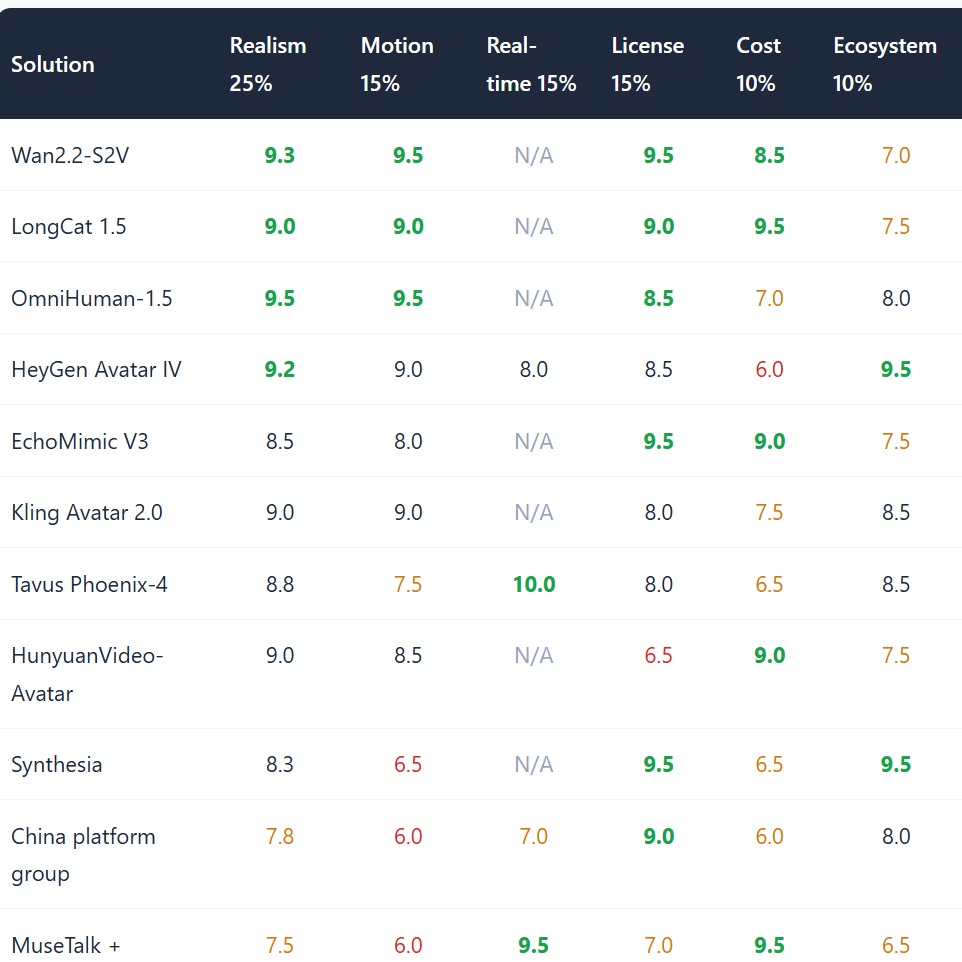
Scoring note: these are not official benchmarks. The basis is this report’s own seven-dimension weighted model (weights re-normalized when the real-time dimension is N/A), with data from model cards/papers, vendor pricing pages, third-party boards such as SOTA2 and EvalTalker, and public 2026 comparisons. Use scores for trend comparison, not as a procurement basis.
6.1 Dimensions & Weights
| Dimension | Weight | What it measures |
|---|---|---|
| Realism | 25% | Visual fidelity, micro-expressions, blind-test “does it look human” |
| Motion expressiveness | 15% | Gestures, body motion, camera work — beyond a moving head |
| Real-time capability | 15% | Conversation latency, full-duplex, stream stability (N/A for pre-render models, weights re-normalized) |
| Licensing | 15% | License type, regional restrictions, consent-mechanism cost |
| Cost | 10% | Normalized per-minute cost and billing traps |
| Ecosystem & usability | 10% | Tooling, tutorials, ComfyUI/API, documentation |
| Scenario coverage | 10% | Framings, duration, multi-person, languages |
6.2 Overall Scoreboard
| # | Solution | Score | Bar | Stars | One-line verdict |
|---|---|---|---|---|---|
| 1 | Wan2.2-S2V / Wan-Animate | 8.9 | ★★★★★ | Cinematic + Apache-2.0 — the open-source ceiling | |
| 2 | LongCat-Video-Avatar 1.5 | 8.8 | ★★★★★ | 15× efficiency + blind-test reversal; #1 production usability | |
| 3 | OmniHuman-1.5 | 8.6 | ★★★★★ | Closed-source performance ceiling; the 30 s cap is its only real flaw | |
| 4 | HeyGen Avatar IV | 8.5 | ★★★★★ | #1 commercial expressiveness; credit opacity is the main deduction | |
| 5 | EchoMimic V3 | 8.4 | ★★★★☆ | Apache-2.0 on consumer GPUs — the small-team first stop | |
| 6 | Kling Avatar 2.0 | 8.4 | ★★★★☆ | Strongest physics simulation, but the blind-test crown has moved | |
| 7 | Tavus Phoenix-4 | 8.2 | ★★★★☆ | Unmatched real-time conversation — billing and concurrency are the price | |
| 8 | HunyuanVideo-Avatar | 8.1 | ★★★★☆ | Only open multi-character dialogue; regional license drags it down | |
| 9 | Synthesia | 8.1 | ★★★★☆ | Compliance-workflow king; expressiveness and real-time are hard flaws | |
| 10 | China enterprise platform group | 7.5 | ★★★★☆ | You buy delivery, not tech: contracts, private deployment, accountability | |
| 11 | MuseTalk + LivePortrait | 7.4 | ★★★☆☆ | The cost floor for real-time — a generation behind in feel |
6.3 Seven-Dimension Detail
| Solution | Realism 25% | Motion 15% | Real-time 15% | License 15% | Cost 10% | Ecosystem 10% | Coverage 10% | Overall |
|---|---|---|---|---|---|---|---|---|
| Wan2.2-S2V | 9.3 | 9.5 | N/A | 9.5 | 8.5 | 7.0 | 8.0 | 8.9 |
| LongCat 1.5 | 9.0 | 9.0 | N/A | 9.0 | 9.5 | 7.5 | 8.0 | 8.8 |
| OmniHuman-1.5 | 9.5 | 9.5 | N/A | 8.5 | 7.0 | 8.0 | 7.5 | 8.6 |
| HeyGen Avatar IV | 9.2 | 9.0 | 8.0 | 8.5 | 6.0 | 9.5 | 8.5 | 8.5 |
| EchoMimic V3 | 8.5 | 8.0 | N/A | 9.5 | 9.0 | 7.5 | 7.5 | 8.4 |
| Kling Avatar 2.0 | 9.0 | 9.0 | N/A | 8.0 | 7.5 | 8.5 | 7.0 | 8.4 |
| Tavus Phoenix-4 | 8.8 | 7.5 | 10.0 | 8.0 | 6.5 | 8.5 | 7.0 | 8.2 |
| HunyuanVideo-Avatar | 9.0 | 8.5 | N/A | 6.5 | 9.0 | 7.5 | 7.5 | 8.1 |
| Synthesia | 8.3 | 6.5 | N/A | 9.5 | 6.5 | 9.5 | 8.0 | 8.1 |
| China platform group | 7.8 | 6.0 | 7.0 | 9.0 | 6.0 | 8.0 | 8.5 | 7.5 |
| MuseTalk + LivePortrait | 7.5 | 6.0 | 9.5 | 7.0 | 9.5 | 6.5 | 5.0 | 7.4 |
The most striking column is Licensing: HunyuanVideo-Avatar’s 6.5 is among the lowest single scores in the table — regional exclusion clauses are outright vetoes for global teams. The spread in Cost (6.0–9.5) shows that billing complexity has become a selection factor on par with visual quality.
6.4 Category Champions
Closed-source performance ceiling; Wan-S2V follows at 9.3 on the open side
Text+audio dual control enables camera work and interaction nobody else offers
<600ms full-duplex — the only commercial solution past the face-to-face feel line
Apache-2.0 with no additional commercial terms — commercial use, fine-tuning, redistribution all clear
15× efficiency dividend pushes per-minute cost to the floor
Web workbench + API + LiveAvatar; non-engineers can use it fully
6.5 Head-to-Head: Four Decisive Match-Ups
① Cinematic feel: Wan2.2-S2V vs OmniHuman-1.5
Winner: Wan2.2-S2V (narrowly). Academic benchmarks (FID 15.66) and the SOTA2 board both edge ahead, with Apache-2.0 self-hosting on top. OmniHuman-1.5 loses on closed weights, the 30 s cap and $8.4/min — but it wins on zero friction: two clicks inside CapCut. Engineering team? Pick Wan. None? Pick OmniHuman.
② Production efficiency: LongCat 1.5 vs HeyGen Avatar IV
Winner: LongCat 1.5. 15× inference efficiency plus a 54.3% blind-test win rate, with no per-minute fees when self-hosted. HeyGen loses on opaque, shifting credit accounting. But HeyGen keeps one irreplaceable case: the team with no GPU, no engineers, and twenty videos due tomorrow.
③ Real-time conversation: Tavus Phoenix-4 vs MuseTalk DIY
Winner: Tavus. 600ms full-duplex vs 0.9–1.5 s simplex; locked likeness vs session drift — an architectural gap no tuning closes. The DIY combo wins on cost and data sovereignty: regulated industries, high volume, in-house ops — often the only option. Buy when feel matters; self-host when data can’t leave.
④ Enterprise procurement: Synthesia vs China platform group
Winner: depends on where you procure. For Western enterprise training, Synthesia’s SCORM/SSO/approvals are irreplaceable; for Chinese government and SOE scenarios, Xiling/Zhiying’s contracts, invoices and private deployment are equally mandatory. Shared weakness: both trail HeyGen and the open top tier on realism — you’re buying process, not faces.
7. Recommendations by Scenario
Marketing / social short video
#1 expressiveness + 177 languages + translation pipeline; OmniHuman-1.5 as the budget-permissive alternative
Enterprise training / compliance
When SCORM + SSO + approval flows are hard requirements; Tencent Zhiying as the China counterpart
Real-time digital employee / support agent
<600ms full-duplex; switch to self-hosted MuseTalk when cost- or data-sensitive
China livestream commerce
Mature live tiers and deep Chinese ecosystem; ShanJian’s unlimited avatars suit matrix accounts
Content factory (hundreds of videos/month)
15× efficiency plus blind-test reversal — scale favors it; EchoMimic V3 as runner-up
Film-grade character performance
Unmatched camera and interaction control; OmniHuman-1.5 when iteration speed matters
Virtual streamer / fixed IP character
Cross-session likeness locking is a hard requirement; DIY combos drift
Healthcare / regulated industries
Data locality is the premise; closed APIs need compliance review first
Individual creators (zero budget)
$0.40/min value or free open source; validate content before upgrading
Multilingual localization matrix
Translation + voice clone + lip-sync in one chain; the avatar is just the final stage
8. Decision Framework
Four Steps to a Decision
1. Ask “does it need to converse?” Real-time interaction → Tavus (experience first) or self-hosted MuseTalk (cost/data first). Finished video only → next step.
2. Ask “do you have an engineering team?” No → HeyGen (marketing), Synthesia (training), or the China platform group (government/SOE). Yes → next step.
3. Compute monthly volume. Under ~30 minutes/month → just use an API. Over ~30,000 minutes/month → self-host Wan2.2-S2V or LongCat 1.5; the GPU bill beats any API.
4. Finally, check the license chain. Going into the EU → HunyuanVideo-Avatar is out (regional exclusion). Using a real person’s likeness → written consent plus AI-disclosure duties (China labeling / EU AI Act Art. 50) on paper first.
One-line decisions: conversation → Tavus; cinematic → self-host Wan; throughput → self-host LongCat; zero-hassle → HeyGen; compliance → Synthesia; invoiced contract → China platforms.
9. Pitfalls and Compliance
| Trap | What happens | Countermeasure |
|---|---|---|
| Credit opacity | HeyGen’s basis moved repeatedly in 2026; identical material cost 2.7× more month-over-month | Pilot with real scripts for a week; write credits-per-minute into the contract |
| Concurrency caps | Real-time platforms quote per-minute but cap sessions (5–20 typical) | First question at negotiation: concurrency; put it in the SLA |
| Regional license exclusions | HunyuanVideo-Avatar excludes EU/UK/KR local deployment plus a revenue gate | Read the weights license, not the code license, for every global project |
| EU AI Act Article 50 | Effective 2026-08-02: interactive systems must disclose AI identity; synthetic content labeled at first exposure | Design disclosure into the experience, not a footer |
| China deep-synthesis labeling | Explicit/implicit labeling duties with platform-level enforcement actions | Use platform labeling features; embed watermarks/metadata in self-built pipelines |
| Clone authorization | HeyGen requires live-recorded consent; using someone else’s likeness is high-risk | Only clone with written authorization — celebrities and employees alike |
| Vendor collapse | Soul Machines entered voluntary receivership in Feb 2026; existing customers scrambled | Export assets and scripts regularly; keep an open-source fallback for critical workflows |
| Leaderboard mirage | Vendors grade themselves on favorable battlefields (see 4.3) | Run your own ten-clip blind test — two hours of cost for selection certainty |
10. Key Findings
- Open source beat commercial systems in a blind test for the first time. LongCat-Video-Avatar 1.5’s win rates over Kling, OmniHuman and HeyGen all cleared 50%, at 15× the efficiency. The “default to commercial APIs” assumption is now shaky — teams with engineering capacity should re-evaluate self-hosting.
- Real-time and pre-render are non-interchangeable tracks. Tavus’s 600ms full-duplex is architecture, not tuning; Synthesia’s SCORM workflow isn’t something an open model plus a script replaces either. Route first, model second.
- Billing transparency is itself product. HeyGen’s shifting credits, Synthesia’s annual minute pools, Tavus’s concurrency caps — in 2026, solutions whose pricing pages let you compute cost-per-minute directly (Hedra, Vidnoz, ShanJian) earn outsized goodwill.
- Compliance costs are rising fast. EU AI Act Art. 50 is in force, China’s labeling duties intensified, clone-consent flows are mandatory. True avatar cost = model cost + authorization chain — and the second term is often larger.
- Chinese teams hold both the open frontier and enterprise delivery. The open-weights leaderboard top five are all Chinese labs (Alibaba/Meituan/Tencent/Ant/ByteDance), while the enterprise-delivery market is equally dominated domestically — the “global commercial product” layer in between is where US/UK players compete.
- The realism arms race is being displaced by production usability. LongCat’s strategy — don’t chase single-frame quality, chase efficiency and stability — proved out in blind testing. Users tolerate “3× pricier but prettier” far less than they punish “0.8% frame jumps.”
- The avatar is not the product; it’s the last stage of a pipeline. Translation → voice cloning → lip-sync → avatar presentation. Full-chain solutions (DeepVideo-class tools feeding avatar APIs) are displacing single-point tools.
Before the avatar speaks, the voice and lips must match
The avatar is the final stage of the pipeline — upstream is translation and voice cloning. DeepVideo uses Voice Clone so translated videos still sound like the original speaker — 30+ languages, processed locally, never uploaded to the cloud, slotting straight into your avatar pipeline.
Try DeepVideo Free →
Realistic AI Video Dubbing at Just $0.17/minHigh quality · Low price · Local client · Security
Free tier: 18 minutes total + 2 minutes daily · Local processing, no cloud upload
DeepForgeHub Research · Global Digital Human Model Comparison (2026) · Data as of Sep 2026 · deepforgehub.com