
Global Voice Library Comparison Report (2026)
TL;DR
- “Voice library” is now three entirely different businesses: pre-built voice galleries from cloud vendors (Azure 500+, Google 1,000+), royalty-bearing voice marketplaces (ElevenLabs Voice Library has paid creators $22M), and open-source zero-shot cloning (any reference audio becomes your library). Pick the form first, then the vendor.
- The top overall score goes to open-source CosyVoice 3 (8.96) — not because it sounds best, but because Apache-2.0 licensing + 3-second cloning + 150ms first packet + zero per-call cost max out four dimensions at once. ElevenLabs is the runaway quality leader (9.5) yet ranks only 7th, losing on cost and cloud lock-in.
- The licensing chain is the hazard unique to voice libraries: model-weight licenses (XTTS CPML, Fish S2 NC), voice-source consent (the estate-licensing controversy in ElevenLabs’ Iconic Marketplace), and destination regulation (China’s deep-synthesis labeling duty, US state laws) stack in three layers. Choosing a voice library is essentially choosing a licensing chain.
- For Chinese dubbing, Volcano Engine’s Doubao voice library leads (200+ voices, 5-second cloning at 97.5% similarity, ¥1.3/1k chars); premium replicated voices at ¥30k–80k each are the proper route to a brand voice. On a budget: Alibaba Cloud (¥0.8/10k chars) or open-source CosyVoice.
1. First, Decide: Which Kind of “Voice Library” Do You Need?
By 2026 the voice-library market has split into three forms; comparing them as one category leads to wrong conclusions:
| Form | Representatives | Essence | Best for | Core risk |
|---|---|---|---|---|
| ① Pre-built voice gallery | Azure, Google, Polly, iFlytek, Alibaba Cloud | A fixed list of vendor-recorded/synthesized voices; pick one and use it | Stable use cases: support, IVR, announcements | Passive voices; expressiveness capped by SSML |
| ② Voice marketplace | ElevenLabs Voice Library / Iconic Marketplace | Consented human clones uploaded by creators, earning per-generation royalties | Content that needs “human” texture and stylistic variety | Complex licensing chain; estate-voice controversies |
| ③ Open-source zero-shot cloning | CosyVoice, Chatterbox, GPT-SoVITS, XTTS | The model itself is the infinite library — seconds of reference audio yield any voice | Bulk dubbing, localization, data that can’t leave premises | Patchwork weight licenses; reference-audio legality is on you |
Form ① buys certainty, form ② buys variety + licensing, form ③ buys infinity + control. The three tables below cover each.
2. Commercial Voice Libraries Overview (13)
| Platform | Voices | Languages | Cloning bar | Pricing | Licensing highlights |
|---|---|---|---|---|---|
| ElevenLabs Voice Library | 3,000+ (marketplace) | 70+ (v3) | 30 s instant / 30 min professional | $5–330/mo + usage | Marketplace voices ship a free commercial license; Iconic celebrity voices licensed per project |
| Azure Neural Voice | 500+ across 140 locales | 140+ | Custom Neural Voice: 30-min recording + human review | $16/1M chars | Only hyperscaler library with on-prem container deployment |
| Google Cloud TTS | 380+ official (1,000+ cumulative) | 75+ | Custom voice from $3,000 + hours of audio | $4–30/1M chars | Five quality tiers to trade cost vs quality |
| Volcano Engine · Doubao | 200+ official voices | Chinese-first + multilingual | 5-second cloning (97.5% similarity) | ¥1.3/1k chars; voice slots ¥138–28/voice/yr | Premium replicated voices ¥30k–80k each, contract-based licensing |
| MiniMax Audio | 20+ preset + cloning | 15+ | 1-minute cloning | ~$8/1M chars | Best-value Chinese cloning API |
| Amazon Polly | 100+ (31 Generative) | 40+ | No cloning | $4–16/1M chars | Free tier 5M chars/mo for first 12 months |
| OpenAI TTS | 13 voices | 50+ | No cloning | ~$15/1M chars | Minimal API, same key as the rest of the stack |
| Cartesia Sonic | Cloning-centric | 40+ | 3-second instant cloning, unlimited | Enterprise contact | 90ms time-to-first-audio, GDPR, 99.9% SLA |
| Deepgram Aura | 40+ EN / 10+ ES | 7 | No cloning | $27–30/1M chars | Lowest-latency tier for realtime voice agents |
| iFlytek Open Platform | 150+ | Chinese-first | Voice replication requires enterprise KYC + consent letter | ¥2/10k chars; 500 free calls/day | Veteran Chinese vendor with mature compliance paperwork |
| Alibaba Cloud TTS | 200+ | Chinese + multilingual | CosyVoice API cloning from 3 s | ¥0.8/10k chars | Cloud edition of the open-source CosyVoice line |
| Baidu Smart Cloud | 100+ | Chinese-first | Premium custom voices | ¥1.2/10k chars; 5M free chars/mo | Largest free tier among Chinese hyperscalers |
| Fish Audio platform | Community voice market | 80+ | 10–30 s cloning | Usage-based API | S2 weights partially open (NC research license) |
3. Open-Source “Infinite Voice Library” Overview (18)
The open-source logic is entirely different: the model IS the library, and the reference audio decides the voice. The weight license (not the code license) decides commercial viability — that is the most load-bearing column in this table.
| Model | Cloning | Languages | VRAM | Weight license | One-line positioning |
|---|---|---|---|---|---|
| CosyVoice 2 / 3 (Alibaba) | 3 s zero-shot | ZH/EN/JA/KR + 18 dialects | ~6GB | Apache-2.0 | Open-source Chinese champion; 150ms streaming first packet |
| Chatterbox Multilingual v3 (Resemble AI) | ~5 s zero-shot | 23–25 | ~4–6GB | MIT (watermark built in) | Cleanest-licensed high-quality cloning |
| Qwen3-TTS | CustomVoice fine-tune | 10+ | ~4GB (0.6B) | Apache-2.0 | The default TTS in HF speech pipelines; three flavors |
| GPT-SoVITS | 1-min few-shot, top similarity | ZH/JA/EN/KR | ~8GB | MIT | The largest user-trained voice ecosystem |
| Fish Speech / OpenAudio S1-mini | 10–30 s | 80+ | ~4–6GB | Apache code / CC-BY-NC-SA weights | TTS Arena leader in quality; weights non-commercial |
| XTTS-v2 (idiap fork) | 6 s / 17 languages | 17 | ~4–6GB | CPML (non-commercial) | Company dead since 2024; community-maintained multilingual cloning |
| F5-TTS (SJTU) | Seconds, zero-shot | ZH/EN | ~4–8GB | MIT code / CC-BY-NC weights | Research-grade flow-matching cloning; elegant architecture |
| OpenVoice V2 (MyShell) | Instant cloning + style control | Multi | ~4GB | MIT | Post-clone “director-level” emotion and accent control |
| Kokoro-82M | No (54 preset voices) | 8–9 | CPU / 2–3GB | Apache-2.0 | The smallest preset gallery; realtime on CPU |
| Piper | No | Dozens | <1GB, Raspberry Pi | Active fork GPL-3.0 | 900+ English voices for offline embedded use |
| MeloTTS | No | 6 | CPU | MIT | CPU realtime with multi-accent English |
| MegaTTS 3 (ByteDance) | Zero-shot | ZH/EN | ~4GB | Apache-2.0 | Top cloning fidelity from a 450M model |
| Orpheus 3B | Zero-shot + emotion tags | 4+ | ~8–12GB | Apache-2.0 | Expressive realtime speech on a Llama backbone |
| IndexTTS-2 (Bilibili) | Zero-shot + precise duration/emotion | ZH/EN | ~8GB+ | Custom license (commercial grant required) | The only cloning that natively hits exact durations |
| ChatTTS | No (voice roulette) | ZH/EN | ~4GB | AGPL + CC-BY-NC | Best conversational prosody; non-commercial |
| Zonos / Zonos2 | Zero-shot, high fidelity | 8 | ~8GB+ | Apache-2.0 | Zonos2 is a low-latency 8B MoE |
| MOSS-TTS family (OpenMOSS) | Zero-shot | 20+ | Nano runs on CPU | Apache-2.0 | Fast-moving newcomer with a dense 2026 release cadence |
| RVC ecosystem | Voice conversion (not TTS) | — | ~4GB | MIT (community models vary) | Keeps the performance, swaps the timbre — AI-cover king |
4. Ten Key Libraries, Reviewed
ElevenLabs Voice Library Commercial ceiling 8.32
The first platform to turn voice into a royalty-bearing digital asset: voice actors upload professional clones, set their own terms and price tiers, and get paid every time another user generates with them — with a free commercial license attached for the customer. In March 2026 it launched the Iconic Voice Marketplace, licensing 25+ well-known voices including Michael Caine under a consent-compensation-credit model. English expressiveness remains the runaway best in class (9.8/10 in community listening tests).
- Quality and emotional range lead every commercial library by a wide margin
- Marketplace voices include a free commercial license; stylistic variety is unmatched
- Instant cloning from 30 s; Starter tier at $5/mo is enough to start
- Transparent licensing chain: creators set use cases, with revocation (notice period up to 2 years)
- Highest cost tier: long-form bills easily exceed $300/mo
- Cloud only; occasional timeouts at peak load
- Iconic Marketplace estate voices (Judy Garland etc.) raise consent questions
- Clone fidelity depends on reference quality; Chinese trails English
Volcano Engine · Doubao Voice Library Chinese-first 8.34
Doubao Speech 2.0 posts the best Chinese naturalness in community tests (9.2/10) and controls emotion via natural-language instructions (“urgent and trembling”). Voice slots price on a ladder (138 RMB/voice under 50, down to 28 RMB at 10k scale), while brand-grade needs go through the ¥30k–80k premium replication track — the most formal “voice as brand asset” path in China.
- Best Chinese naturalness and instruction-based emotion control in China
- 5-second cloning at 97.5% similarity, consistent in practice
- Contract-based licensing: premium replication comes with clean paperwork
- WebSocket streaming + full SSML at China-direct low latency
- Voice slots billed yearly; noticeable cost for small projects
- Premium replication starts at ¥30k with no self-serve delivery
- Multilingual coverage trails ElevenLabs / Google
- Voices lock after first synthesis — validate before going live
Azure Neural Voice Gallery Enterprise compliance 8.45
The broadest language coverage among hyperscalers, with the most complete SSML expressiveness (styles, role-play, whispering). The core differentiator is container deployment — regulated industries can move the entire voice library into their own datacenter. CNV cloning demands 30 minutes of audio plus human review and registered use cases: cumbersome, but the licensing chain is therefore the cleanest.
- Widest locale coverage globally; long-tail languages exist only here
- Container on-prem is the only answer for strict compliance scenarios
- Strongest SSML style control (cheerful/whispering/role-play)
- Enterprise SLA / GDPR / SOC 2 / HIPAA eligible
- High cloning bar: 30 min of audio + approval + restricted use cases
- Console and billing structure are complex
- Naturalness varies noticeably across languages
- No marketplace form; variety depends on official releases
Google Cloud TTS Voice Gallery Catalog king 8.01
The largest official preset gallery, with five model tiers (Standard/WaveNet/Neural2/Studio/Chirp 3 HD) letting you match cost to scenario. WaveNet reads batch documents at under $0.30 per hour of audio — the cheapest batch price of any commercial library. But custom voices start at $3,000 and require hours of material; cloning is effectively absent.
- The richest combination of preset voices and languages
- Five tiers squeeze batch costs down dramatically
- Best stability and lowest error rates at hyperscale
- Smooth GCP ecosystem integration
- Cloning essentially absent ($3,000 + hours of audio)
- Studio tier at $30/1M chars is pricey
- Expressiveness trails ElevenLabs / Doubao overall
- Assumes GCP familiarity
Fish Audio (S2 / Open Platform) Quality champion 7.66
TTS Arena’s quality leader with 80+ languages. S2 weights opened in March 2026 under a research license — commercial use requires a separate agreement. The community voice market is the closest thing open source has to the ElevenLabs model.
- Open-source quality ceiling; TTS Arena leader
- 80+ languages, the widest cross-lingual dubbing coverage
- Rich emotion tags; ready-made community voices to pick from
- S1-mini (0.5B) runs locally
- NC weight license — commercial local use requires buying a grant
- Community voices carry uneven source licensing
- API stability trails the big three clouds
- Free-tier promos (e.g. “free S2.1 Pro”) are time-boxed
CosyVoice 3 (Alibaba) Overall #1 8.96
It tops the overall score for a simple reason: no weak dimension, while licensing, cost, cloning and latency all sit near perfect scores simultaneously. It leads open-source Chinese (with dialect coverage nobody else has), ships 14 fine-grained control tags ([laughter], [breath]…), and clones from 3 seconds of audio. Alibaba Cloud’s commercial API shares lineage with the open model — the “prototype open, produce on cloud” path has zero migration cost.
- Apache-2.0 across the whole chain — zero licensing friction
- 3-second cloning + 150ms first packet; viable for realtime
- Chinese + dialect coverage unique in open source
- Dual open/cloud forms with frictionless migration
- English emotional nuance trails ElevenLabs / Chatterbox
- Self-hosting still needs GPUs and ops capability
- No marketplace form; variety depends on your own reference audio
Chatterbox Multilingual v3 (Resemble AI) Cleanest commercial license 8.71
The June 2026 v3 release expanded to 25 languages with both code and weights under MIT. Resemble’s own blind study claims 65% of listeners preferred it over ElevenLabs (vendor data — discount accordingly). Every output embeds a PerTh watermark by default, claimed to survive transcoding — a plus, not a minus, for teams worried about deepfake provenance.
- MIT for both code and weights — zero commercial friction
- Adjustable clone expressiveness (exaggeration parameter)
- Built-in watermarking; friendly to compliance audits
- Strong blind-test reputation (vendor-run, caveat noted)
- Chinese performance is average; fewer languages than Fish / CosyVoice
- No preset “gallery” — everything rides on reference audio
- Default watermarking needs evaluation in some pipelines
Qwen3-TTS (Alibaba Tongyi) Ecosystem default 8.70
Its three flavors map exactly to the three uses of a voice library: Base for direct use, CustomVoice to fine-tune your own voices, and VoiceDesign to “design” a voice that never existed from a text description. It is now the default component in Hugging Face’s speech pipeline, making the surrounding toolchain the easiest to live with.
- Apache-2.0 + small footprint = low deployment bar
- VoiceDesign (text-to-voice) is a unique capability
- Default HF slot; best toolchain compatibility
- Clone fidelity trails CosyVoice / GPT-SoVITS
- Modest language coverage
- Expressiveness is middle-of-the-road
GPT-SoVITS Community library king 8.50
Strictly speaking GPT-SoVITS is not “a model” — it is the world’s largest user-trained voice ecosystem: 1-minute fine-tuning, one-click packages, and hundreds of thousands of community-trained Chinese voice models. If you need “one specific person’s voice,” it probably already exists here — just verify consent before using someone else’s.
- 1 minute of audio yields the highest open-source clone similarity
- MIT license + enormous community voice resources
- All-in-one packages and WebUI make it extremely approachable
- Few-shot fine-tuning takes training time; not instant
- Community voices carry murky licensing — audit before commercial use
- Long-form stability is mediocre; needs sentence-splitting strategy
XTTS-v2 (idiap fork) Multilingual legacy 7.29
Six-second cloning across 17 languages was once the open-source multilingual default. But with Coqui gone there is no official maintenance, CPML forbids commercial use, and 24kHz quality has been lapped by the 2025–2026 generation. It is listed here mainly as a warning: it still appears in old tutorials, but it is not the 2026 answer.
- 17-language cross-lingual cloning still works
- Community forks keep patching
- Largest stock of tutorials and tooling
- CPML forbids commercial use — a hard blocker
- Quality a full generation behind current models
- No official maintenance; security and dependency risk is yours
5. Comparison Matrices
5.1 Capability Matrix: Cloning / Languages / Deployment
| Platform / Model | Instant cloning | Few-shot fine-tune | Voice marketplace | On-prem | Preset gallery |
|---|---|---|---|---|---|
| ElevenLabs | ✓ 30 s | ✓ Pro tier | ✓ 3,000+ | ✗ | ✓ |
| Volcano Doubao | ✓ 5 s | ✓ Premium replication | ✗ | ✗ | ✓ 200+ |
| Azure | ✗ | ✓ 30 min | ✗ | ✓ Containers | ✓ 500+ |
| ✗ | △ $3,000 | ✗ | ✗ | ✓ Largest | |
| Cartesia | ✓ 3 s | ✓ 30 min | ✗ | △ | ✗ |
| CosyVoice 3 | ✓ 3 s | ✓ | ✗ | ✓ Local | △ BYO |
| Chatterbox v3 | ✓ 5 s | ✗ | ✗ | ✓ Local | ✗ |
| GPT-SoVITS | △ Needs training | ✓ 1 min | △ Community-trained | ✓ Local | △ Community |
| Fish Audio | ✓ 10 s | ✓ | ✓ Community | △ S1-mini | ✓ |
| Kokoro / Piper | ✗ | ✗ | ✗ | ✓ CPU | ✓ 54 / 900+ |
5.2 Price Normalization: Cost per 1M Characters
| Option | Cost / 1M chars | Fixed fees | Notes |
|---|---|---|---|
| CosyVoice 3 self-hosted | ≈ 0 (electricity) | One-time GPU outlay | An RTX 4090 yields tens of audio-hours per day |
| Alibaba Cloud TTS | ≈ $11 | None | Lowest commercial API tier in China |
| MiniMax | ~$8 | None | Cloning included |
| Baidu Smart Cloud | ≈ $17 | None | 5M free chars/mo |
| Google WaveNet | $16 | None | Best for batch document reading |
| Azure Neural | $16 | None | Down to $9.75 at volume |
| Volcano Doubao | ≈ $18 | Slots ¥28–138/voice/yr | Premium replication extra (from ¥30k) |
| ElevenLabs Pro | ~$99–300 | Subscription | Quality premium; highest long-form cost |
5.3 Field Data: Chinese Naturalness & Clone Similarity
| Option | Chinese naturalness (subjective field test) | Clone similarity | First-packet latency |
|---|---|---|---|
| Volcano Doubao 2.0 | 9.2 / 10 | 97.5% (vendor figure, 5 s) | <300ms |
| ElevenLabs v3 | 8.8 / 10 | High (30 s instant) | ~75ms (Flash tier) |
| CosyVoice 3 | ~9.0 | High (3 s) | ~150ms |
| ChatTTS | 4.5/5 MOS (dialogue) | Not supported | Medium |
| Azure (Chinese voices) | 8.5 / 10 | 30-min fine-tune | ~120ms (China node) |
| Alibaba Cloud API | ~8.5 (MOS 4.0–4.3) | 3 s (CosyVoice lineage) | <300ms |
Note: naturalness figures blend Chinese developer-community field tests (Apr–Jul 2026, 10-point scale) with public MOS scores, for relative comparison only. Clone similarity figures are vendor-reported; real results depend on reference audio quality.
6. Scoring & Head-to-Head Evaluation
6.1 Dimensions and Weights
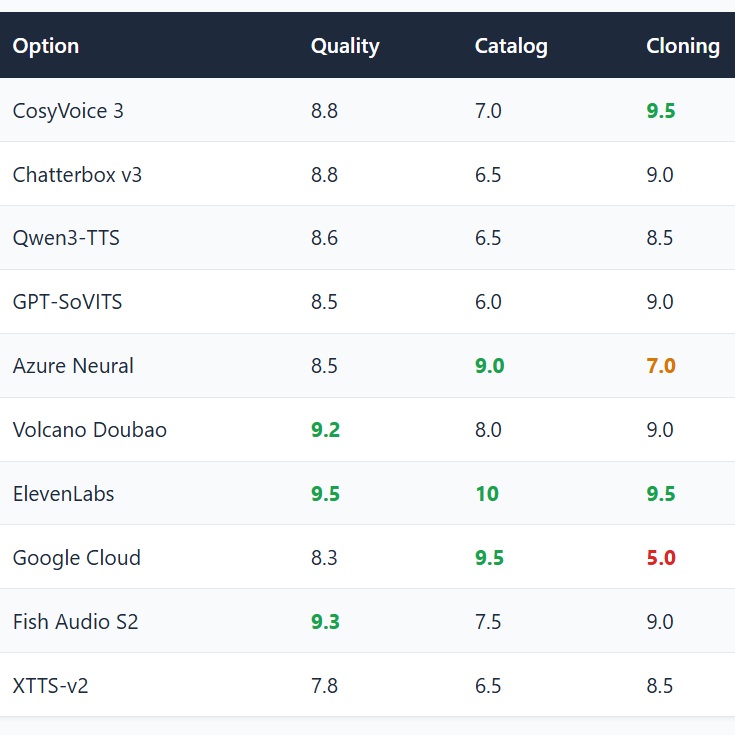
Seven dimensions tailored to the voice-library category (10-point weighted): Voice quality 20% (naturalness/expressiveness), Catalog breadth 15% (preset count and style coverage), Cloning bar 15% (material required and similarity), Licensing compliance 15% (weight licenses / voice-source consent / contract maturity), Cost 15% (normalized price plus fixed fees), Ecosystem & usability 10% (tooling/docs/community), Deployment flexibility 10% (local/CPU/edge). Scores are this report’s synthesis of public materials and community benchmarks — not official benchmarks.
6.2 Overall Scoreboard
One-liners — CosyVoice: the all-rounder with licensing/cost/cloning maxed; Chatterbox: the most friction-free MIT license; Qwen3: the ecosystem default; Azure: the only enterprise-compliance play; Doubao: the best Chinese quality-licensing balance; ElevenLabs: the quality ceiling with a cost premium; Fish S2: best sound, dragged down by licensing; XTTS: a legacy kept for compatibility only.
6.3 Seven-Dimension Breakdown
| Option | Quality | Catalog | Cloning | Licensing | Cost | Ecosystem | Deployment |
|---|---|---|---|---|---|---|---|
| CosyVoice 3 | 8.8 | 7.0 | 9.5 | 10 | 9.5 | 8.5 | 9.5 |
| Chatterbox v3 | 8.8 | 6.5 | 9.0 | 10 | 9.5 | 8.0 | 9.0 |
| Qwen3-TTS | 8.6 | 6.5 | 8.5 | 10 | 9.5 | 9.0 | 9.0 |
| GPT-SoVITS | 8.5 | 6.0 | 9.0 | 9.5 | 9.5 | 8.5 | 8.5 |
| Azure Neural | 8.5 | 9.0 | 7.0 | 9.5 | 7.5 | 9.0 | 9.0 |
| Volcano Doubao | 9.2 | 8.0 | 9.0 | 9.0 | 7.0 | 8.5 | 7.0 |
| ElevenLabs | 9.5 | 10 | 9.5 | 8.0 | 5.0 | 9.5 | 6.0 |
| Google Cloud | 8.3 | 9.5 | 5.0 | 9.5 | 7.0 | 9.0 | 8.0 |
| Fish Audio S2 | 9.3 | 7.5 | 9.0 | 5.0 | 7.5 | 8.0 | 6.5 |
| XTTS-v2 | 7.8 | 6.5 | 8.5 | 3.0 | 9.5 | 7.5 | 8.5 |
6.4 Category Champions
6.5 Head-to-Head Verdicts
Duel 1: Marketplace voices vs self-cloning
Marketplaces win on human texture and licensing: ElevenLabs marketplace voices are recorded by professional actors, come in every style, and ship a commercial license. But generic voices (“clear English narrator”) compete with a thousand near-identical listings, and free-tier usage triggers no royalty. Self-cloning wins on exclusivity — with the reference-audio legal risk entirely on you. Verdict: brand voices go premium-replication/professional-cloning; generic narration goes to the marketplace.
Duel 2: CosyVoice 3 vs Chatterbox v3 (open-source rivals)
CosyVoice wins Chinese and dialects (18 dialects, nobody else has them); Chatterbox balances multilingual work better (25 languages + watermarking). Both license at a perfect 10. If your content is Chinese-only there is no reason not to pick CosyVoice; for Western multilingual work, Chatterbox’s expressiveness dial is friendlier.
Duel 3: Doubao vs ElevenLabs (for Chinese)
Doubao wins Chinese dubbing: naturalness 9.2 vs 8.8, ¥1.3 vs ~¥2.1 per 1k chars, China-direct with no proxy. ElevenLabs fights back on multilingual breadth and marketplace variety. For Chinese-first localization, the Doubao + CosyVoice pairing covers essentially everything.
Duel 4: Fish S2 quality vs its weight license
S2 is the best-sounding open model and the TTS Arena leader, but CC-BY-NC-SA weights mean commercial local deployment requires buying a grant — not a money problem, a compliance-chain problem. Verdict: use S2 freely for research and prototypes; for shipped products either go through the Fish Audio API or fall back to CosyVoice/Chatterbox.
7. Recommendations by Scenario
Short video / commentary (Chinese)
First choice: Volcano Doubao (¥1.3/1k chars, instruction-based emotion). Backup: Moyin Gongfang (the commentary-scene staple), open-source CosyVoice.
Multilingual video localization
First choice: ElevenLabs (marketplace voices in 70+ languages, pre-licensed). Backup: Fish Audio API (80+ languages), self-hosted Chatterbox.
Brand voice
First choice: Volcano premium replication (¥30k–80k, contract-based). Backup: Azure CNV (30-min recording + review, the safest compliance posture).
Support bots / IVR
First choice: Azure (full locales + private containers). Backup: Google WaveNet (lowest batch cost); Alibaba Cloud in China.
Realtime voice agents
First choice: Cartesia Sonic (90ms first audio + 3 s cloning). Backup: ElevenLabs Flash (75ms), CosyVoice streaming.
Audiobooks / long-form
First choice: ElevenLabs (curated narration voices). Budget: self-hosted CosyVoice at electricity-level cost.
Local / privacy-first
First choice: CosyVoice 3 (cloning + streaming in one). No GPU: Kokoro-82M (54 CPU voices), Piper (Raspberry Pi).
AI covers / voice swapping
First choice: the RVC ecosystem (keeps the performance, swaps the timbre; 10–20 min of audio trains a model). Mind celebrity-voice licensing.
Game character voices
First choice: ElevenLabs marketplace filtered by character archetype. Backup: Qwen3 VoiceDesign to “design” fictional voices from text.
8. Decision Framework
The 90-Second Selection Path
1. Commercial product? → filter out NC-weight models first (XTTS, F5-TTS, Fish S1-mini, ChatTTS, IndexTTS-2). Safe zone: CosyVoice, Chatterbox, Qwen3-TTS, GPT-SoVITS, Kokoro, MegaTTS 3.
2. Want ready-made “human” voices? → ElevenLabs Voice Library (English/multilingual) or the Doubao library (Chinese). Celebrity voices → Iconic Marketplace, verifying approved use cases case by case.
3. Want a brand-owned voice? → Volcano premium replication or Azure CNV on a budget; GPT-SoVITS 1-minute fine-tuning on a small one.
4. Data can’t leave the premises? → Azure containers (enterprise) or self-hosted CosyVoice (flexible).
5. Extreme cost focus? → above ~30 audio-hours/month, self-hosted open source wins outright; below that just use an API — don’t feed a GPU.
6. Whose voice is the reference audio? → written consent at every link of the chain. This one outranks all five above.
9. Pitfalls and Compliance
| Risk | How it shows up | Mitigation |
|---|---|---|
| Weight-license misreading | MIT code but NC weights (F5-TTS), CPML (XTTS), NC-SA (Fish S1-mini) | Always check the “weights” layer, not just the GitHub repo license |
| Voice-source consent | Community-market voices / GPT-SoVITS user models may come from unconsented recordings; Iconic estate voices are licensed by third parties | Commercially use only traceably licensed voices; cloning a real person requires their written consent |
| China deep-synthesis duties | Deep-synthesis rules: prominent labeling + filing; cloning someone’s voice needs separate consent | Complete labeling and filing before launch; keep consent records |
| US state laws | Some states treat voice as biometric (e.g. Illinois BIPA litigation risk); NY now regulates digital replicas | Check state-by-state before US release; note ElevenLabs’ royalty program already excludes Illinois residents |
| Vendor-polished figures | Clone similarity (97.5%) and blind-test win rates (65%) are vendor-run numbers | Test with 10 real scripts in your target language before committing |
| Voice-slot traps | Doubao voices lock after first synthesis; preview voices are deleted after 7 idle days | Validate before final synthesis; plan slot orders in batches |
10. Key Findings
- 1. Voice-library competition has shifted from voice count to the licensing chain. ElevenLabs built the fullest licensing economy with $22M in royalties and the Iconic Marketplace; Azure trades convenience for compliance via review gates; the open-source camp sidesteps licensing talks entirely with Apache/MIT. Three routes, three risk appetites.
- 2. Open source overtaking commercial libraries on overall score is a genuinely new 2026 landscape. Three of the top four are open source (CosyVoice, Chatterbox, Qwen3-TTS). Once the cloning bar drops to 3 seconds and the license to Apache, a voice library’s moat shrinks to sound quality and licensing services.
- 3. ElevenLabs’ price premium buys optionality, not a quality ceiling. The commercial license and revocation mechanism attached to marketplace voices deliver a certainty self-cloning can never offer — that is the part of the premium that is actually justified.
- 4. Chinese is a battlefield of its own. The Doubao library (9.2 naturalness) + CosyVoice (dialects + open source) + Moyin Gongfang (creator ecosystem) stack means the global optimum for Chinese dubbing cost and quality sits with Chinese vendors.
- 5. The compliance cost of “3-second cloning” far exceeds its technical cost. Technically, one voice message clones anyone; legally (China’s deep-synthesis rules, US state laws), cloning without consent carries damages and takedown risk that can erase a project’s entire margin. Half of voice-library selection is licensing due diligence.
- 6. The cost crossover sits at roughly 30 audio-hours per month. Below it, APIs (Alibaba Cloud at ¥0.8/10k chars is the floor) win on total cost; above it, self-hosted open source (GPU depreciation + electricity) pulls away — with data sovereignty thrown in for free.
Voices matched — now keep them matched across languages
Dubbing’s second half is preserving the voice after translation. DeepVideo uses Voice Clone so translated videos still sound like the original speaker — 30+ languages, processed locally, never uploaded to the cloud.
Try DeepVideo Free →
Realistic AI Video Dubbing at Just $0.17/minHigh quality · Low price · Local client · Security
Free tier: 18 minutes total + 2 minutes daily · Local processing, no cloud upload
DeepForgeHub Research · Global Voice Library Comparison Report (2026) · Data as of Sep 2026 · deepforgehub.com