
Traditional Talking-Head Models vs Text-to-Video Models
For Digital Human Generation · A Global Two-Roadmap Comparison — September 2026
Lip Sync · Identity Consistency · Controllability · Motion Freedom · Cost · Licensing
Executive Summary
“AI-generated digital humans” today split into two very different technical roadmaps: traditional talking-head models (audio/pose-driven pipelines purpose-built for talking faces — SadTalker, MuseTalk, LivePortrait, Hallo3, OmniHuman, HeyGen Avatar IV) and text-to-video models (T2V giants that “paint” people as one element among many — Veo 3.1, Kling 3.0, Sora 2, Seedance 2.0, Wan 2.2, HunyuanVideo 1.5). The first locks a known face and dubs it; the second invents a moving person from scratch. This report compares 15+ representative models worldwide, dimension by dimension, specifically for the digital-human task.
The one-sentence conclusion: for the “talking digital human” task, traditional driven models still win across the board — controllable lip sync, locked identity, budgetable cost, real-time capability. T2V models win on motion, camera language, and scene freedom — they are not better digital-human tools, they are better cinematic-shot generators. The defining 2026 trend is convergence: hybrid architectures (OmniHuman, Wan2.2-S2V, Hallo3) graft T2V-grade image quality and motion freedom onto the traditional roadmap’s lip sync and identity control.
Key findings:
- Lip sync is the traditional roadmap’s moat. Purpose-built models like Wav2Lip and Sync 1.9 remain unbeaten at strict frame alignment. Even when T2V models support audio (e.g., Veo 3.1’s native dialogue), lip movement is only usable on a lucky first roll — it cannot be refined against an existing audio track or reused in batch.
- Identity consistency is the business baseline. The digital-human business is “the same face, over and over.” Traditional pipelines lock the face at input; T2V characters drift across shots (face shape, features, wardrobe) — still the #1 quality-incident source. HeyGen’s and Synthesia’s premium pricing is, at heart, a fee for “identity that never drifts.”
- Cost structures differ — never compare sticker prices directly. Self-hosted open traditional models cost little more than electricity; HeyGen works out to roughly $0.97–2.90/min and Synthesia $1.40–2.97/min; T2V APIs bill per second in 5–10s clips, so stitching one minute of talking-head footage means multiple generations and re-rolls — real per-minute cost often exceeds dedicated platforms and is hard to predict.
- Real-time and livestreaming: only the traditional roadmap can do it. MuseTalk at 30fps+, LivePortrait near-real-time, HeyGen LiveAvatar, Tavus conversational avatars — diffusion-based T2V cannot respond frame-by-frame in real time under current architectures.
- The open-weights frontier is in Chinese labs’ hands. Wan 2.2 (Apache-2.0), HunyuanVideo 1.5, EchoMimic V3, MultiTalk, Hallo3 — on the HumanScore human-motion benchmark, open-source HunyuanVideo 1.5 ties proprietary leader Seedance at 91.1. “Open = behind” no longer holds.
1. First, the Fundamentals: What Actually Differs
Both roadmaps output “a person talking on video,” but inputs, mechanics, and failure modes differ completely. Step one of any selection is figuring out which box you’re in.
| Dimension | Traditional Digital Human (Audio/Pose-Driven) | Text-to-Video (T2V) |
|---|---|---|
| Input | One reference photo / one source clip + audio (or pose sequence) | A text prompt (optionally reference images — the face is still “generated”) |
| Mechanism | Facial landmarks / 3DMM / audio features → drive a fixed identity’s face region (mouth sync, expressions) | Text → a diffusion model “paints” the whole clip in spacetime latent space; the human is just one part of the frame |
| Identity | Locked by input, unchanged throughout | Generative; drifts across shots and reruns |
| Lip control | Frame-accurate phoneme alignment; re-run on any new track | Some models generate dialogue audio, but no refinement pass |
| Motion & camera | Mostly upper-body close-ups, fixed camera, small motion | Full body, camera moves, scenes, multi-character — film-grade freedom |
| Failure modes | Profile/large-angle collapse, stiff “wax-figure” feel, upper body only | Broken hands/limbs, character drift, off-sync lips, physics glitches |
| Typical use | Talking-head marketing, corporate training, VTubing, localization | Ad films, narrative shorts, character shots that need environment and camera work |
A common selection mistake: using a T2V model directly for “talking-head presenter” videos — every clip’s “presenter” looks slightly different, and lips may not match the audio. The reverse mistake: asking a traditional model for “a presenter walking on a snowy ridge” — feed it one frontal photo and you will always get a fixed-camera upper-body shot. The two roadmaps solve different sides of the same task.
2. The Traditional Camp: Global Representative Solutions
Driven digital humans have gone through three generations: early 2D keypoint drivers (Wav2Lip, MakeItTalk, SadTalker) → real-time high-fidelity drivers (MuseTalk, LivePortrait, LatentSync) → diffusion-backbone hybrids (Hallo3, EchoMimic V3, MultiTalk, OmniHuman, Wan2.2-S2V). Commercial platforms wrap this pipeline into products (HeyGen, Synthesia, D-ID).
2.1 Camp Overview
| Solution | Org | Method | Real-time | License | Access |
|---|---|---|---|---|---|
| SadTalker | OpenTalker / Xi’an Jiaotong Univ. et al. (CN) | 3DMM audio-driven, single image → talking video | No | Apache-2.0 | Open weights |
| Wav2Lip | IIIT Hyderabad (IN) | Phoneme→lip discriminator; rewrites lips on existing video | No | Research-oriented (non-commercial restrictions) | Open weights |
| MuseTalk | Tencent Music (CN) | Latent lip-region repaint, 30fps+ real-time | 30fps+ | Apache-2.0 | Open weights |
| LivePortrait | Kuaishou (CN) | Video/expression-driven portrait animation, stitching-grade retargeting | Near real-time | Permissive (MIT-family) | Open weights |
| Hallo3 | Fudan University (CN) | DiT diffusion backbone + audio driving, long-horizon stability | No | MIT | Open weights |
| EchoMimic V3 | Ant Group (CN) | Audio + expression-edit multimodal driving | No | Apache-2.0 | Open weights |
| LatentSync | ByteDance (CN) | Latent diffusion lip sync (video re-dubbing) | No | Apache-2.0 | Open weights |
| MultiTalk | Meituan (CN) | L-RoPE multi-speaker binding; multi-person dialogue video | No | Apache-2.0 | Open weights |
| OmniHuman 1.5 | ByteDance (CN) | DiT hybrid: single photo + audio → full-body dynamic avatar | No | Closed, metered API | Commercial API / platforms |
| HeyGen (Avatar III/IV/V) | HeyGen (US) | Avatar cloning + driving pipeline, incl. real-time LiveAvatar | Via LiveAvatar | Closed SaaS | Commercial SaaS / API |
| Synthesia | Synthesia (UK) | Enterprise avatar library + script workbench + compliance packaging | No (no real-time dialogue) | Closed SaaS | Commercial SaaS |
| D-ID | D-ID (IL) | Photo-to-talk + streaming avatar API | Streaming API | Closed | Commercial API |
2.2 Key Model Deep-Dives
SadTalker Open Source · Apache-2.06.7/10
The classic “starter kit” of driven digital humans: predicts head pose and expression coefficients from audio via 3DMM, with natural blinking and nodding built in. Low barrier, fast output — ideal for prototyping and lightweight talking-head content.
Pros
- Lowest deployment barrier — runs on 6GB VRAM
- Full-face naturalness: blinking, nodding, expressions integrated
- Apache-2.0, commercially safe; mature community
- Single-image input, near-zero marginal cost
Cons
- Noticeable quality drop on profiles and steep angles
- Slow and degrading on videos > 1 minute
- Resolution and fidelity behind newer diffusion approaches
- Frontal close-up paradigm only — no full body or camera work
MuseTalk Open Source · Apache-2.0Real-Time King7.6/10
Repaints only the lip region in latent space, which is how it reaches 30fps+ real time — the de-facto open-source standard for self-hosted avatar livestreaming (VTubing, unmanned streams). High-fidelity output and mature multilingual phoneme handling.
Pros
- 30fps+ real time: one of the few open options fit for live streaming
- Lip-region-only repaint preserves image detail
- Mature phoneme mapping (EN/ZH/JA and more)
- Works on existing footage — strong for dubbing/localization
Cons
- Mouth only — no body motion or camera changes
- Heavy dependencies; documentation is thin
- Identity quality depends on source video
- Artifacts on extreme profiles and wide-open mouths
LivePortrait Open SourceControllability King7.9/10
Performance-driven rather than audio-driven: it “stitches” the expressions, head motion, even gaze of a driving video onto a static portrait, with best-in-class retargeting precision. Commonly paired with MuseTalk in real-time avatar pipelines (LivePortrait for expressions + MuseTalk for lips).
Pros
- Extremely precise expression/pose transfer, natural micro-expressions
- Near real-time — supports interactive driving
- Composable with audio-driven models
- Runs locally; data never leaves the machine
Cons
- Doesn’t consume audio directly — needs a driving video or a companion model
- Unstable on cross-identity stylized content (anime/pets)
- Quality tracks the source image
- Same upper-body close-up paradigm
OmniHuman 1.5 Closed · Commercial API7.4/10
The hybrid of the two roadmaps: a diffusion backbone conditioned on audio, generating full-body talking videos with body language and cinematic presence from one photo — breaking past the “wax-figure upper body” ceiling of classic driven models. Micro-expression and head-motion naturalness lead blind tests.
Pros
- Full-body dynamics with natural body language — no wax-figure feel
- Any reference photo (not a fixed avatar library)
- Top-tier micro-expression naturalness
- Pay-per-generation, no monthly lock-in
Cons
- Closed source; footage must go to the cloud
- Expensive: ~$7–14/min effective — painful at scale
- Frontal/slight-angle faces, single person, fixed camera only
- No self-hosting path, hence no on-prem compliance route
HeyGen (Avatar III/IV/V) Closed · Commercial Platform7.5/10
The efficiency benchmark among commercial avatar platforms: 175+ languages, lip-synced translation, enterprise workflows (SSO/SCORM), and real-time LiveAvatar. The premium buys peace of mind — no lip-sync plumbing, no identity drift, no GPU ops.
Pros
- Commercial-grade identity consistency; library + cloning dual track
- Among the best multilingual lip-synced localization
- Within quota, cheaper per minute than T2V re-roll loops
- Real-time dialogue line available (LiveAvatar)
Cons
- Closed: data goes to the cloud — a constraint for privacy-sensitive work
- Credit billing is complex; re-rolls cost the same
- Premium avatars and 4K locked to higher tiers
- Motion freedom still limited to the talking-head paradigm
3. The T2V Camp: Global Representative Solutions
T2V models weren’t built for digital humans, but by 2026 their “people generation” is strong enough to guest-star: native audio dialogue (Veo 3.1, Sora 2, Kling 3.0), image-to-video character locking (Seedance 2.0 leads), and open weights for local deployment (Wan, HunyuanVideo, LTX). On the HumanScore human-motion benchmark, proprietary leaders Seedance/Kling and open-source HunyuanVideo 1.5 all score ~91 — biomechanical plausibility approaching real footage (94.3).
3.1 Camp Overview
| Model | Org | Audio/Dialogue | I2V Character Lock | License | Access |
|---|---|---|---|---|---|
| Veo 3.1 | Google DeepMind (US) | Native joint audio-video | Up to 4 reference images | Closed API | Gemini / Vertex AI / Flow |
| Sora 2 | OpenAI (US) | Native synced audio + Cameo characters | Cameo needs recorded consent | Closed; channel stability uncertain | API / app |
| Kling 3.0 | Kuaishou (CN) | Synced audio-video | Supported | Closed API | App / API |
| Seedance 2.0 | ByteDance (CN) | Dual-channel audio | Industry-leading I2V | Closed API | Dreamina / API |
| Runway Gen-4.5 | Runway (US) | Audio supported | Character-consistency tooling | Closed subscription | App / API |
| Hailuo 2.3 | MiniMax (CN) | No native audio | Strong I2V realism | Closed API | App / API |
| Luma Ray 3 | Luma AI (US) | No native audio | Supported | Closed subscription | App / API |
| Wan 2.2 | Alibaba Tongyi (CN) | S2V branch is audio-driven | I2V + Wan-Animate character replacement | Apache-2.0 | Open weights (HF) |
| HunyuanVideo 1.5 | Tencent Hunyuan (CN) | Via variants | I2V; strong face fidelity reputation | Community license (commercial up to 100M MAU) | Open weights (HF) |
| LTX-2 | Lightricks (IL) | Native synced audio | Supported | Apache-2.0 | Open weights (HF) |
| Mochi 1 | Genmo (US) | None | Good text alignment, mediocre people | Apache-2.0 | Open weights |
| CogVideoX-5B | Zhipu AI / Tsinghua (CN) | None | I2V supported | Apache-2.0 | Open weights |
3.2 Key Model Deep-Dives
Veo 3.1 Closed · Commercial APIOverall Quality Benchmark6.3/10
The straight-A student of the T2V camp: native 4K, synchronized audio dialogue, and reference-image identity control. When it generates “a person speaking,” lips are broadly plausible — but remember the lip movement is generated: it cannot be aligned precisely to a pre-existing audio track, re-rolls are dice throws, and identity is only “soft-locked” by reference images.
Pros
- 4K quality + cinematic camera language; single-shot ceiling
- Native audio dialogue — characters speak out of the box
- Up to 4 reference images constrain character and scene
- Mature compliance stack (SynthID watermarking)
Cons
- Lips can’t be refined against an existing track; every re-roll is a new dice throw
- Cross-shot character drift still needs human QC
- Per-second billing makes long talking-heads costly and unpredictable
- No local deployment; data goes to the cloud
Kling 3.0 Closed · Commercial API6.3/10
For “human performance,” Kling is widely regarded as the strongest T2V family: coherent motion, nuanced expression, physically plausible body mechanics (HumanScore kinematics ~95, the top band). Kuaishou also ships a dedicated Kling Avatar line for talking heads — an implicit admission that pure T2V can’t do lip-synced presenting without a specialized branch.
Pros
- Top-tier human motion and performance quality in T2V
- Synced audio-video; characters speak with sound
- Strong price/performance among closed flagships
- Natural Asian faces and Chinese-context scenes
Cons
- Talking heads require the separate Kling Avatar line
- Identity locking weaker than traditional pipelines; long pieces must be shot-split
- Closed API, no on-prem option
- Short shots (mostly 5–10s)
Sora 2 Closed · Channel Risk6.2/10
Physics simulation and motion logic are its signature: fabric, water, and collisions react convincingly. The Cameo mechanism lets a consenting person record their likeness once and reuse it across videos — essentially the traditional roadmap’s identity-locking idea transplanted into T2V. As a production tool, though, channel volatility and per-second cost make scaled use risky.
Pros
- Top-tier T2V physical realism
- Cameo provides reusable, consented character likenesses
- Synced audio — talking heads ship with voice
Cons
- Channel availability fluctuated through 2026 — not a foundation for production
- Consistency depends on Cameo; ordinary generations drift visibly
- High cost, short shots
- Strict content policies limit commercial material
Wan 2.2 (incl. S2V / Animate branches) Open Source · Apache-2.0Open-Source All-Rounder7.9/10
One of the highest scorers in this report, for a simple reason: one family covers both roadmaps — the T2V/I2V trunk delivers cinematic quality and motion freedom, the Wan2.2-S2V branch delivers audio-driven avatars (widely considered the strongest open audio-driven solution), and Wan-Animate can transplant a performance video onto any character. For teams that need self-hosted digital humans, this is currently the most complete open answer.
Pros
- T2V + S2V + Animate in one family — both roadmaps covered
- Apache-2.0: zero barriers for commercial use, fine-tuning, on-prem
- First-tier skin realism among open models
- Mature ComfyUI ecosystem; quantized builds run on consumer GPUs
Cons
- Multi-step diffusion: slow per clip, no real time
- Lip sync still trails dedicated models like MuseTalk
- 14B full precision wants 24GB+ VRAM
- All plumbing (batching, review, distribution) is DIY
HunyuanVideo 1.5 Open Source · Community License7.3/10
The open camp’s face-fidelity representative: HumanScore anatomy 95.6 (best in field) and 91.1 overall, tying proprietary leaders. Runs 720P on ~14GB with offload — a natural first backbone for small teams experimenting with human-centric video.
Pros
- Best open anatomy/kinematics plausibility
- Resource-efficient: 720P on 14GB offloaded
- Strong face fidelity — high fit for avatar work
- Avatar derivative branches exist (incl. audio-driven)
Cons
- Community license carries an MAU threshold — caution for very large deployments
- ~5s shots; long content requires stitching
- No native audio (needs Avatar variants)
- Ecosystem/tooling less complete than Wan’s
4. Head-to-Head: The Two Roadmaps, Dimension by Dimension
Scoring both camps as “fighters” (typical level within each camp):
| Dimension | Traditional Digital Human (Driven) | Text-to-Video (T2V) | Edge |
|---|---|---|---|
| Lip / audio sync | Frame-accurate phoneme alignment; re-run on any track (Wav2Lip/Sync 1.9 near-perfect) | Native dialogue usable on a lucky first roll; no refinement against an existing track | Traditional |
| Identity consistency | Face locked at input; same face across every clip | Generative identity; drift across shots/reruns (reference images only soft-constrain) | Traditional |
| Motion & scene freedom | Upper-body close-ups, fixed camera (except hybrid architectures like OmniHuman) | Full body, camera moves, multi-character, any scene | T2V |
| Controllability & editability | Expression/pose editable and re-runnable item by item (LivePortrait stitching-grade) | Re-prompt and re-roll only; no frame-level control | Traditional |
| Cost predictability | Open self-host ≈ electricity; commercial per-minute fixed ($0.15–3/min) | Per-second billing + low first-take hit rate; long-form cost unpredictable | Traditional |
| Real-time capability | MuseTalk 30fps+, LivePortrait near-RT, HeyGen LiveAvatar | Diffusion architecture cannot respond frame-by-frame live | Traditional |
| Cinematic look & feel | Great close-up texture, but no environmental light/shadow narrative | 4K, lighting, depth of field, camera language — ad-grade visuals | T2V |
| Licensing & on-prem | SadTalker/MuseTalk/Wan all Apache-2.0, self-hostable | Open camp (Wan/HunyuanVideo) deployable; closed flagships cloud-only | Traditional, slightly |
Traditional wins seven dimensions, T2V wins two — but those two are precisely the most valuable ones in advertising and content creation. So the verdict isn’t “who replaces whom” — it’s division of labor.
5. Scoring & Head-to-Head Evaluation
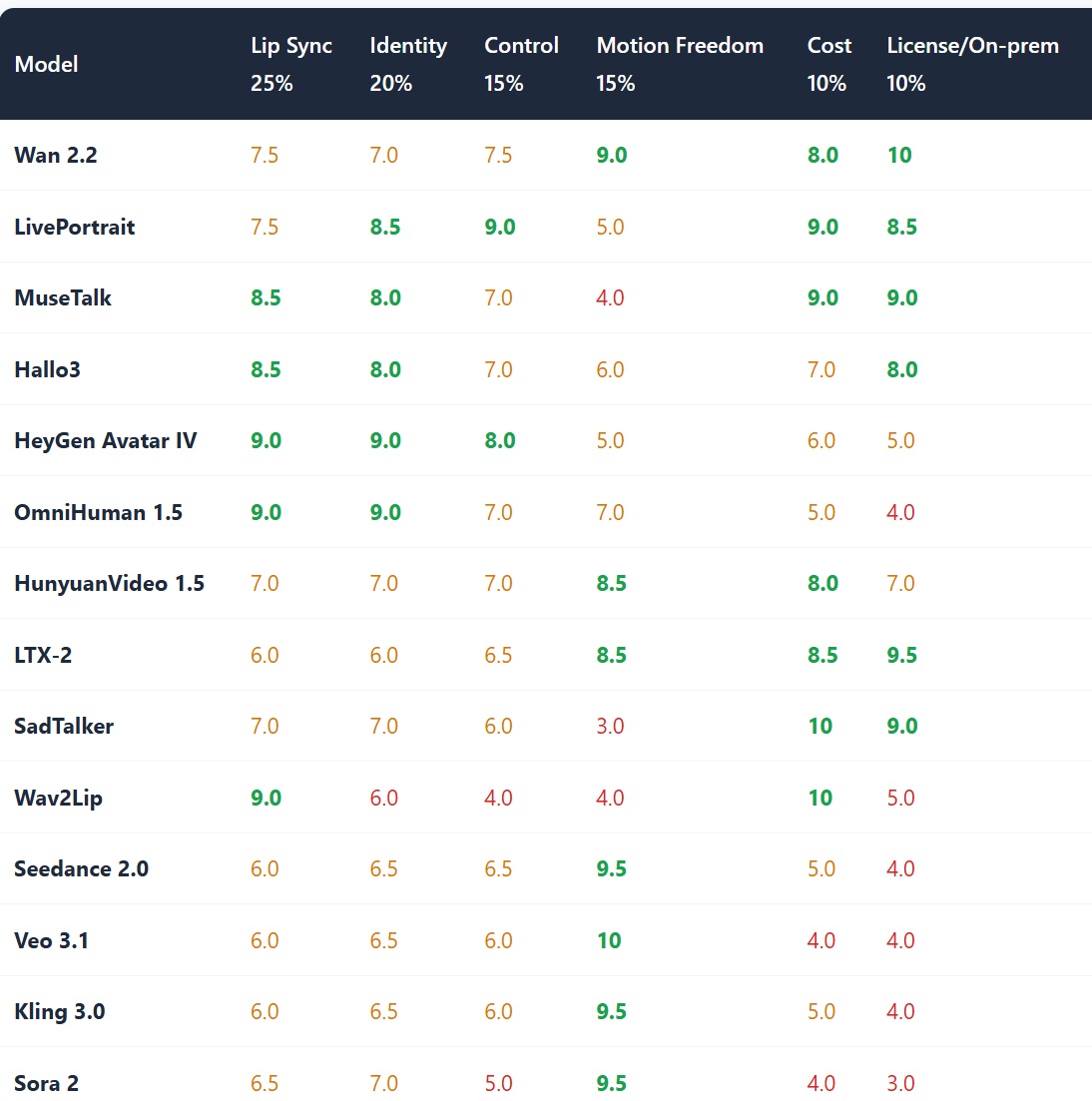
Scoring disclaimer: the scores and star ratings below are this report’s unofficial evaluation, compiled from public materials, official documentation, third-party benchmarks (HumanScore, Artificial Analysis, blind-test data), and community feedback. They are not official benchmark numbers; task-specific weighting is explained below.
5.1 Criteria & Weights (customized for the digital-human task)
| Criterion | Weight | What it measures |
|---|---|---|
| Lip / audio sync | 25% | The hard spec of the business: do lips match audio, and can you re-run on a new track |
| Identity consistency | 20% | Can the same face be reproduced stably across clips and shots |
| Controllability | 15% | Editability and repeatability of expression/pose/lips |
| Motion & scene freedom | 15% | Ceiling of full-body motion, camera language, environment generation |
| Cost efficiency | 10% | Effective cost per finished minute, and budgetability |
| Licensing & on-prem | 10% | License permissiveness and private-deployment feasibility |
| Real-time capability | 5% | Real-time inference for streaming/interactive use; N/A (weights renormalized to 95%) when not applicable |
5.2 Overall Scoreboard
| Model | Roadmap | Score | Stars | Progress |
|---|---|---|---|---|
| Wan 2.2 (S2V/Animate) | Hybrid (open T2V+S2V) | 7.9 | ★★★★★ | |
| LivePortrait | Traditional (open) | 7.9 | ★★★★★ | |
| MuseTalk | Traditional (open) | 7.6 | ★★★★★ | |
| Hallo3 | Hybrid (open diffusion) | 7.6 | ★★★★★ | |
| HeyGen Avatar IV | Traditional (commercial) | 7.5 | ★★★★☆ | |
| OmniHuman 1.5 | Hybrid (commercial) | 7.4 | ★★★★☆ | |
| HunyuanVideo 1.5 | T2V (open) | 7.3 | ★★★★☆ | |
| LTX-2 | T2V (open) | 7.1 | ★★★★☆ | |
| SadTalker | Traditional (open) | 6.7 | ★★★★★ | |
| Wav2Lip | Traditional (open) | 6.5 | ★★★★★ | |
| Seedance 2.0 | T2V (commercial) | 6.4 | ★★★★★ | |
| Veo 3.1 | T2V (commercial) | 6.3 | ★★★★★ | |
| Kling 3.0 | T2V (commercial) | 6.3 | ★★★★★ | |
| Sora 2 | T2V (commercial) | 6.2 | ★★★★★ |
Note: this board is a task-fit score for digital-human generation, not a general video-quality ranking. Seedance, Kling, and Veo top the general T2V leaderboards but are dragged down here by the lip-sync and identity hard specs. Conversely, SadTalker and Wav2Lip score modestly overall yet remain the workhorses of their niches (fast cheap single-image output; pure lip-sync rewriting).
5.3 Seven-Criterion Detail
Legend: ✓ strength · ◐ average · ✗ weakness · N/A not applicable (weight renormalized out)
| Model | Lip Sync 25% |
Identity 20% |
Control 15% |
Motion Freedom 15% |
Cost 10% |
License/On-prem 10% |
Real-time 5% |
|---|---|---|---|---|---|---|---|
| Wan 2.2 | 7.5 | 7.0 | 7.5 | 9.0 | 8.0 | 10 | N/A |
| LivePortrait | 7.5 | 8.5 | 9.0 | 5.0 | 9.0 | 8.5 | 9.0 |
| MuseTalk | 8.5 | 8.0 | 7.0 | 4.0 | 9.0 | 9.0 | 9.0 |
| Hallo3 | 8.5 | 8.0 | 7.0 | 6.0 | 7.0 | 8.0 | N/A |
| HeyGen Avatar IV | 9.0 | 9.0 | 8.0 | 5.0 | 6.0 | 5.0 | 8.0 |
| OmniHuman 1.5 | 9.0 | 9.0 | 7.0 | 7.0 | 5.0 | 4.0 | N/A |
| HunyuanVideo 1.5 | 7.0 | 7.0 | 7.0 | 8.5 | 8.0 | 7.0 | N/A |
| LTX-2 | 6.0 | 6.0 | 6.5 | 8.5 | 8.5 | 9.5 | 7.0 |
| SadTalker | 7.0 | 7.0 | 6.0 | 3.0 | 10 | 9.0 | N/A |
| Wav2Lip | 9.0 | 6.0 | 4.0 | 4.0 | 10 | 5.0 | N/A |
| Seedance 2.0 | 6.0 | 6.5 | 6.5 | 9.5 | 5.0 | 4.0 | N/A |
| Veo 3.1 | 6.0 | 6.5 | 6.0 | 10 | 4.0 | 4.0 | N/A |
| Kling 3.0 | 6.0 | 6.5 | 6.0 | 9.5 | 5.0 | 4.0 | N/A |
| Sora 2 | 6.5 | 7.0 | 5.0 | 9.5 | 4.0 | 3.0 | N/A |
5.4 Category Champions
Strict frame alignment remains unbeaten; open-source pick: MuseTalk.
Commercial platforms turned “the same face” into their core selling point.
Stitching-grade expression/pose retargeting, item-by-item control.
Camera moves, lighting, crowds, any scene — the dimension traditional models can’t reach.
Marginal cost ≈ electricity; at scale it’s an order of magnitude below any API.
Zero barriers for commercial use, fine-tuning, on-prem — and covers both T2V and S2V.
The de-facto open standard for live avatars; commercial: HeyGen LiveAvatar.
HumanScore anatomy 95.6 — best in field; people don’t break.
5.5 Head-to-Head Verdicts
① Talking-Head Short Videos: MuseTalk vs Kling 3.0
The job demands “the same face + synced audio + dozens of clips a day.” MuseTalk re-runs on any new track, streams at 30fps, costs near zero at the margin; Kling re-rolls every clip with a slightly different presenter each time. Winner: MuseTalk — T2V only fits the b-roll and transitions here.
② Corporate Training Video: HeyGen vs Veo 3.1
Training needs batch production, versioning, and compliance. HeyGen’s per-minute cost is budgetable (~$0.97–2.90), SSO/SCORM included, instructor identity never drifts; Veo 3.1 is gorgeous but per-second with no subscription, every revision a re-roll, and no way to lock the instructor’s face. Winner: HeyGen — cost and determinism win.
③ One Photo to Talking Video: SadTalker vs Sora 2
One photo + one voiceover, output in minutes. SadTalker runs locally on 6GB VRAM, auto-aligns lips, free for commercial use under Apache-2.0; Sora 2 looks cinematic but costs an order of magnitude more, can’t refine lips against the track, and has channel risk. Winner: SadTalker (Sora enters only for “viral cinematic shorts”).
④ On-Prem / Data-Compliant Deployment: Wan 2.2 vs OmniHuman 1.5
Finance, government, and healthcare clients require footage that never leaves the intranet. Wan 2.2 is fully local (Apache-2.0) with the S2V branch covering audio-driven avatars at first-tier open quality; OmniHuman 1.5 produces higher fidelity but is cloud-only with no obtainable weights. Winner: Wan 2.2; if the cloud is allowed and maximum realism matters, OmniHuman.
6. Scenario Recommendations
Talking-Head Marketing / Courses
Or HeyGen for the no-ops version. Daily volume, live streaming, cost-sensitive — the traditional roadmap’s home turf. T2V for the intro b-roll only.
Corporate Training / Compliance Content
Batch versioning, SCORM, SSO, and instructor consistency — the turnkey platform can’t be substituted here.
VTubing / 24h Live Avatars
Real-time driving is a hard gate — diffusion T2V simply cannot; for chat interaction use Tavus/HeyGen LiveAvatar.
Cinematic Ad Films
Camera language, lighting, and environment are T2V’s absolute domain; with few and short character shots, drift is manageable. Cut to a traditional pipeline for the talking-head close-ups.
Multilingual Localization
Re-dubbing existing footage and re-syncing lips is a “rewrite the existing video” task — dedicated lip-sync models are the only right answer.
On-Prem / Data Stays In-House
Fully Apache-2.0 local deployment — the complete open-source answer for finance, government, and healthcare.
7. Decision Framework
The Five-Question Method
Q1: Does the same face need to appear repeatedly? Yes (talking heads, training, IP avatars) → traditional roadmap. No (ads/narrative where each clip can have a different person) → T2V.
Q2: Do you need real time? Livestream/interactive → traditional only (MuseTalk, LivePortrait, HeyGen LiveAvatar, Tavus). Offline rendering → Q3.
Q3: Can data go to the cloud? No → open self-hosting (Wan 2.2, HunyuanVideo, MuseTalk, SadTalker). Yes → Q4.
Q4: How should the budget behave? Predictable monthly fee → HeyGen/Synthesia subscription (~$1–3/min). Occasional hero shots with re-roll budget → T2V APIs (Veo/Kling/Seedance). High volume + strong engineering team → open self-hosting is cheapest.
Q5: Cinematic or deterministic? Cinematic camera work → T2V. Determinism (accurate lips, unchanged face, re-runnable) → traditional. Most mature teams end up with a hybrid pipeline: T2V for scenes and camera moves, traditional models for the talking-head close-ups, merged in the edit.
8. Trends: The Two Roadmaps Are Converging
The most significant 2026 development isn’t any single model — it’s the erosion of the boundary:
- Hybrid architectures became the mainline. OmniHuman (ByteDance), Hallo3 (Fudan), Wan2.2-S2V (Alibaba), EchoMimic V3 (Ant) share one recipe: a diffusion/T2V backbone for image quality and motion ceiling, audio conditioning for lips and control — “traditional roadmap’s goals, T2V roadmap’s engine.”
- Identity-locking ideas flow back into T2V. Sora 2’s Cameo and Seedance 2.0’s reference-image character locking are tacit admissions that generative identity is unreliable — the traditional roadmap’s “lock the input identity” transplanted into T2V.
- Open weights have caught up on human motion. On HumanScore, open HunyuanVideo 1.5 (91.1) ties proprietary Seedance (91.1), one step behind real footage (94.3); the remaining gap is long-horizon and multi-shot consistency.
- Audio is the new battlefield. Veo 3.1, Kling 3.0, Sora 2, LTX-2 all ship native audio — but “can produce sound” is not “can precisely align lips to any given track,” which remains the specialists’ territory.
- Platform division of labor is solidifying. Expect the dominant production shape within 1–2 years: T2V for b-roll and transitions → driven models for character segments → automated lip-sync for localized versions — three pipelines converging in the edit bay.
9. Compliance & Ethics Notes
- Deepfake labeling duties. EU AI Act Article 50 took effect in August 2026, requiring prominent disclosure of AI-generated content; China’s deep-synthesis rules likewise mandate explicit and implicit labeling. Always label digital-human output.
- Consent chains for real likenesses. Cloning a real person (HeyGen digital twins, Sora Cameo) requires the individual’s explicit recorded consent; generating a real person’s talking video without authorization is now a legal risk in most jurisdictions, not merely an ethical one.
- Voice AND likeness are both protected. Hybrid avatars that swap only the face or only the voice still fall under deep-synthesis regulation; verify the license chain before commercial use.
- Data egress. Closed APIs (HeyGen, OmniHuman, Veo) require uploading face and voice data — regulated industries should review cross-border transfer and retention terms.
10. Key Takeaways
- On task-fit, the traditional roadmap leads overall. Five of the top six scores are driven/hybrid architectures (Wan 2.2 spans both); pure T2V flagships lose on lip-sync refinement and identity drift — not on image quality.
- Lip sync and identity are the dimensions the traditional roadmap never loses. As long as the business is defined as “a digital human speaking,” these are hard specs, and T2V’s per-roll uncertainty keeps it in the “footage generator” role.
- T2V’s irreplaceability is motion and camera. The upper-body talking-head paradigm can’t deliver ads and narrative — camera moves and scene storytelling belong to T2V alone; that’s its correct role in an avatar production pipeline.
- Hybrid architecture is 2026’s technical mainline. OmniHuman, Wan2.2-S2V, and Hallo3 prove “diffusion backbone + audio driving” captures both camps’ strengths — this direction will keep absorbing market share from both ends.
- The open-source center of gravity is China. Wan, HunyuanVideo, EchoMimic, MultiTalk, MuseTalk, Hallo3 — nearly all avatar-related open weights come from Chinese teams, mostly under permissive licenses (Apache-2.0 dominant).
- The cheapest option depends on volume and team capability. Low volume → HeyGen/Synthesia subscription; high volume with GPUs and engineering → open self-hosting; T2V APIs fit “low-frequency, high-value” shot-level generation — not as the workhorse for talking-head production.
11. Stress-Testing the Conclusions: Evidence, Sensitivity, Falsification
This chapter pressure-tests the seven core claims made earlier in three steps: ① evidence re-check — incorporating the latest third-party blind tests, vendor technical reports, and objective metrics as of September 2026 (EvalTalker blind test, KlingAvatar 2.0 technical report, JoyStreamer paper, SyncNet/HumanScore benchmarks, and progress in streaming diffusion such as CausVid and Live Avatar); ② weight sensitivity — re-ranking the 14 scored models under three task profiles to check whether conclusions depend on a particular weighting choice; ③ falsification conditions — stating explicitly when each claim does not hold.
11.1 Claim-by-Claim Assessment
| Claim | Evidence | Confidence | Counterexamples & Qualifications | Verdict |
|---|---|---|---|---|
| C1 On task-fit, the traditional roadmap leads overall | Medium | Medium-high (needs scoping) | Weight-sensitive: under the “cinematic ad” profile T2V overtakes, taking 4 of the top 7 (see 11.2) | Scope it: “talking-head / live / training tasks” only; does not hold for general content creation |
| C2 Lip sync and identity are the traditional moat | Strong | High | Backed by architectural difference (locked vs generated); but even the best model in LongCat’s blind test still shows a 29.8% lip-sync problem rate — a moat is not perfection; hybrid product lines (KlingAvatar 2.0) are narrowing the gap | Upheld, with a horizon qualifier “as of 2026”; monitor hybrid erosion |
| C3 T2V’s irreplaceability is motion and camera | Strong | High | No substantive counterexample: every leading hybrid (OmniHuman, KlingAvatar, LongCat, Wan-S2V) borrows the T2V backbone, implicitly conceding where that capability comes from | Upheld |
| C4 Hybrid architecture is 2026’s technical mainline | Strong | High | No counterexample, and this round added the most new evidence: KlingAvatar 2.0, LongCat-Video-Avatar 1.5, and JoyStreamer are all “diffusion backbone + audio conditioning”; mutually contradictory vendor self-benchmarks signal a crowded race | Upheld, upgraded from “trend call” to “verified fact” |
| C5 The open-weights center of gravity is Chinese labs | Strong | High | New corroboration: Meituan LongCat (MIT license), Live Avatar (Mar 2026, 14B real-time streaming avatar, 10,000s drift-free) | Upheld |
| C6 The cheapest option depends on volume and team capability | Strong | High | Under the cost-sensitive profile, all four closed T2V models sink to the bottom (5.4–5.8) — quantitative confirmation | Upheld |
| C7 Real-time/livestream: only the traditional roadmap can do it | Weak (partially overturned) | Low (needs revision) | Streaming diffusion distillation has shipped: CausVid (MIT/Adobe) runs at 9.4 FPS on one GPU with 1.3s first-frame latency; Live Avatar (Mar 2026) streams a 14B model in real time, drift-free for 10,000 seconds, with ~3s end-to-end latency | Revise to a two-tier statement: interactive latency (<1s) still belongs to lightweight driven pipelines (MuseTalk/LivePortrait/Tavus); near-real-time (2–3s) diffusion streaming has landed at 14B scale and may erode MuseTalk’s real-time edge within 1–2 years |
11.2 Weight Sensitivity: How Rankings Shift Across Task Profiles
Using the seven-criterion scores from 5.3, models were re-ranked under three profiles (N/A dimensions renormalized as before): Profile A is this report’s talking-head weighting; Profile B is cinematic-ad/content creation (motion freedom 35%, lip sync cut to 10%); Profile C is cost-sensitive scale production (cost 25%, licensing 15%, motion cut to 5%).
| Profile | #1 | #2 | #3 | #4 | #5 | #6 |
|---|---|---|---|---|---|---|
| A Talking-head (this report) | Wan 2.2 (7.95) | LivePortrait (7.88) | MuseTalk (7.62) | Hallo3 (7.55) | HeyGen IV (7.50) | OmniHuman (7.42) |
| B Cinematic ad / content creation | Wan 2.2 (8.19) | HunyuanVideo (7.69) | LTX-2 (7.47) | LivePortrait (7.35) | Veo 3.1 (7.31) | Seedance (7.31) |
| C Cost-sensitive scale production | LivePortrait (8.32) | MuseTalk (8.25) | Wan 2.2 (8.00) | SadTalker (7.79) | Hallo3 (7.63) | LTX-2 (7.38) |
Four takeaways from the sensitivity analysis:
- Wan 2.2 is the only weight-robust champion. It ranks first under all three profiles (7.95 / 8.19 / 8.00) — the “one family covering both roadmaps” advantage does not depend on any particular weighting. This is the most defensible conclusion on the board. Note Wan 7.95 vs LivePortrait 7.88 is within scoring error (±0.3 treated as a tie).
- “Traditional leads” is profile-dependent, not universal. Under Profile B, T2V holds 4 of the top 7 (HunyuanVideo, LTX-2, Veo, Seedance) while SadTalker/Wav2Lip fall to last place — they are talking-head tools; a cinematic profile is task mismatch, not model decline.
- Closed T2V collapses under the cost profile. In Profile C, Seedance/Kling/Veo/Sora all land at the bottom (5.39–5.76), a stark reversal from their mid-table spots in 5.2 — per-second billing plus re-rolls is untenable at scale.
- Open vs closed T2V diverges more than “T2V vs traditional.” Under Profile B, open HunyuanVideo/LTX-2 outrank closed Veo/Seedance (license and cost points) — within-camp licensing differences matter more to rankings than between-camp differences.
11.3 Data & Benchmark Limitations
- Vendor self-benchmarks contradict each other — there is more than one “winner.” The KlingAvatar 2.0 technical report claims a 194% GSB score vs OmniHuman-1.5 and 126% vs HeyGen; Meituan’s EvalTalker blind test claims a 65.9% user-preference win rate for LongCat over KlingAvatar 2.0 and 61.1% over OmniHuman; the JoyStreamer paper flags physical-plausibility flaws in KlingAvatar 2.0 and an “AIGC look” in OmniHuman-1.5. Three materials, three winners, all from interested parties — treat them as directional only.
- No single benchmark covers all seven criteria. SyncNet Sync-C/D measures only lip sync, DINOv2 cosine similarity only identity, HumanScore only human-motion biomechanics, and GSB blind-test protocols are vendor-defined. This report’s seven-criterion composite is a patchwork over fragmented evidence, not a single authoritative benchmark.
- Pricing carries time-point risk. Platform prices moved repeatedly through 2026 (HeyGen billing changes; OmniHuman’s effective rate differs nearly 4x between direct and aggregator pricing); Sora 2 channel volatility comes from third-party reporting, not official confirmation.
- Subjective scoring error bands. The seven-criterion scores are editorial judgments; ranking differences within ±0.3 are not meaningful. Wan 2.2 vs LivePortrait, and MuseTalk vs Hallo3, should be read as ties.
11.4 Final Verdict After Stress-Testing
Of the seven claims: five are upheld (C2–C6, with C4 upgraded to verified and C5/C6 reinforced by new evidence), one is scoped (C1 — traditional-roadmap leadership holds for talking-head-class tasks only), and one is revised (C7 — streaming diffusion distillation has turned “real-time” from a traditional-only property into a two-tier landscape). The overall verdict stands: the traditional roadmap keeps lips and identity, T2V takes motion and camera, hybrids take both — and Wan 2.2 is currently the only “all-rounder” that survives all three profiles. One last recommendation for anyone selecting: use these scores to narrow the candidate list, then run your own blind evaluation on 10–20 clips of your own material before committing — no vendor benchmark can substitute for that step.
Run Talking-Head Localization on Your Own Machine
DeepVideo is a locally running AI video translation and dubbing client: Voice Clone in 30+ languages, 100+ preset voices, TTS + lip sync — all processing happens on your device, nothing uploaded to the cloud.
Try DeepVideo Free
Realistic AI Video Dubbing at Just $0.17/min
High quality · Low price · Local client · Security
Free tier: 18 minutes total + 2 minutes daily · Local processing, no cloud upload
DeepForgeHub Research · Traditional Talking-Head Models vs Text-to-Video Models · September 2026
deepforgehub.com · Compiled from public sources; scores are unofficial evaluations