
Video Dubbing Technology Evolution Report
Seven Evolution Paths · From Waveform Concatenation to Unified Foundation Models
September 2026 | Timeline: 1970s – 2026 | Unit of analysis: evolution path × milestone model
Executive Summary
This report answers one specific question: how did video dubbing technology become what it is today, step by step? Rather than writing a chronological account, we break the field into seven independent evolution paths, each presented as a complete chain: starting problem → each generation of approach → key milestone models and papers → breakthrough → cost of that breakthrough → what superseded it or how it coexists.
- The seven paths are not seven components of one pipeline — they are seven separate problem-solving tracks. Speech synthesis solves “how to produce a human voice”. Voice cloning solves “how to sound like this person“. Lip-sync solves “how to make the mouth keep up”. Machine translation and prosody alignment solve “what to say, and for how long”. End-to-end unification asks “can we drop the pipeline entirely”. Real-time asks “can we dub while speaking”. Platform internalization asks “who bears the cost”. Understanding each track on its own terms matters more than memorising any single model name.
- Only eight paradigm shifts occurred; everything else was optimization. Concatenation → parametric synthesis (1990s–2015); parametric → neural vocoder (2016 WaveNet); autoregressive → non-autoregressive parallel generation (2019 FastSpeech); modular assembly → unified generation (2021 VITS, 2023 SeamlessM4T, 2026 LTX-2 audio-visual unification).
- Every path has one “impossibility-to-possibility” threshold. Speech synthesis: 2016 WaveNet, the first time synthetic speech stopped sounding like a machine. Voice cloning: 2023 VALL-E, which cut the requirement from hours of speaker data plus fine-tuning to a 3-second prompt. Lip-sync: 2020 Wav2Lip, whose frozen SyncNet discriminator made zero-training sync possible on any face.
- All seven paths converge on the same direction: eliminating the pipeline. From the 1970s to 2019 the mainstream was cascaded — ASR → MT → TTS → lip-sync, four independent models chained together, with errors amplifying at each stage. Translatotron opened the end-to-end precedent in 2019; by 2026, unified audio-visual diffusion models such as LTX-2 / Just-Dub-It compress translation, dubbing and lip-sync into a single model that preserves paralinguistic signals — laughter, sighs, breathing — that unimodal systems structurally cannot retain.
- The cost curve is not linear — each paradigm shift drops it by an order of magnitude. Traditional human dubbing $500–2000/min → TTS plus manual editing $100–300 → neural TTS $20–100 → voice cloning plus lip-sync $2–20.
- But four hard constraints remain unsolved by any path. The emotional fidelity ceiling (human listeners still distinguish AI emotional speech from human performance with 78% accuracy), the low-resource language data gap, the physical conflict between duration alignment and lip naturalness, and mandatory compliance disclosure (EU AI Act Article 50 fully enforceable from 2 August 2026).
- The most useful conclusion for practitioners: choosing a solution is not about picking the newest path, but about finding the path whose constraints do not conflict with your scenario. Cost-sensitive high-volume content needs neural TTS plus time-sync voice-over only; brand consistency demands voice cloning; quality-sensitive markets require lip-sync. And the genuinely new variable in 2026 is platform internalization — YouTube and Meta have already packaged the capabilities of the first four paths into free default features.
1. The Technology Map: Seven Paths and How They Relate
Before the detailed breakdown, establish the global view. The complete video dubbing technology stack is composed of seven independently evolving paths. They are not seven stages of one assembly line, but seven evolution tracks each with its own starting point, milestones and ceilings. Generational replacement within a path is a “supersession” relationship; relationships between paths are “complementary or competing”.
| # | Evolution path | Starting problem | Evolution chain (generations) | Current state |
|---|---|---|---|---|
| 1 | Speech synthesis (TTS) | How does a machine produce a human voice | Formant → concatenative → HMM parametric → neural vocoder → non-autoregressive parallel → end-to-end unified | Converged, near-human quality |
| 2 | Voice cloning | How to sound like “this person” | Multi-speaker fine-tuning → speaker embedding adaptation → zero-shot prompt cloning → cross-lingual timbre transfer | Mature, cloneable from 3 seconds |
| 3 | Lip-sync | How the mouth keeps up with new speech | CG keyframes → Video Rewrite concatenation → GAN masked inpainting → latent diffusion → mask-free frame editing | Usable quality, paradigm not converged |
| 4 | Speech translation and prosody alignment | What to say, and for how long | Statistical MT cascade → NMT → speech translation → duration prediction / time stretching → paralinguistic preservation | Good for major languages, weak for low-resource |
| 5 | End-to-end unification | Can we drop the four-stage pipeline | Cascaded pipeline → Translatotron direct S2ST → unified multilingual model → joint audio-visual diffusion | Newest paradigm in 2026, advancing fast |
| 6 | Real-time | Can we dub while speaking | Offline full-sentence → chunked streaming → wait-k policy → streaming simultaneous → live real-time dubbing | Working prototypes (2–3s latency) |
| 7 | Platform internalization and compliance | Who bears the cost | Outsourced services → creator-adopted tools → free platform default capability → mandatory disclosure and machine-readable marking | Largest variable in 2026 |
1.1 How the seven paths interlock: three orthogonal axes
The key to understanding the relationships is that the seven paths sit on three orthogonal technical axes. Any given product occupies one position on each axis, and generational changes on each axis happen independently — this is the root of many misjudgements (assuming that “using the latest TTS” means “the whole stack is state of the art”).
→
TTS quality
+ cloning fidelity
Paths 1 + 2
→
Translation accuracy
+ duration fit
Paths 4 + 6
→
Mouth synchrony
+ identity stability
Path 3
Note: Path 5 (end-to-end unification) is the attempt to merge all three axes into a single model. Path 7 (platform internalization) addresses “who pays and who complies” — outside the technology itself. The former is technical convergence; the latter is commercial convergence.
1.2 How to read the following chapters
Sections 2 to 8 break down the seven paths one by one, each using the same structure and visual form: ① starting problem (what the path originally set out to solve); ② evolution chain (each generation in time order with key years and milestone models); ③ breakthrough and cost of each generation; ④ current state and coexistence. Section 9 provides a cross-path comparison and scoring, and Section 10 gives a decision framework for practitioners.
Citation caveats
- Technical milestones in this report are dated by paper publication or model open-sourcing, which typically precedes productization by 1–3 years. WaveNet, for instance, was published in 2016, but at 2016 compute levels it took minutes to generate one second of audio; genuine commercial deployment had to wait for parallel architectures and lightweight vocoders after 2019.
- MOS (Mean Opinion Score) figures come from the self-reported data of each paper. Test sets and listener panels differ, so they cannot be compared across papers directly. This report cites them only to show relative progress within a single path.
- This report does not cover product pricing or commercial comparison. For tool selection, see DeepForgeHub’s comparison reports: AI Video Translation Pricing (DeepVideo vs 12 competitors) · Video Translation Software Landscape (18 tools) · Why DeepVideo Is So Much Cheaper.
2. Path 1 · Speech Synthesis (TTS): How a Machine Produces a Human Voice
This is the most fundamental and earliest of the seven paths. Its logic is unusually clear: each generation solved the most jarring flaw of the previous one — first “choppy”, then “muffled”, then “robotic”, and finally “slow”.
2.1 Evolution chain
-
Generation 1 · Formant synthesis1970s – 1980s
Approach: parametric models of the human vocal tract (formant frequencies, bandwidths) driven by hand-written rules. The canonical example is MIT’s KlattTalk, commercialised as DECtalk (1984).
Breakthrough: the first time a machine could “speak”, with fully controllable parameters and a tiny footprint. This is the voice Stephen Hawking used from the mid-1980s onward.
Cost: relentlessly mechanical. Its voice derives from rules rather than data, so it could never learn the details of human speech that resist parameterization.
Why superseded: intelligible but far too unnatural for entertainment content. -
Generation 2 · Concatenative synthesis1990s – 2010s
Approach: record hours or tens of hours of real speech, cut it into phoneme and diphone units stored in a database, then retrieve and stitch the best-matching segments at synthesis time. The core algorithm is unit selection, formalised by Hunt and Black in 1996. Representative systems: ATR nuu-talk, Festival.
Breakthrough: a large jump in naturalness — because the output is a splice of real human recordings, the timbre is inherently authentic.
Cost (two fatal flaws): first, segment boundaries never sound natural; the prosodic transition at each splice cannot be fully smoothed, which is exactly why early GPS navigation voices sounded so odd. Second, it cannot generalize — whatever voice was recorded is the only voice it can speak; changing timbre required re-recording the entire database, plus GB-level storage.
Legacy: it established the intuition that naturalness depends on the authenticity of the acoustic units, which directly inspired the later idea of generating waveforms directly with neural networks. -
Generation 3 · HMM-based statistical parametric synthesis2000s – 2016
Approach: model speech features (fundamental frequency, duration, spectral envelope) with hidden Markov models, then synthesize waveforms through a vocoder. Introduced via the HTS toolkit from Keiichi Tokuda’s lab at Nagoya Institute of Technology, and formalised by Heiga Zen, Tokuda and Alan Black in 2009.
Breakthrough: first, no seams — speech is generated from parameters, so the splice-transition problem disappears. Second, transferability — speaker adaptation allowed a model to be moved to a new timbre with only a small amount of data. This was the first implementation of “change the voice without re-recording the database”.
Cost: the voice sounded “muffled”. Parameterization discards detail such as phase, so audio quality was clearly below concatenative output.
Why it dominated commercial deployment until 2016: its controllability (rate, pitch, emotion) mattered more than raw quality for the industrial use cases of the time — customer service, announcements. -
Generation 4 · The neural vocoder era2016 – 2019 · paradigm shift #1
Approaches and milestones: this is the true watershed for the whole path.
· September 2016, WaveNet (DeepMind): autoregressive generation of raw 16-bit audio samples one at a time (16,000 samples per second) using dilated causal convolutions. In blind listening tests it scored MOS above 4.0, and DeepMind stated it “reduces the gap between the state of the art and human-level performance by over 50%” for both US English and Mandarin Chinese.
· March 2017, Tacotron (Google): a sequence-to-sequence “character-to-mel-spectrogram” model with attention, achieving automatic alignment between phonemes and acoustic features — no more hand-designed linguistic rules.
· December 2017, Tacotron 2 (Google): paired the same encoder-decoder with a WaveNet-style vocoder, reaching MOS 4.526 ± 0.066 against 4.582 ± 0.053 for professionally recorded studio speech — a gap of just 0.056.
Breakthrough: the first time synthetic speech stopped sounding like a machine. The bottleneck moved from prosody modelling to compute.
Cost: autoregressive sample-by-sample generation was punishingly slow. Generating one second of audio took minutes at 2016 compute levels, and it required a separate text-to-spectrogram model — in essence still a two-stage pipeline. -
Generation 5 · Non-autoregressive parallel generation2019 – 2021 · paradigm shift #2
Approaches and milestones:
· 2019, FastSpeech (Microsoft + Zhejiang University): replaced autoregressive decoding with a parallel feed-forward Transformer, and used a length regulator to explicitly model phoneme-to-frame duration mapping. Spectrogram generation became roughly 270 times faster, while eliminating the attention-alignment errors (skipped or repeated words) common in autoregressive models.
· 2020, FastSpeech 2: added explicit pitch, energy and duration conditioning, turning prosody from something implicitly learned into a controllable input — the point at which “controllability” became an independent selling point.
· 2020, HiFi-GAN (Kakao): became the dominant vocoder, generating 22.05 kHz audio about 168 times faster than real time on a V100 GPU.
· 2020, Glow-TTS: introduced normalizing flows and monotonic alignment search, removing the dependence on external duration annotation during alignment.
Breakthrough: moved TTS from “demonstrable in a lab” to “deployable in production”. RTF improved from 50–100 times slower than real time to 5–10 times slower.
Cost: still a multi-module architecture (acoustic model plus vocoder), with high training and deployment complexity. -
Generation 6 · End-to-end unification and lightweighting2021 – 2026 · paradigm shift #3
Approaches and milestones:
· 2021, VITS: unified the acoustic model and vocoder into a single end-to-end variational autoencoder with adversarial training, producing natural speech in a single forward pass. This was the first successful removal of the pipeline inside TTS.
· 2023, StyleTTS 2 (Columbia University): style diffusion with self-supervised models such as HuBERT and WavLM, decoupling style from timbre.
· 2024, NaturalSpeech 3 (Microsoft): attribute-decomposed diffusion models with an attribute-decomposed neural codec. Through data and model scaling it achieved zero-shot human-level speech synthesis on multi-speaker datasets such as LibriSpeech for the first time.
· Lightweighting on the engineering side: Piper (5.8MB model, ONNX/VITS, RTF up to 1409 on CPU), Kokoro (82MB, about 5x real time), MeloTTS and others represent the new “small, fast, good” paradigm. A 5.8MB model can generate speech at thousands of times real time on an ordinary CPU.
Breakthrough: (1) architecture converges to a single end-to-end stage; (2) deployment descends to CPU and edge devices, making local processing a realistic option; (3) quality reaches zero-shot human level.
Current state: this path has essentially converged. Subsequent work focuses on fine-grained emotional and stylistic control rather than architectural revolution.
Path 1 summary Converged6 generations
What this path achieved
- Naturalness went from obviously mechanical to MOS 4.4+, approaching studio recording quality
- Inference speed improved by thousands of times; real-time operation on CPU and edge devices
- Architecture converged from a four-stage pipeline to a single-stage end-to-end model
- Model size dropped from gigabytes to megabytes, making local deployment realistic
What this path cannot solve
- Speaking well is not the same as sounding like you — cloning is a separate path (Path 2)
- Emotion and paralinguistic signals (laughter, sighs, breathing) remain weak
- Prosody data for low-resource languages is scarce, causing sharp quality drops
- Document-level prosodic consistency over long text remains unstable
3. Path 2 · Voice Cloning: How to Sound Like “This Person”
The through-line of this path is a single word: volume — the amount of data required dropped from “hours of audio plus per-speaker fine-tuning” all the way down to “a 3-second prompt, zero fine-tuning”. Each generational shift amounts to cutting the data volume and engineering cost by an order of magnitude.
3.1 Evolution chain
-
Generation 1 · Multi-speaker TTS with per-speaker fine-tuning2016 – 2019
Approach: fine-tune a pre-trained multi-speaker TTS model on tens of minutes to several hours of recordings from the target speaker.
Breakthrough: the first demonstration that neural networks can learn and reproduce a specific timbre, rather than only using a preset voice library.
Cost: an extremely high data threshold, plus retraining for every new speaker — not scalable in engineering terms. For dubbing, where every series has dozens of characters, entirely impractical. -
Generation 2 · Speaker embeddings and adaptation2019 – 2022
Approach: extract speaker identity into a reusable vector (speaker embedding, d-vector) and condition the TTS model on it. A new speaker only requires extracting the embedding once, with no retraining of the main model. Translatotron in 2019 used a pre-trained speaker encoder to extract a “voice fingerprint” from source audio to retain the original speaker’s timbre.
Breakthrough: from “one model per speaker” to “one model plus one vector” — a large drop in engineering cost.
Cost: an embedding vector carries limited identity information, so similarity plateaus; loss of timbre is more pronounced across languages. -
Generation 3 · Zero-shot prompt cloning2022 – 2024 · paradigm shift #4
Approaches and milestones:
· 2022, Tortoise TTS (James Betker): a GPT-style autoregressive prior with a diffusion decoder and a contrastive language-voice transformer — the first publicly usable zero-shot cloning.
· January 2023, VALL-E (Microsoft): the single most important node on this path. It reframed TTS as a language modelling task over discrete EnCodec audio tokens — treating “speaking” as “composing sentences from audio tokens”. Trained on 60,000 hours of English audio, it could clone an unseen speaker from a 3-second prompt. Microsoft reported it “significantly outperforms the state-of-the-art zero-shot TTS system in terms of speech naturalness and speaker similarity”.
· April 2023, NaturalSpeech 2 / Bark: the former used latent diffusion over codec tokens (trained on 44,000 hours, including singing); the latter, released by Suno under the MIT licence, generates speech, music, sound effects and non-verbal cues such as laughter from text alone.
· 2023, Voicebox (Meta FAIR): introduced flow matching for speech infilling, supporting cross-lingual style transfer.
· November 2023, XTTS-v2 (Coqui): brought open multilingual voice cloning to 17 languages. OpenVoice (MyShell + MIT) added accent and emotion control.
· March 2024, OpenAI Voice Engine preview: voice cloning from a 15-second sample.
Breakthrough: the data threshold collapsed from “hours plus fine-tuning” to “seconds plus zero fine-tuning”. This is the threshold at which dubbing became genuinely viable — because dubbing operates on the source audio of unfamiliar speakers, and you cannot ask for hours of reference material first.
Cost: (1) the similarity ceiling is bounded by prompt quality; (2) noise, accent and emotion in the prompt are learned along with everything else; (3) ethical and compliance risk rises sharply — cloning from 3 seconds means the bar for misuse is extremely low. -
Generation 4 · Cross-lingual timbre transfer and unified architectures2024 – 2026
Approaches and milestones:
· Three technical schools in parallel: neural codec language models (the VALL-E line), LLM-adapted TTS (treating speech as an output modality of an LLM), and flow-matching TTS (such as the CosyVoice line).
· Duration control becomes its own research topic: dubbing has a special requirement — speech must fit inside a fixed lip-motion window. This spawned a body of work specifically on duration control, decoupling “what is said” from “how long it takes”.
· December 2025, GLM-TTS (open-sourced by Zhipu): a two-stage generation architecture with GRPO-based reinforcement learning, learning a speaker’s timbre and speech habits from only 3 seconds of audio, achieving open-source SOTA on character error rate and emotional expression.
Breakthrough: cross-lingual timbre consistency — the same person speaking Mandarin and Spanish must sound like the same person. This is the core experience metric for cross-lingual dubbing.
Current state and limits: see the box below.
The structural limitation Path 2 has never resolved: a unimodal blind spot
All voice cloning systems share one architectural premise: input is audio plus text, output is audio. They cannot see the picture. This produces three consequences that cannot be solved within Path 2 — and they are precisely why Path 5 exists:
- Paralinguistic information is lost: laughter, sighs, breathing, hesitation — these non-verbal vocalizations have no place in a “pure speech synthesis” framework and are typically erased.
- Scene-level acoustic events cannot be aligned: a door slamming on screen, a beat in the background music — a speech synthesis system cannot see these and therefore cannot make the dub resonate with them.
- Lip-window duration can only be guessed: the synthesis system does not know how long the mouth movement lasts, so it estimates with a duration predictor — and the error shows up directly as audio-visual desynchronization.
The 2026 joint audio-visual generation models (Path 5) are designed against exactly these three points — they condition jointly on visual dynamics and text, faithfully reproducing non-verbal expression and grounding speech timing in the physical scene.
4. Path 3 · Lip-Sync: How the Mouth Keeps Up
What makes this path distinctive is its input: video plus audio (editing the mouth in existing footage), entirely different from Path 2’s input. It must satisfy two conflicting goals simultaneously — the mouth must be accurate (audio-driven), and the identity must not change (visual consistency). The entire history of this path is a repeated search for balance between those two goals.
4.1 Evolution chain
-
Generation 1 · Graphics keyframes and pre-recorded animation librariesbefore 1997
Approach: animators adjusted mouth shapes frame by frame, or matched and stitched from pre-recorded animation libraries. Bregler et al. (1997) were the first to attempt graphics-based audio-visual concatenation.
Cost: extremely high skill requirements and enormous time investment; not scalable at all. -
Generation 2 · Video Rewrite (concatenation)1997 – 2017
Approach: retrieve mouth-matching segments from other footage of the same person and reassemble them into new mouth shapes. The core idea is “don’t generate, just retrieve and recombine”.
Breakthrough: no 3D modelling required; uses real footage directly.
Cost: requires a substantial library of footage of the same person, and the splicing is visibly detectable; generalization is extremely poor. -
Generation 3 · The GAN masked-inpainting era (the Wav2Lip epoch)2020 – 2023 · paradigm shift #5
Approaches and milestones:
· 2017, SyncNet (Chung & Zisserman): proposed a lip-sync discriminator network that became the evaluation and supervision infrastructure for all subsequent work.
· 2020, Wav2Lip (IIIT Hyderabad, ACM Multimedia): the most important single breakthrough on this path. For each target frame, the generator receives three inputs — the face with its lower half masked out, a reference frame of the same person (supplying identity and texture), and a short mel-spectrogram window around that moment. An encoder-decoder network “paints in” the mouth region, which is then blended back into the original video.
Key contribution: a pre-trained, frozen SyncNet “expert” discriminator judging whether mouth frames match the audio. Earlier methods trained the sync discriminator jointly with the generator, and those discriminators turned out to be poor judges of sync — a classic case of “a good critic matters more than a good generator“.
Breakthrough: “works on any face, zero training required”. This property is why Wav2Lip was still widely used in 2026.
Cost (three clear defects): (1) low-resolution mouth region with blurry teeth; (2) visible seams and flicker at the mask boundary; (3) exaggerated mouth motion can fool the sync score while looking unnatural — i.e. a good LSE-D/LSE-C score does not mean the video looks real. -
Generation 4 · Latent-space inpainting and real-time operation2023 – 2024
Approaches and milestones:
· 2023, VideoReTalking / DINet / IP-LAP: improved realism through spatial deformation, intermediate landmark prediction, or 3D priors.
· 2023, StyleSync / StyleLipSync: StyleGAN-inspired architectures.
· 2023, TalkLip: leverages a lip-reading expert within a contrastive learning framework to enhance lip-speech synchronization.
· 2025, MuseTalk (Tencent Music Lyra Lab): single-step inpainting of the lower face in a compressed latent space (rather than many diffusion steps), achieving 30 FPS at 256×256 on a single V100 — exactly the threshold for live video. It improves synchronization by selecting reference frames with similar head poses.
Breakthrough: speed enters the real-time zone, with quality clearly ahead of Wav2Lip.
Cost: single-step inpainting has a bounded expressive capacity; fine detail falls short of multi-step diffusion. -
Generation 5 · Diffusion models and mask-free frame editing2024 – 2026 · second half of paradigm shift #5
Approaches and milestones:
· 2024–2025, LatentSync (ByteDance): among the first audio-driven lip generation methods to use a latent diffusion model, greatly reducing compute and VRAM requirements and enabling higher-resolution video frames.
Three key designs: (1) affine transformation at the data preprocessing stage to normalize face orientation, improving learning in challenging cases such as profile views; (2) a fixed full-face mask (rather than a dynamic landmark-based mask) to suppress “visual shortcuts” — the model may otherwise learn to infer mouth shape from the eyes and facial appearance without being controlled by audio, and dynamic landmark trajectories themselves leak lip-motion information; (3) pixel-space SyncNet supervision (the paper’s experiments showed latent-space supervision converges poorly, probably because lip detail is lost in VAE encoding), with a two-stage training strategy designed to relieve the resulting VRAM bottleneck.
· TREPA for temporal consistency: independent per-frame diffusion causes flicker; TREPA (Temporal Representation Alignment) removes jitter by aligning the temporal representations of generated and ground-truth frames. Its internal sync checker rose from 91% to 94% accuracy on a standard test set.
· 2025, OmniSync: a creative abandonment of masking — directly initializing diffusion from “video frame plus noise”. This yields three advantages: markedly stronger performance on head-pose variation, identity consistency, occlusion and stylized content; a fundamental bypass of the visual-shortcut problem; and no dependence on face detection or landmark alignment, so it generalizes to non-human characters (animation, puppets).
Two key mechanisms: (1) progressive training strategy — exploiting the staged nature of the diffusion process (early stages form pose and identity structure, middle stages generate audio-driven lip motion, late stages refine texture), using limited pseudo-paired data early and arbitrary video data in the middle and late stages, thus learning stably without perfect paired samples; (2) progressive noise initialization — at inference, instead of starting from pure random noise, inject a degree of noise into the source frame, skipping the early structure-formation stage and directly inheriting the source frame’s head pose and facial structure, effectively suppressing pose inconsistency and identity drift.
· DS-CFG (Dynamic Spatiotemporal Classifier-Free Guidance): spatially, Gaussian weighting concentrates guidance on the mouth and its surroundings; temporally, guidance is strong early and weakens later — resolving the contradiction that too much guidance damages overall image quality while too little produces imprecise lip motion.
· December 2025, FlashLips: replaces diffusion and GANs with reconstruction objectives in a two-stage framework (a single-forward-pass deterministic editor plus an audio-to-pose transformer) — mask-free, no heavy preprocessing, 100 FPS, achieving faster-than-real-time high-resolution inference. This signals that the quality-versus-speed trade-off is beginning to break down.
Current state: the paradigm is not yet converged — masked versus mask-free, GAN versus diffusion versus reconstruction, U-Net versus DiT, 2D versus 3D VAE. The field is in a state of competing schools.
Path 3 rule of thumb: three options, three jobs
Wav2Lip — when you need it to work on any face cheaply. The price is a small, blurry mouth region.
MuseTalk — when you need real time (30 FPS). The price is less fine detail than diffusion models.
LatentSync / OmniSync — when you need the best-looking result and can spend the compute. The price is slow multi-step diffusion, still not real-time on a single GPU in 2026.
And FlashLips (the 100 FPS reconstruction route) is challenging this trichotomy — it attempts to deliver speed and quality simultaneously. If that route succeeds, the classic “real-time versus high-quality” trade-off will no longer hold.
5. Path 4 · Speech Translation and Prosody Alignment: What to Say, and For How Long
This path contains two problems of different natures: “what to say” is a semantic problem (translation quality), while “how long it takes” is a physical problem (duration alignment). They are often conflated, but their technical difficulty is entirely different — the former is a matter of model capability; the latter is a structural difference between languages that no model can eliminate.
5.1 Evolution chain
-
Generation 1 · Statistical machine translation with human post-editing1990s – 2016
Approach: phrase-based statistical machine translation combined with human translators for polishing and cultural adaptation.
Cost: translator headcount set the capacity ceiling, and translations differed substantially in length from the source, requiring manual rewriting to fit the duration. -
Generation 2 · Neural machine translation (NMT)2016 – 2019
Approach: Transformer-based NMT replaced statistical methods, enabling context-aware translation (rather than word-by-word substitution) and beginning to support terminology bases and domain dictionaries.
Breakthrough: a large improvement in fluency, capable of handling idioms and cultural references (though still requiring human oversight).
Cost: text-only; it perceives neither speech prosody nor video duration. -
Generation 3 · Speech-to-speech translation (S2ST) and the original trade-off2019 – 2021
Approaches and milestones:
· 2019, Translatotron (Google, Interspeech): the first neural architecture translating speech from one language directly into another without an intermediate text representation, mapping source audio spectrograms to target audio spectrograms. On Spanish-to-English it achieved 42.7 BLEU (cascaded baseline 48.7) and MOS 4.08 using a WaveRNN vocoder.
It exposed three defects of cascaded systems: (1) error propagation (words misheard by ASR are amplified by MT); (2) information loss (speech-to-text is a lossy conversion that strips speaker identity, emotion and prosody); (3) complexity and latency (three independent models in series add overhead).
An interesting observation: Translatotron was found to translate disfluencies like “um” directly and showed a bias for retaining cognates (keeping “Guillermo” rather than translating to “William”) — evidence that it genuinely learns from the acoustic signal rather than transforming at the text layer.
Key lesson: auxiliary phoneme prediction is essential; without it, the model fails to learn cross-lingual alignment effectively.
· The cascaded route was optimized in parallel: AppTek and RWTH Aachen built both cascaded and end-to-end systems for IWSLT 2020, combining high-quality hybrid ASR with Transformer NMT for the cascaded baseline, while the end-to-end systems benefited from adapted encoder-decoder pretraining, synthetic data and fine-tuning to compete with cascaded systems on MT quality.
Conclusion: the 2019–2021 trade-off was that cascades still led on translation quality (especially in high-resource settings and spontaneous speech), while end-to-end led on latency, information retention and deployment simplicity. This trade-off has shaped every architectural decision since. -
Generation 4 · Duration alignment and paralinguistic preservation2021 – 2024
Approaches and milestones:
· The engineering solution to duration alignment — time stretching: Meta’s production dubbing system provides a highly representative case. “I am going to the store” (6 words in English) becomes “voy a la tienda” (4 words in Spanish); the translated audio is naturally shorter and would directly cause desynchronization. Meta developed a time-stretching algorithm that speeds up or slows down the translated audio while ensuring the output does not sound rushed or unnaturally slow.
· Natural pause prediction: a smarter approach is to let the AI predict where to insert natural pauses, maintaining sync without unnatural acceleration or deceleration.
· Paralinguistic preservation:
· 2023, Voicebox (Meta FAIR): flow matching for speech infilling.
· From August 2023, SeamlessM4T (Meta): described as the “first all-in-one multimodal and multilingual AI translation model”, supporting speech-to-speech translation (101→36 languages), speech-to-text (101→96), text-to-speech (96→36) and speech recognition (96 languages). Its core breakthrough is preserving tone, emotion and prosody through translation, directly addressing the “flat, robotic” quality that plagued earlier AI dubbing.
SeamlessExpressive architecture in detail: a prosody-aware encoder plus a pretssel decoder, with an expressivity embedding that lets the translation model carry prosodic information while maintaining high semantic translation quality. The encoder uses a speech encoder with an expressivity encoder and a non-autoregressive text-to-unit encoder to generate prosodic units; the decoder applies a textless acoustic model over those prosodic units and concatenates the target language embedding with the expressivity encoder output to produce target-language audio.
Concrete results: speech-to-speech translation accuracy improved 30% since 2023; used to automatically dub videos on Instagram and Facebook; its SeamlessStreaming variant delivers translation with about 2 seconds of latency.
· Background noise handling: Seamless was trained on clean audio and performs poorly on noisy input. Meta’s solution is to extract background noise during preprocessing and reintegrate it during postprocessing, ensuring ambient sound is naturally preserved in the final output.
Limitations Meta itself acknowledges: “ASR performance may vary based on gender, race, accent or language”, and “performance in translating slang or proper nouns may be inconsistent across high and low-resource languages”. -
Generation 5 · Translation understanding in the LLM era2024 – 2026
Approach: LLMs participate in the translation and cultural adaptation layer, upgrading “sentence-by-sentence translation” to “context-aware localization rewriting” — handling puns, cultural references and register (formal versus slang).
Three hard problems that remain unsolved:
(1) The physical duration constraint has no solution: when the translation is 40% longer than the source, “accurate translation” and “fitting the time window” necessarily conflict; any model can only trade one against the other.
(2) Low-resource language data gap: parallel corpora for languages such as Swahili and Hausa are scarce, leaving a large quality gap versus high-resource languages.
(3) Cultural adaptation requires rewriting, not translation: a line that passes unchanged in India or Southeast Asia may need re-dubbing or script rewriting in MENA. This lies beyond the capability boundary of translation models and requires human review.
6. Path 5 · End-to-End Unification: Can We Drop the Four-Stage Pipeline
This is the youngest of the seven paths and the one that best represents the 2026 technical direction. Its proposition is to compress the four-stage pipeline of recognition → translation → synthesis → lip-sync into a single unified model. This is not merely engineering optimization but a paradigm-level reconstruction — because each of the four stages discards information, whereas a unified model can retain joint cross-modal information.
6.1 Evolution chain
-
Stage 0 · The cascaded pipeline2000s – still the dominant production approach
Approach: ASR → MT → TTS → lip-sync, four independent models in series.
Advantages: each module can be optimized, replaced and debugged independently. This matters enormously in engineering — Meta’s production dubbing system orchestrates more than 10 different AI models, including audio decoding, language identification, speech presence detection (using audio classifiers to confirm there is enough translatable speech), sentence splitting (using ASR to detect punctuation boundaries combined with VAD to identify natural pauses, rather than arbitrary cutting that could truncate mid-sentence), translation, time stretching and background noise handling.
Three structural defects: (1) error propagation — ASR errors are inherited and amplified downstream; (2) information loss — speech-to-text is lossy, stripping speaker identity, emotion and prosody; (3) cumulative latency — four serial stages, each adding its own delay.
Why it remains the production mainstream in 2026: observability, replaceability, and the ability to apply quality fallbacks at each module. The fact that end-to-end models “cannot show intermediate states” is a genuine burden in industrial delivery. -
Generation 1 · Direct speech-to-speech translation (the Translatotron paradigm)2019 – 2023 · paradigm shift #6
Approach: map source-language audio spectrograms directly to target-language audio spectrograms, eliminating the intermediate text representation (see Path 4, Generation 3).
Breakthrough: proved that end-to-end S2ST is not only feasible but offers unique advantages in preserving paralinguistic information that cascaded systems cannot match.
Cost: translation quality still lagged cascaded baselines (especially on spontaneous speech), largely due to insufficient paired speech data at scale. -
Generation 2 · Unified multilingual and multimodal models2023 – 2025
Approaches and milestones:
· 2023, SeamlessM4T: a single model covering five tasks (ASR / S2TT / S2ST / T2ST / S2ST), nearly a hundred languages, using language tags for multilingual parameter sharing and cross-lingual knowledge transfer, with zero-shot direction support.
· Production practice: Meta combined Seamless (a universal translation model) with its own lip-sync technology into an end-to-end dubbing system for Reels. The architecture follows a distributed workflow: a creator uploads a Reel → stored in media storage → a translation request is queued → AI workers pull the media, perform translation and lip-sync processing and upload results → on the consumption side content is delivered by user language setting (a device set to Spanish receives the Spanish version; English receives the English original). This requires changes to the playback stack to factor language settings into prefetch optimization.
Early alpha data: 90% eligibility rate for submitted content, with meaningful increases in content impressions due to expanded language accessibility; early testing suggested engagement increases of up to 20%.
· Meta’s deployment boundaries on Facebook / Instagram: initially limited to English and Spanish; creators must opt in via platform settings, and can review and approve dubbed versions before distribution. -
Generation 3 · Joint audio-visual diffusion (unified audio and video generation)2026 · paradigm shift #7
Approaches and milestones: this is the current frontier, moving from “cascade” toward “unified signal“.
· The LTX-2 foundation model: processes video and audio as a unified signal. It employs an Asymmetric Dual-Stream Diffusion Transformer (DiT) over decoupled latent inputs — video frames are compressed into 3D spatiotemporal tokens (zv) via a 3D VAE, while audio is encoded into 1D tokens (za) via a separate 1D VAE. The model allocates different capacities to each modality (their information densities differ) and enforces tight temporal alignment through bidirectional cross-attention layers, allowing each modality to continuously condition the other. Training uses flow matching (specifically Rectified Flow).
· 2026, Just-Dub-It (ACM): a video dubbing method built on LTX-2 whose core idea is to rely on no masks, no explicit face tracking and no modular pipeline. Its two-step approach is elegant: (1) first use the pretrained audio-visual diffusion model’s generative capacity to synthesize identity-consistent bilingual training pairs (solving the scarcity of paired dubbing data); (2) then learn a constrained editing behaviour on top of it with a lightweight in-context LoRA, enabling precise, temporally aligned dubbing at inference.
Why it matters: the paper states plainly that all speech-only systems (including zero-shot cloning systems such as CosyVoice and OpenVoice) “remain unimodal — synthesizing speech without access to visual context and therefore missing paralinguistic cues (laughter, sighs, breathing), scene-level acoustic events, and the precise timing of the mouth”. Just-Dub-It instead conditions jointly on visual dynamics and text, faithfully reproducing non-verbal expression and grounding speech timing in the physical scene.
This is the end state toward which all seven paths converge: translation, dubbing and lip-sync cease to be three models and become different facets of one generative process.
Note: unified end-to-end models are still transitioning from research to engineering in 2026. They remain significantly inferior to cascaded approaches in controllability (no way to correct a single stage as a pipeline allows), observability (intermediate states are invisible) and compute cost. For production delivery, “cascade for delivery, end-to-end for the experience ceiling” is the realistic arrangement in 2026.
7. Path 6 · Real-Time: Can We Dub While Speaking
Real-time looks like simply “running the offline system faster”, but it is in fact an independent technical problem — because it must introduce something offline systems do not need: a decision policy. On receiving partial input, the system must decide whether to read more input or emit a token now. That decision directly determines the quality-latency trade-off, and no model can bypass it.
7.1 Evolution chain
-
Generation 1 · Statistical methods and heuristic segmentation2013 – 2015
Approach: simple segmentation and latency control based on statistical methods. The unit of processing was the sentence or chunk, with manually configured policies.
Cost: latency and quality could not be optimized simultaneously; the usual outcome was sacrificing quality for latency. -
Generation 2 · Neural simultaneous interpretation and the wait-k policy2016 – 2020
Approaches and milestones:
· Monotonic attention: Arivazhagan et al. (2019) modelled the read/write decision as a monotonically increasing attention path.
· The wait-k policy: a canonical policy operator — wait for k input tokens, then begin outputting, maintaining a “read one, write one” rhythm thereafter. The parameter k directly controls the quality-latency trade-off.
· Prefix-to-prefix and chunkwise policies: implemented as monotonic attention masks, triggered by thresholds on alignment, completeness probability, or learned gating functions.
· Local agreement decoding: compare consecutive output sequences and display only the parts that agree — a streaming strategy with a very good accuracy-latency trade-off.
Breakthrough: turned the quality-latency trade-off from a vague goal into an explicit frontier adjustable with a single parameter. -
Generation 3 · Streaming architectures and blockwise-causal encoding2020 – 2024
Approaches and milestones:
· Blockwise-causal encoding: divide input speech into temporally fixed blocks, using masking and KV caching to avoid quadratic recomputation.
· Causal encoders: RNN-T, chunkwise Conformer, Wav2Vec 2.0 and others.
· Augmented memory modules: maintain summaries of recent context windows to enable long-range attention at fixed compute cost.
· A general method for online conversion: adapt offline systems to online operation by fine-tuning with partial input sequences combined with a decoding strategy that compares consecutive outputs and displays the agreeing parts. Experiments show this approach reduces relative latency by about 40% across both cascaded and end-to-end architectures, and that end-to-end architectures suffer smaller translation quality losses after adaptation — a finding that generalizes to zero-shot directions unseen in training.
· MoE routing for implicit policy learning: gating modules enable simultaneous adaptation to multilingual scenarios and streaming TTS.
Key finding: cascaded and end-to-end offline models can both be converted to online models by the same technique, but cascaded models suffer relatively larger translation quality losses — a clear advantage for end-to-end architectures in real-time settings. -
Generation 4 · Production-grade real-time dubbing and duplex systems2024 – 2026
Approaches and milestones:
· SeamlessStreaming: delivers translation with about 2 seconds of latency, enabling live dubbing applications that were previously impossible.
· Duplex systems: further improve fidelity by interleaving text and audio token outputs, with voice cloning realized via speaker embedding conditioning.
· On-device deployment: causal adapters project speech embeddings to LLM or unit-model decoders, letting real-time translation run on the device.
State in 2026: live real-time dubbing has working prototypes with 2–3 seconds of latency — “not perfect, but usable in some contexts”. Access to multilingual real-time dubbing has expanded considerably (YouTube live streams, international meetings, cross-language communication in multiplayer games).
A physical constraint to take seriously: the latency problem in real-time dubbing may never be fully resolved for timing-critical scenarios such as competitive gaming or live trading — this is a hard information-theoretic boundary, unrelated to model capability.
Expected industry timeline: sub-second latency for major languages by 2027; native integration in streaming platforms by 2028; imperceptible latency at broadcast quality by 2029–2030.
→
Chunked streaming
→
wait-k policy control
→
Streaming simultaneous (40% latency cut)
→
Production real-time dubbing (2–3s)
8. Path 7 · Platform Internalization and Compliance: Who Bears the Cost
This path has the least technical content but the greatest practical impact on the industry, because it determines in what form, at what price, and to whose hands the achievements of the first six paths arrive.
8.1 Evolution chain
-
Generation 1 · Professional outsourced localization2010s and earlier
Form: content owners outsource dubbing to professional localization companies at $500–2000 per minute, with turnaround measured in weeks.
Characteristic: the highest quality, but only affordable to major studios and streaming platforms. -
Generation 2 · Tooling and self-service2018 – 2023
Form: AI dubbing tools become SaaS products; creators upload and process content themselves, with costs falling to $2–20 per minute.
Characteristic: dubbing shifted from a “studio privilege” to something accessible to small teams and individual creators. This generation created the dubbing tool market. -
Generation 3 · Free platform default capability (cost absorption)2025 – 2026 · paradigm shift #8
Forms and milestones:
· 4 February 2026, YouTube opened auto-dubbing to all creators: covering 27 languages, eight of which support Expressive Speech (emulating the tone, intonation and acoustic environment of the original content). As of December 2025, over 6 million viewers per day were watching at least 10 minutes of auto-dubbed content. YouTube officially states that auto-dubbing has no negative impact on the original video’s discovery, and may even help discovery in other languages.
· An important distinction: Expressive Speech is not the same as voice cloning. The former focuses on generating a language track that emulates the original content’s tone, intonation and acoustic environment; the latter focuses on preserving the unique characteristics of a specific voice and replicating that person’s voice. This distinction matters for understanding platform capability boundaries.
· Meta’s rollout on Facebook / Instagram Reels: based on SeamlessM4T plus proprietary lip-sync technology, initially supporting English and Spanish, with creator opt-in and the ability to review before publishing.
· Other platforms: TikTok is testing auto-dubbing for Reels in selected markets; Netflix already uses AI to dub some content (hybrid model: AI-generated first pass plus human localization team review).
Two-directional impact:
(1) Creator-side demand is released at near-zero cost — previously only large channels could afford multi-language versions; now it is a default feature.
(2) Viewer expectations are reset — once platforms offer dubbing by default, audiences begin to treat the absence of multi-language versions as the content owner’s failing.
What this means for third-party suppliers: the stronger the platform, the more likely baseline demand is internalized. External space lies in what platforms are unwilling or unable to do well. -
Generation 4 · Mandatory disclosure and machine-readable marking2025 – 2026 · compliance becomes an independent technology stack
Forms and milestones: the maturation of dubbing technology coincided exactly with the arrival of regulation. Compliance moved from “a legal matter” to “a product architecture matter”.
· EU AI Act Article 50: in force since August 2024, with transparency obligations fully enforceable from 2 August 2026. Generative AI tools, including AI dubbing systems, are categorized as “high-risk” technology. Four mandatory requirements:
(1) Explicit labelling — any audiovisual work using AI-generated content such as dubbed voices must include clear disclosure that is “easily perceived by users”. The European Commission’s December 2025 draft Code of Practice proposes an “EU common icon”, a standardized symbol letting viewers identify AI-generated content at a glance and access further information.
(2) Machine-readable marking — providers of AI dubbing systems must ensure outputs are marked in machine-readable formats and detectable as artificially generated or manipulated. This requirement extends beyond visible labels to metadata watermarking for forensic verification.
(3) Deepfake-specific disclosure — deployers of AI systems generating content “constituting a deep fake” must disclose that content has been artificially generated or manipulated. The EU defines deepfakes as AI-generated audio or video “that resembles existing persons” and “would falsely appear to a person to be authentic”.
(4) Penalties — fines up to EUR 30 million or 6% of global annual revenue, whichever is higher.
(5) Extraterritorial reach — applies to any company serving content in the European Union, regardless of headquarters location. This means US-based platforms such as Netflix and Amazon Prime Video must satisfy EU labelling requirements for content accessible to European viewers.
· China’s Measures for the Identification of Synthetic Content Generated by Artificial Intelligence: effective 1 September 2025, with stricter requirements.
(1) Dual labelling obligation — service providers must apply both visible labelling (perceptible to any user) and implicit labelling (digital watermarks, metadata or equivalent tools) to all AI-generated content: text, images, audio, video and virtual scenes.
(2) No artistic exemption — unlike the EU AI Act, which allows minimal disclosure for “evidently artistic, creative, satirical or fictional” content, China’s rules provide no exceptions; transparency is framed as an absolute principle.
(3) Platform liability — internet platforms must act as “watchdogs”; on detecting or suspecting AI-generated content they must alert users and may add implicit labels themselves.
· Netflix’s compliance tension: Netflix’s practice of deploying AI dubbing without explicit disclosure to viewers puts it on a potential collision course with incoming transparency regulations.
Breakthrough and cost: compliance capability has shifted from a cost item to a structural moat — suppliers with built-in authorization frameworks and disclosure mechanisms hold an advantage. Voice cloning involves IP and performer rights that must be resolved by contract before production, not after delivery.
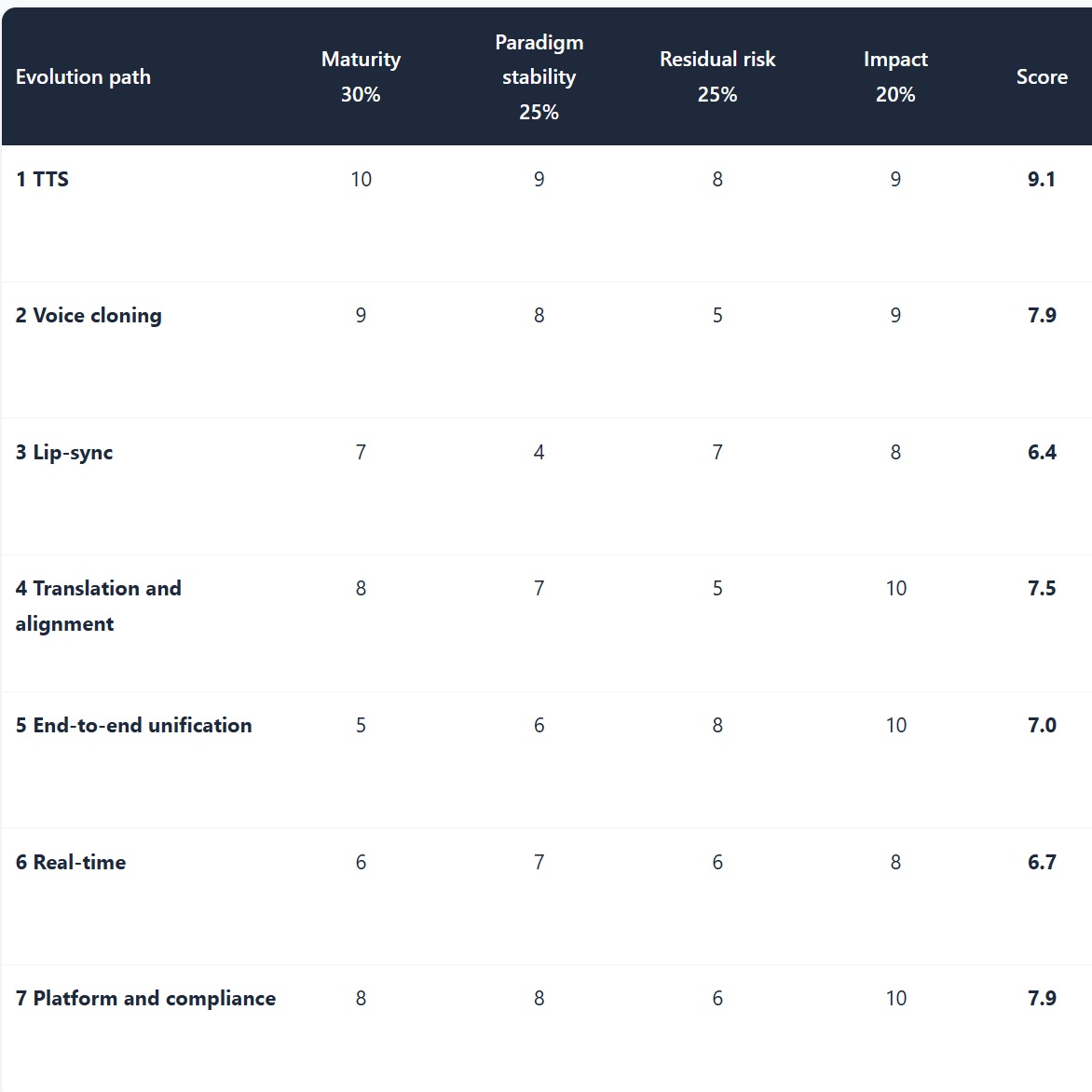
9. Cross-Path Comparison
The seven paths compressed into one comparable table. The scoring subject is each path’s current maturity and residual risk, not any single product.
| Evolution path | Maturity 30% |
Paradigm stability 25% |
Residual risk 25% |
Impact 20% |
Score | One-line verdict |
|---|---|---|---|---|---|---|
| 1 TTS | 10 | 9 | 8 | 9 | 9.1 | Architecture converged to end-to-end, quality near-human; only the emotional fidelity ceiling remains |
| 2 Voice cloning | 9 | 8 | 5 | 9 | 7.9 | Cloneable from 3 seconds, technology mature; but ethical and compliance risk is the highest of all seven paths |
| 3 Lip-sync | 7 | 4 | 7 | 8 | 6.4 | Quality usable, but the masked/mask-free and GAN/diffusion/reconstruction paradigm battles are unresolved |
| 4 Translation and alignment | 8 | 7 | 5 | 10 | 7.5 | Good for high-resource languages; the duration constraint and low-resource gap are long-term problems |
| 5 End-to-end unification | 5 | 6 | 8 | 10 | 7.0 | Most advanced in direction, but insufficient controllability and observability; not yet the production mainstream |
| 6 Real-time | 6 | 7 | 6 | 8 | 6.7 | 2–3s latency prototypes work; latency in timing-critical scenarios is a physical boundary, not fully solvable |
| 7 Platform and compliance | 8 | 8 | 6 | 10 | 7.9 | The largest variable in 2026; compliance has escalated from a legal matter to a product architecture matter |
Score = maturity × 0.30 + paradigm stability × 0.25 + residual risk × 0.25 + impact × 0.20. This is an analytical tool built by this report for cross-path comparison, not an official technology ranking. Dimension scores are subjective assessments intended for ranking and communication rather than precise measurement. Higher risk scores indicate lower residual risk.
Six generations and three paradigm shifts; architecture converged to single-stage end-to-end; MOS 4.4+ near studio recording; models as small as 5.8MB running thousands of times real time on CPU
Determines “what to say and for how long”, an unavoidable stage in every dubbing scenario; yet its duration constraint and low-resource gap remain unsolved
Masked vs mask-free, GAN vs diffusion vs reconstruction, U-Net vs DiT, 2D vs 3D VAE — four technical axes still in open competition, unconverged
YouTube opened auto-dubbing free to all creators in Feb 2026 (27 languages); Meta deployed on Reels; compliance disclosure became a mandatory architectural requirement
10. Decision Framework: How to Use This Evolution History
The value of a technology evolution history is not in “knowing which is newest” but in knowing where each path’s constraints lie, so you can judge which constraints will actually hit you. Below are four head-to-head matchups.
Autoregressive vs non-autoregressive (within Path 1)
Autoregressive (WaveNet / Tacotron 2) has the higher quality ceiling but generates sample by sample, far too slow to deploy; non-autoregressive (FastSpeech / VITS) improves speed by two orders of magnitude at the cost of occasional prosodic stiffness. The 2026 answer is that non-autoregressive has won outright — the quality gap has been closed by subsequent diffusion and flow-matching architectures. Verdict: no need to pay the speed penalty for autoregressive quality any more
Multi-speaker fine-tuning vs zero-shot cloning (within Path 2)
Fine-tuning (hours of data) has a higher similarity ceiling but cannot scale in engineering terms; zero-shot (3-second prompt) is engineering-feasible but bounded by prompt quality. Dubbing operates on the source audio of unfamiliar speakers, so only the zero-shot approach is viable in practice. Verdict: zero-shot is the only option for dubbing
Speed vs quality (within Path 3)
MuseTalk’s single-step latent inpainting reaches 30 FPS real time; LatentSync / OmniSync’s multi-step diffusion delivers the best quality but is slow. The classic trade-off is either-or, but FlashLips (Dec 2025) replaces diffusion and GANs with reconstruction, delivering high-resolution output at 100 FPS, breaking the dichotomy. Verdict: this trade-off is failing — worth re-evaluating
Cascaded pipeline vs end-to-end unified model (Path 5)
Cascades are observable, replaceable and allow per-module fallbacks — the production mainstream in 2026; end-to-end preserves paralinguistic information with lower latency, but intermediate states are invisible and point corrections are hard. Verdict: cascade for delivery, end-to-end for the experience ceiling
Choosing a path by scenario: four typical needs
(1) Cost-sensitive high-volume content (short video, ad creatives): “neural TTS (Path 1, generations 5–6) plus time-sync voice-over (not full lip-sync)” is sufficient. Voice cloning and lip-sync are unnecessary — their cost is wasted here. Most Southeast Asian markets accept time-sync voice-over rather than full lip-sync, which directly and significantly reduces production cost.
(2) High brand-consistency requirements (personal IP, courses, corporate training): Path 2 (voice cloning) is mandatory. Continuity of brand voice is worth more than single-instance quality, and one cloned voice asset can cover every language. Note that compliance must come first — voice cloning involves IP and performer rights that must be resolved by contract before production.
(3) Quality-sensitive markets (Japan, Latin American premium content, Western streaming): Path 3 (lip-sync) cannot be skipped. These markets have clear expectations of full lip-sync, and poor localization is rejected immediately. A hybrid model (AI first pass plus human review) should also be configured — already achieving 40–60% cost reduction while maintaining broadcast-grade quality.
(4) Creators distributing across platforms: first establish how much of the need platform internalization (Path 7) already covers. For long-form content on YouTube, native auto-dubbing is sufficient; external solutions are only needed when exporting a finished MP4 for Shorts/Reels/TikTok, when script-level fine control is required, or when handling off-platform source material — these three are precisely the spaces platform capability leaves open.
11. Key Findings
- Seven paths, eight paradigm shifts. 1990s concatenation → parametric; 2016 WaveNet neural vocoder; 2019 FastSpeech non-autoregressive parallel; 2021 VITS end-to-end unification; 2020 Wav2Lip zero-training sync on any face; 2023 VALL-E three-second zero-shot cloning; 2019 Translatotron end-to-end S2ST; 2026 LTX-2 / Just-Dub-It joint audio-visual diffusion; 2026 YouTube free platform internalization. Of the eight shifts, 2016, 2019, 2023 and 2026 account for half.
- Every path has a clear threshold, and each can be stated in one sentence. TTS: 2016 WaveNet, the first time synthetic speech stopped sounding like a machine. Voice cloning: 2023 VALL-E, cutting the requirement from hours of data to a 3-second prompt. Lip-sync: 2020 Wav2Lip, whose frozen SyncNet discriminator enabled zero-training sync on any face. End-to-end: 2019 Translatotron, proving that dropping the intermediate text representation is feasible and preserves paralinguistic information. Find the threshold, and you have found the watershed for that path.
- All seven arrows point toward eliminating the pipeline. Before 2016, TTS internally was “text → spectrogram → waveform”, two stages; VITS merged them into one in 2021. Dubbing as a whole is moving from the four-stage cascade of ASR → MT → TTS → lip-sync toward a single generative process combining translation, dubbing and lip-sync in 2026. The core advantage of a unified model is not speed but retaining the information that is inevitably lost when passing between modules — laughter, sighs, breathing, scene acoustic events, precise mouth timing.
- Cost falls not linearly, but by an order of magnitude with each paradigm shift. Traditional dubbing $500–2000/min → TTS plus manual editing $100–300 → neural TTS $20–100 → voice cloning plus lip-sync $2–20. This curve explains how dubbing went from a studio privilege to a creator default expectation within a decade.
- But four hard constraints have never been solved by any path. (1) The emotional fidelity ceiling — human listeners still distinguish AI emotional speech from human performance with 78% accuracy; this is the most important current quality boundary. (2) The physical duration constraint — when the translation is 40% longer, “accurate” and “fits the time window” necessarily conflict, and any model can only trade one against the other. (3) The low-resource data gap — quality for languages such as Swahili and Hausa lags far behind high-resource languages. (4) Cultural adaptation requires rewriting rather than translation — the same line may need script rewriting in MENA, beyond the capability boundary of any model.
- The real variable in 2026 is not at the model layer but at the platform layer. YouTube opened auto-dubbing free to all creators (27 languages, over 6 million daily viewers); Meta deployed on Reels (SeamlessM4T plus lip-sync). This means the capabilities of Paths 1 through 4 have already been packaged as free default features. The space for third-party suppliers consequently contracts to what platforms are unwilling or unable to do well: cross-platform distribution, script-level control, off-platform source material, compliance review, and languages outside platform coverage.
- Compliance escalated from a legal matter to a product architecture matter. EU AI Act Article 50 becomes fully enforceable on 2 August 2026, requiring explicit labelling plus machine-readable watermarking, with fines up to EUR 30 million or 6% of global revenue, and extraterritorial reach. China’s labelling measures took effect on 1 September 2025, requiring both visible and implicit labelling with no artistic exemption. Voice cloning involves IP and performer rights that must be resolved by contract before production — suppliers with built-in authorization frameworks hold a structural advantage.
- The most practical conclusion for practitioners: choosing a solution is not about picking the newest, but about finding the path whose constraints do not conflict with your scenario. Cost-sensitive high-volume content does not need lip-sync; high brand-consistency requirements require cloning; quality-sensitive markets require lip-sync; cross-platform creators should first check how much platform cost absorption already covers. Aligning path constraints with scenario constraints beats chasing the newest model.
Technical boundaries and usage notes
- Technical milestones are dated by paper publication or model open-sourcing, typically preceding productization by 1–3 years. Key milestones are dated in the text; verify against the original paper or official announcement when citing.
- Subjective metrics such as MOS come from each paper’s self-reported data. Test sets and listener panels differ, so they cannot be compared across papers directly. This report cites them only to show relative progress within a single path.
- The path division is an analytical framework built by this report for clarity. In real engineering, multiple paths are often packaged in the same product. The purpose of the division is to clarify “which path’s constraint is at work”, not to claim they are mutually independent.
- The technical landscape is changing extremely fast in 2026: unified end-to-end audio-visual models, 100 FPS mask-free lip-sync, and platform auto-dubbing language coverage are all advancing rapidly. The Chinese and English versions are consistent in content; verify the latest official announcement dates when citing.
- This is a technology evolution analysis and does not include capability scoring or pricing comparison of specific products. For tool selection, see DeepForgeHub’s topical reviews: voice clone models · lip-sync models · voice libraries.
From technology evolution to deliverable multilingual cuts
All seven paths ultimately have to land on a tool that works. DeepVideo covers the full chain of Paths 1 through 4 — Voice Clone in 30+ languages, 100+ preset voices, lip-sync and multi-language audio tracks, with fully local processing and no cloud upload, suited to multilingual distribution where both asset confidentiality and cost matter.
Download DeepVideo Free
Realistic AI Video Dubbing at Just $0.17/minHigh quality · Low price · Local client · Security
Free tier: 18 minutes total + 2 minutes daily · Local processing, no cloud upload
Produced by DeepForgeHub Research | September 2026
Milestone sources: WaveNet / Tacotron 2 / FastSpeech / VITS / VALL-E / NaturalSpeech 3 (TTS path); Tortoise / VALL-E / XTTS-v2 / GLM-TTS (voice cloning path); SyncNet / Wav2Lip / MuseTalk / LatentSync / OmniSync / FlashLips (lip-sync path); Translatotron / SeamlessM4T / SeamlessExpressive (translation and end-to-end paths); wait-k / streaming simultaneous interpretation / SeamlessStreaming (real-time path); YouTube official blog and help centre / Meta production practice / EU AI Act Article 50 / China’s Measures for the Identification of Synthetic Content Generated by AI (platform and compliance path). All technical milestones are dated with their source; this report performs no original estimation.