
Global Text-to-Image AI Models Report
Comprehensive Comparison of 10 Leading Models — September 2026
Quality · Pricing · Strengths · Use Case Recommendations
Executive Summary
The text-to-image AI market in 2026 is no longer a one-horse race. Midjourney v8.1 remains the undisputed king of artistic aesthetics, while FLUX.2 Pro has emerged as the top choice for photorealism and open-source flexibility. GPT Image 2 (replacing DALL-E 3) dominates in prompt understanding and complex instruction following. Ideogram 3.0 leads text-in-image rendering with 90%+ accuracy, and Adobe Firefly Image 3 offers the only legally indemnified commercial outputs.
Costs range from free (Stable Diffusion self-hosted) to $0.21/image (GPT Image 2 High), with FLUX Schnell at just $0.003/image being the most cost-effective paid option. Choosing the right model depends entirely on your use case — there is no single “best” model anymore.
Models Included
| Model | Developer | Max Resolution | Latest Version | Open-Weight | API |
|---|---|---|---|---|---|
| Midjourney v8.1 | Midjourney Inc. | 2K (native HD) | Jun 2026 | No | No (Discord/Web) |
| FLUX.2 (Pro/Max/Klein) | Black Forest Labs | 2048×2048 | Nov 2025 – Jan 2026 | Partial (Klein-4B: Apache 2.0) | Yes |
| GPT Image 2 | OpenAI | 1536×1536 | 2026 | No | Yes |
| Stable Diffusion 3.5 / 4.0 | Stability AI | 1024×1024 (native) | 2025 / early 2026 | Yes (fully open) | Yes (self-hosted) |
| Ideogram 3.0 | Ideogram AI | 1024×1024 | 2026 | Partial (quantized) | Yes |
| Adobe Firefly Image 3 | Adobe | 2048×2048 | 2025 | No | Yes |
| Recraft V3 | Recraft | 2048×2048 | 2025 | No | Yes (paid plans) |
| Google Imagen 4 | Google DeepMind | 4K | 2025 | No | Yes (Vertex AI) |
| Leonardo.ai | Leonardo Interactive | 2048×2048 | 2026 | No | Yes |
| Freepik AI Suite | Freepik | 1024×1024 | 2026 | No | No |
| 通义万相 Wanx 2.6 | Alibaba (Tongyi) | 1440×1440 | 2026 | Partial (open weights) | Yes (DashScope API) |
| 即梦 Jimeng (Seedream) | ByteDance | 1440×1440 | 2026 | No | Yes (Volcano Engine) |
| 可图 Kolors | Kuaishou | 1024×1024 | 2025 | Yes (open-source) | Yes |
| 腾讯混元 Hunyuan | Tencent | 1280×1280 | 2026 | Partial (3.0 open) | Yes |
| 文心一格 Wenxin Yige | Baidu | 1024×1024 | 2025 | No | No |
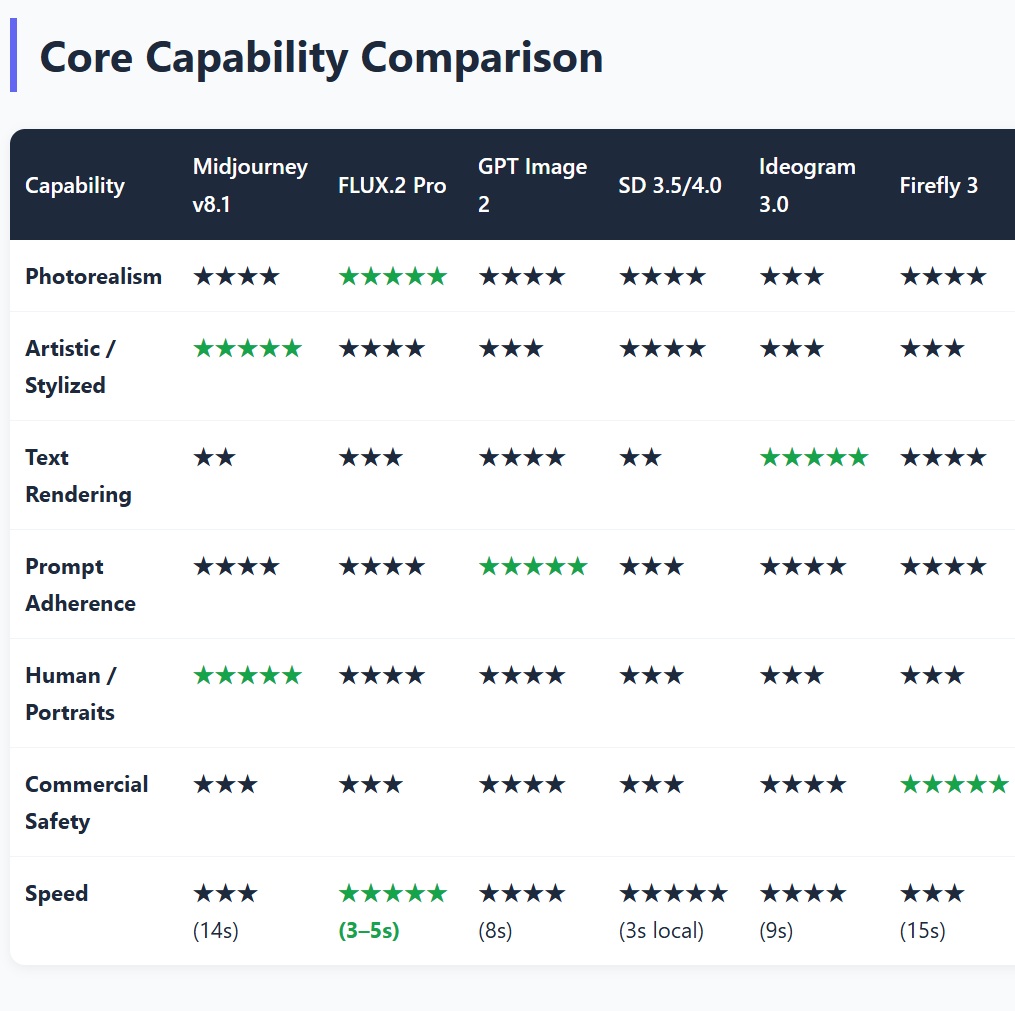
Core Capability Comparison
| Capability | Midjourney v8.1 | FLUX.2 Pro | GPT Image 2 | SD 3.5/4.0 | Ideogram 3.0 | Firefly 3 | Recraft V3 | Imagen 4 |
|---|---|---|---|---|---|---|---|---|
| Photorealism | ★★★★ | ★★★★★ | ★★★★ | ★★★★ | ★★★ | ★★★★ | ★★★ | ★★★★★ |
| Artistic / Stylized | ★★★★★ | ★★★★ | ★★★ | ★★★★ | ★★★ | ★★★ | ★★★ | ★★★★ |
| Text Rendering | ★★ | ★★★ | ★★★★ | ★★ | ★★★★★ | ★★★★ | ★★★★★ | ★★★★★ |
| Prompt Adherence | ★★★★ | ★★★★ | ★★★★★ | ★★★ | ★★★★ | ★★★★ | ★★★ | ★★★★ |
| Human / Portraits | ★★★★★ | ★★★★ | ★★★★ | ★★★ | ★★★ | ★★★ | ★★★ | ★★★★ |
| Commercial Safety | ★★★ | ★★★ | ★★★★ | ★★★ | ★★★★ | ★★★★★ | ★★★★ | ★★★★ |
| Speed | ★★★ (14s) | ★★★★★ (3–5s) | ★★★★ (8s) | ★★★★★ (3s local) | ★★★★ (9s) | ★★★ (15s) | ★★★★★ (fast) | ★★★★ (10s) |
Detailed Model Analysis
Midjourney v8.1 Best for Art
Midjourney v8.1 is the undisputed king of artistic image generation. It produces images 4–5× faster than v7, follows detailed prompts more accurately, and renders text noticeably better (though still behind specialists). The new native 2K HD mode delivers stunning detail without external upscaling. Its signature aesthetic — cinematic lighting, painterly composition, rich color grading — remains unmatched.
For concept art, editorial illustration, marketing visuals, and any work where aesthetic beauty is the primary goal, Midjourney wins 34 out of 50 blind aesthetic tests against all competitors (per independent panel testing in 2026).
Strengths
- Unrivaled artistic flair and cinematic lighting
- Native 2K output via HD mode
- Style reference (–sref) for brand consistency
- Voice prompts for natural generation
- Strong community and prompt-sharing ecosystem
Weaknesses
- Text rendering still weak (~41% accuracy for phrases)
- No official API for automation
- Discord/web only — no programmatic pipelines
- No free tier
- Higher-tier plans required for commercial use at scale
FLUX.2 Pro / Max / Klein Best for Realism
FLUX.2 has replaced FLUX.1 as Black Forest Labs’ flagship. The family includes five variants: Max (top quality, ELO ~1,190), Pro (production scale, from $0.03/megapixel), Flex (adjustable, best for typography), Dev (balanced), and Klein (lightweight, 4B open-source). FLUX.2 Max leads photorealism benchmarks with exceptional skin texture, fabric detail, and lighting accuracy.
The Klein-4B variant under Apache 2.0 license is a game-changer for self-hosting — unrestricted commercial use, no per-image fees beyond compute.
Strengths
- Best-in-class photorealism (tied with Imagen 4)
- Open-weight Klein-4B (Apache 2.0)
- Fast generation: 3–5 seconds per image
- Cost-effective: as low as $0.003/image
- Multiple variants for different use cases
- Grounded generation (web context) in Max tier
Weaknesses
- Narrower aesthetic range than Midjourney
- Human interactions can look slightly stiff
- Licensing varies by variant (Pro/Max = paid commercial)
- Smaller community ecosystem than Stable Diffusion
GPT Image 2 Best for Prompts
GPT Image 2 (the successor to GPT Image 1.5) is the most “intelligent” image generator available. Built by the same team behind the world’s best language model, it follows complex, multi-sentence instructions without dropping a single detail. Native integration with ChatGPT enables conversational iteration — describe, refine, and regenerate in natural language.
It correctly renders complex prompts like “a cat wearing a tuxedo, holding a blue umbrella, standing on a giant strawberry in a desert” on the first try — a task most competitors fail. Text rendering is strong at ~95% accuracy for short phrases.
Strengths
- Best prompt adherence of any model
- Conversational iteration via ChatGPT
- Excellent text rendering (~95% accuracy)
- Strong semantic understanding (“mid-century modern” vs “minimalist”)
- Commercial rights on all tiers
Weaknesses
- High-end variants expensive ($0.211/image for Image 2 High)
- No fine-grained style control like Midjourney’s –sref
- Less distinctive artistic “look”
- API latency 10–20 seconds
Stable Diffusion 3.5 / 4.0 Open Source
Stable Diffusion remains the only truly open-source model in this comparison. SD 3.5 (10.5B parameters) and SD 4.0 offer full control over the generation process — LoRA fine-tuning, custom pipelines, local execution with no usage restrictions. The community has built thousands of model variants, making it the most flexible option for technical users.
Self-hosted on an RTX 4090, SDXL generates ~900 images/hour at a cost of ~$0.0005/image — the lowest cost-per-image of any option. Break-even vs. managed APIs is around 2,700 images/day.
Strengths
- Fully open-source — no restrictions, no fees
- LoRA fine-tuning for brand-specific styles
- Lowest cost at scale (self-hosted)
- Largest community and model ecosystem
- Local execution — complete privacy
Weaknesses
- Requires technical setup (Python, GPU, drivers)
- Fragmented community — inconsistent best practices
- Text rendering poor without fine-tuning
- Quality highly variable depending on model and setup
Ideogram 3.0 Best for Text
Ideogram 3.0 has one superpower: typography. It renders correctly spelled, properly styled text in images 87–95% of the time — compared to DALL-E 3’s ~71% and Midjourney’s ~41%. For social media graphics, poster design, logo concepts, and marketing materials where text legibility matters, Ideogram is in a class of its own.
Beyond text, image quality is good but not exceptional — it’s a specialist tool, not an all-rounder. The dedicated design tooling (Reframe, Remix, Replace Background) and character-reference consistency add practical value for production workflows.
Strengths
- Best-in-class text rendering (90%+ accuracy)
- Dedicated design tools (Reframe, Remix)
- Character-reference consistency
- Generous free tier (10 prompts/week)
- Affordable paid plans ($8/month)
Weaknesses
- Narrower aesthetic range than Midjourney
- Good but not exceptional for photorealism
- Credit-based system — unpredictable costs at volume
- Self-hosted weights require separate commercial license
Adobe Firefly Image 3 Enterprise Safe
Adobe Firefly Image 3 is purpose-built for professional creative workflows. Trained exclusively on licensed Adobe Stock imagery and public domain content, it is the only model offering legal IP indemnification — Adobe will legally defend you if a Firefly image ends up in an IP dispute. For agencies and enterprises, this is the only defensible choice from a legal standpoint.
Deep integration with Photoshop, Illustrator, and Premiere makes it seamless for existing Adobe users. Image quality is consistently professional — not quite Midjourney’s ceiling, but reliable for commercial work.
Strengths
- Legal IP indemnification (unique in the market)
- Native Creative Cloud integration
- Trained on licensed content — legally safe
- Consistent, professional output quality
- Unlimited standard generations on paid plans
Weaknesses
- Less creative range than Midjourney
- Tied to Adobe ecosystem
- More conservative aesthetic
- Expensive if not already using Creative Cloud
Recraft V3 Best for Vectors
Recraft V3 is the only AI image generator producing native SVG vector output. When you generate with vector mode, you get actual SVG files with proper paths, curves, and anchor points that open cleanly in Illustrator or Figma — no manual tracing required. V3 reduced anchor point count by 60% vs. V2 for smoother curves.
Beyond vectors, Recraft offers Brand Kit (upload your assets, enforce color palette), long-form text rendering (full sentences, not just words), and a comprehensive AI editing suite. It topped the Hugging Face Text-to-Image Benchmark by Artificial Analysis.
Strengths
- Only model with native SVG vector output
- Brand Kit for style consistency
- Long-form text rendering (full sentences)
- Complete AI editing suite (eraser, inpaint, outpaint, mockups)
- 4.7 stars on G2 (80% five-star ratings)
Weaknesses
- Photorealism behind Midjourney and FLUX
- Smaller community ecosystem
- Subscription-only for commercial use
- Free tier outputs are public
Google Imagen 4 Photorealism
Google Imagen 4 is frequently cited as producing the most photorealistic output of any publicly available model — skin texture, fabric detail, and reflections are especially strong. It also excels at text-in-image rendering (legible captions, signage, UI mockups). Available through Vertex AI with enterprise-grade billing and IAM.
Note: Google is retiring standalone Imagen on August 17, 2026, recommending migration to the Nano Banana models integrated into Gemini.
Strengths
- Best-in-class photorealism (tied with FLUX.2 Max)
- Excellent text rendering
- 4K output support
- Enterprise-grade infrastructure via Google Cloud
- Strong multimodal integration with Gemini
Weaknesses
- Google Cloud ecosystem lock-in
- Regional availability varies
- Token-based pricing can be confusing
- Transition to Nano Banana models adds uncertainty
Leonardo.ai Game Assets
Leonardo.ai focuses on game asset creation and consistent character generation. It excels at creating recurring characters and brand mascots across multiple images, with built-in asset libraries. The hosted interface provides Stable Diffusion-like capabilities without technical setup.
Strengths
- Best for game asset creation
- Consistent character generation
- Generous free tier (150 credits/day)
- No technical setup required
- Built-in asset libraries
Weaknesses
- Photorealism behind top-tier models
- Credit system can be limiting at scale
- Less suited for fine art or editorial
Freepik AI Suite Multi-Model
Freepik bundles 8 AI image models into a single subscription at €12/month — the cheapest way to test multiple models before committing. It’s not a model itself but a platform aggregating Midjourney, FLUX, SD, and others with a unified interface.
Strengths
- 8 models in one subscription
- Lowest entry cost for multi-model access
- Unified interface
- Good for exploration and comparison
Weaknesses
- No proprietary model
- Quality depends on underlying models
- No API access
Chinese AI Image Models
通义万相 Wanx 2.6 Best for Chinese
通义万相 (Tongyi Wanxiang) is Alibaba’s flagship text-to-image model, trained on massive Chinese datasets. It excels at understanding Chinese prompts, traditional art styles (ink painting, Gongbi, landscape), and e-commerce product photography. Deeply integrated with Taobao ecosystem, it’s the top choice for Chinese merchants creating product listings and marketing materials.
Wanx 2.6 supports HTTP synchronous calls for faster response, flexible aspect ratios (1:4 to 4:1), and intelligent prompt rewriting. The API pricing at ¥0.20/image (~$0.03) makes it one of the most cost-effective options for high-volume generation.
Strengths
- Best Chinese prompt understanding
- Excellent for e-commerce product photos
- Traditional Chinese art styles (ink, Gongbi)
- Low API cost (¥0.20/image)
- Domestic access, fast response
Weaknesses
- Less artistic flair than Midjourney
- Photorealistic details slightly weaker
- Limited international presence
即梦 Jimeng (Seedream 5.0) Most Generous Free Tier
即梦 (Jimeng) is ByteDance’s all-in-one AI creation platform, powered by the Seedream image model and Seedance video model. It offers the most generous free tier in China — 200 daily credits, enough for regular use without payment. Deeply integrated with Jianying (CapCut China), it’s the go-to tool for short video creators.
Seedream 5.0 Pro features real-time web search for context and intelligent logical reasoning. The platform also supports image-to-video, dynamic posters, and motion imitation. In 2026, Jimeng partnered with the prestigious Hundred Flowers Film Awards for AIGC content creation.
Strengths
- Most generous free tier (200 credits/day)
- Chinese-friendly, domestic access
- Deep Jianying (CapCut) integration
- Short video creators’ first choice
- Flexible credit system
Weaknesses
- Less artistic than Midjourney
- Hand details slightly weak
- Complex lighting effects less refined
可图 Kolors Best Chinese Text Rendering
可图 (Kolors) by Kuaishou is the leading Chinese model for rendering Chinese characters within images. Unlike other models that produce garbled text, Kolors accurately generates Chinese characters for posters, logos, and marketing materials. This unique capability makes it indispensable for designs requiring embedded Chinese text.
Kolors is fully open-source and free to use, with strong performance in traditional Chinese styles and cultural scenes. While overall image quality is slightly lower than Jimeng or Wanx, its text rendering accuracy is unmatched in the Chinese market. Mobile-first design makes it more accessible on phones than PC.
Strengths
- Best Chinese text rendering in images
- Completely free
- Good for traditional Chinese scenes
- Open-source, self-hostable
Weaknesses
- Overall image quality slightly lower
- Weak PC presence
- Mobile experience better than desktop
腾讯混元 Hunyuan 3.0 WeChat Ecosystem
腾讯混元 (Tencent Hunyuan) is deeply integrated into the WeChat ecosystem. Generated images can be shared directly to WeChat with one click, making it ideal for private domain marketing. Hunyuan 3.0 is optimized for Chinese business scenarios and brand style reproduction, producing clean, commercial-oriented outputs.
The model is open-source (Hunyuan 3.0 image model) with over 3,000 derived models in the community. Core features are free with periodic resource pack distributions. It’s the top choice for WeChat Official Account, Video Account, and enterprise promotional materials.
Strengths
- Best WeChat ecosystem integration
- Completely free
- Optimized for Chinese business scenes
- Clean, commercial style
- Open-source, self-hostable
Weaknesses
- Less artistic tension
- Default style conservative
- Limited international presence
文心一格 Wenxin Yige Largest Style Library
文心一格 (Wenxin Yige) by Baidu offers the largest preset style library among Chinese AI image tools — anime, realistic, oil painting, cyberpunk, and more can be selected with one click. Users earn credits through daily check-ins, tasks, and sharing, providing 10-20 free images daily for casual users.
Integrated with Baidu’s ecosystem and accessible via WeChat scan, it’s beginner-friendly for creating avatars, WeChat covers, and promotional posters. However, model iteration speed lags behind ByteDance’s offerings, and hand details plus complex lighting are one tier below Jimeng.
Strengths
- Largest preset style library
- Beginner-friendly interface
- Baidu ecosystem integration
- WeChat scan access
Weaknesses
- Slower model iteration
- Hand details and lighting weaker
- Limited advanced features
Pricing Comparison
| Model | Free Tier | Subscription | Cost / Image (API) | Commercial License |
|---|---|---|---|---|
| Midjourney v8.1 | None | $10–$120/mo | ~$0.05–$0.10 (by fast-hours) | Paid plans only |
| FLUX.2 Pro | None | None (pay-per-use) | $0.03–$0.07 | Paid usage |
| FLUX.2 Klein-4B | Free (Apache 2.0) | N/A | $0.00 (self-hosted) | Unrestricted |
| GPT Image 2 | 3 images/day | $20/mo (ChatGPT Plus) | $0.005–$0.211 | All tiers |
| Stable Diffusion 3.5 | Free (open-source) | N/A | $0.00 (self-hosted) – $0.065 (API) | Check per model |
| Ideogram 3.0 | 10 prompts/week | $8–$48/mo | $0.03–$0.09 | Paid plans |
| Adobe Firefly 3 | 25 credits/mo | $9.99–$199.99/mo | Included in plan | Yes + IP indemnification |
| Recraft V3 | 50 credits/day | $12–$48/mo | ~$0.04 | Paid plans |
| Google Imagen 4 | None | None (pay-per-use) | $0.02–$0.06 | Yes |
| Leonardo.ai | 150 credits/day | $10–$48/mo | $0.03–$0.07 | Paid plans |
| Wanx 2.6 (通义万相) | Free tier available | N/A | ~$0.03 (¥0.20/image) | Yes |
| Jimeng Seedream 5.0 (即梦) | 200 credits/day | ¥949/year | Free (via credits) | Yes |
| Kolors (可图) | Free | N/A | Free | Yes |
| Hunyuan 3.0 (腾讯混元) | Free | N/A | Free | Yes |
| Wenxin Yige (文心一格) | 10–20 credits/day | N/A | Free (via tasks) | Yes |
Recommendations by Use Case
Artistic / Concept Art
Unrivaled aesthetics, cinematic lighting, painterly quality. The benchmark for beauty. Use for hero images, editorial illustrations, mood boards, and any output where visual impact matters most.
Photorealistic Product Shots
Best photorealism — skin texture, fabric detail, reflections. FLUX.2 for API workflows; Imagen 4 for 4K output. Both produce images indistinguishable from professional photography.
Text in Images (Posters, Logos)
90%+ text accuracy — 2× better than any competitor. For social media graphics, poster design, packaging mockups, and marketing materials with embedded text.
Complex Prompt Accuracy
Follows multi-sentence instructions without dropping details. Conversational iteration via ChatGPT. Best for storyboard artists, conceptual thinkers, and specification-driven imagery.
Commercial / Enterprise
Only model with IP indemnification. Trained on licensed content. Deep Creative Cloud integration. The only legally defensible choice for agencies and brands.
Vector / Brand Design
Only model with native SVG output. Brand Kit for consistency. Long-form text rendering. For UI/UX designers, brand identity work, and icon libraries.
Maximum Flexibility / Low Cost
Fully open-source. LoRA fine-tuning. Self-hosted at $0.0005/image. For technical users, custom pipelines, and high-volume generation where cost matters.
Game Assets / Characters
Consistent character generation across images. Built-in asset libraries. Generous free tier. For game developers and brand mascot creation.
Decision Framework
1. Need maximum beauty? → Midjourney v8.1
2. Need photorealism? → FLUX.2 Pro or Google Imagen 4
3. Need text in images? → Ideogram 3.0 or Recraft V3
4. Need complex instructions followed exactly? → GPT Image 2
5. Need legal safety for commercial use? → Adobe Firefly Image 3
6. Need vector output? → Recraft V3 (only option)
7. Need lowest cost? → Stable Diffusion (self-hosted) or FLUX Klein-4B
8. Need API for automation? → FLUX.2 Pro, GPT Image 2, or Imagen 4
9. Need open-source? → Stable Diffusion 3.5/4.0 or FLUX Klein-4B (Apache 2.0)
Key Takeaways
1. No single “best” model exists. Each model has carved out a specialty — Midjourney for art, FLUX for realism, Ideogram for text, GPT Image for prompt accuracy, Firefly for commercial safety, Recraft for vectors.
2. Open-source is viable at scale. FLUX Klein-4B (Apache 2.0) and Stable Diffusion offer unrestricted commercial use. Self-hosted cost can be as low as $0.0005/image — 100× cheaper than managed APIs.
3. Text rendering is solved. Ideogram 3.0 (90%+), GPT Image 2 (95%), and Recraft V3 can reliably render text in images. Midjourney still struggles at ~41%.
4. Commercial safety matters. Only Adobe Firefly offers IP indemnification. All others grant usage rights but don’t defend you in IP disputes. For enterprise use, this distinction is critical.
5. Cost varies 100×. From free (self-hosted SD) to $0.211/image (GPT Image 2 High). Your choice should be driven by use case, not just price — a $0.003 image with wrong text costs more than a $0.21 image with perfect text.
© 2026 DeepForgeHub Research. Data sourced from Artificial Analysis, community benchmarks, and hands-on testing. Model versions and pricing as of September 2026.