
Text-to-Video Model Pricing Worldwide 2026
Same model, different shelf
Value score (unofficial)
Hidden cost multiplier
China platforms
Self-hosting
Third-party platform rates
Executive Summary
This report answers one question: if you want AI-generated video in 2026, where do you buy it and what does it actually cost. Not “which model is best”, but “how far apart can the price of the same video be, depending on where you buy it”.
- A 30x spread. Mainstream text-to-video APIs in 2026 run from $0.02 to $0.75 per second. The same 5-second clip costs $0.10 at the cheap end and $3.75 at the top.
- Quality and price have decoupled. ByteDance Seedance 2.0, at the top of the blind-vote arena, costs about $0.15/second — three to five times less than the priciest Western flagship, Veo 3.1 Standard at $0.40/second. The 2025 assumption that the best must also be the most expensive no longer holds.
- The same model can cost 2–6x more on a different shelf. Veo 3.1 Fast is $0.10/second direct from Google and $0.24/second through a reseller (2.4x). Seedance 2.0 at 1080p is $2.40/second on one platform and $0.40/second on another (6x). Choosing the platform saves more than choosing the model.
- Chinese platforms are the absolute price floor. Dreamina 3.0 runs CNY 0.28/second at 720p (about $0.039); Kling 2.6 silent 720p is CNY 0.3; Volcengine’s Seedance 2.0 mini at 480p is CNY 0.282 — roughly an order of magnitude below most overseas models.
- Google’s strongest video model is not Veo. Gemini Omni Flash (Elo 1245) ranks first on the blind arena, 150 points above Veo 3.1 (Elo 1095, 11th) — at $0.10/second. Almost nobody knows this.
- The Sora 2 API was shut down on 24 September 2026 and OpenAI names no replacement. Any pipeline still built on it needs to migrate now.
- Multiply the sticker price by 1.7. After failed generations (15–30%), iteration (1.5–2x), upscaling and bolt-on audio, real bills land about 70% above list.
1. Pricing Units: Normalise First, Compare Second
The easiest mistake in a pricing report is not bad data but comparing numbers that are in different units. Text-to-video in 2026 runs on four billing models at once, and without conversion they are not comparable.
1.1 Four billing units and how to convert them
| Billing model | Examples | How to convert | Where people go wrong |
|---|---|---|---|
| Per output second ($/s) | Google (Veo / Omni Flash), Kling, MiniMax, Volcengine, Dreamina, Vidu, PixVerse | Directly comparable; watch the resolution tier | The same model can differ 2–3x between 720p and 1080p |
| Credits / points | Runway (1 credit = $0.01), Luma, Google Flow | Credits per second × price per credit | The same credit is worth different amounts on a subscription vs the API (see Section 4) |
| Per token | Volcengine Seedance 2.0 / 2.5 | CNY per million tokens → divide by duration to get CNY/second | Rates are lower with video input, but billing counts input plus output duration |
| Per clip | Hailuo 2.3, Dreamina second packs | Clip price ÷ duration = effective per-second rate | Fixed lengths (6s / 10s); you do not get money back for shorter output |
1.2 Real cost = sticker price × 1.7
List pricing only covers the ideal single successful generation. A real bill adds these lines:
| Cost item | Magnitude | Note |
|---|---|---|
| First-pass discard rate | 15–30% | Most APIs still bill for generations that complete but are unusable |
| Iteration and re-generation | 1.5–2x | Reaching deliverable quality usually takes several rounds |
| Upscaling | $0.02–0.10/s | Many “1080p” outputs still need a post pass for client work |
| Bolt-on audio | $0.02–0.05/s | Silent models need TTS or music (native-audio models avoid this) |
| Aggregator markup | 0–25% | fal.ai, Replicate and similar resale layers |
The working rule in the industry: multiply the nominal per-second rate by 1.7 to get a realistic all-in cost including retries, post and audio. The rates in Section 2 are all list prices; Section 7 gives scenario maths with the 1.7 factor applied.
Calibration warning (read first)
- Prices come from each platform’s public pricing page and official documentation, captured in September 2026. This market reprices monthly — the Veo 3 family was cut roughly in half in September 2025. Confirm on the official page before you commit volume.
- Tiers are not interchangeable. “$0.05/second” may mean a 480p silent draft tier; “$0.40/second” may mean a 1080p standard tier with audio. Every figure here states its resolution and audio condition.
- CNY prices are converted at 1 USD ≈ 7.15 CNY, excluding FX movement, taxes and cross-border payment fees. Chinese platforms settle in CNY, which in practice is usually cheaper still.
- The “value score” in Section 5 is this report’s own five-dimension weighted model — not an official ranking and not investment advice. It is a relative comparison for procurement decisions.
- All per-second figures exclude prompt failures, model moderation rejections, asset storage and human labour.
2. Global Price Table
The table below sorts by 720p rate, cheapest first. It is probably the one page worth screenshotting.
| Model | Owner | 720p | 1080p | 4K | Native audio | Max single take | Billing |
|---|---|---|---|---|---|---|---|
| Dreamina 3.0 (China) | ByteDance | CNY 0.28 ≈ $0.039 | CNY 0.63 ≈ $0.088 | — | No | — | Per second / packs |
| Kling 2.6 (silent) | Kuaishou | CNY 0.3 ≈ $0.042 | CNY 0.5 ≈ $0.070 | — | No | 10s | Per second |
| Seedance 2.0 mini | ByteDance | CNY 0.605 ≈ $0.085 | — | — | No | — | Per second |
| MiniMax H3-Max | MiniMax | $0.08 (768p) | — | 2K $0.13 | Yes | 15s | Per second |
| Kling 3.0 (silent) | Kuaishou | CNY 0.6 ≈ $0.084 | CNY 0.8 ≈ $0.112 | CNY 3.0 ≈ $0.42 | No | 15s | Per second |
| Veo 3.1 Lite | $0.05 | $0.08 | Not supported | Yes | 8s | Per second | |
| Veo 3.1 Fast | $0.10 | $0.12 | $0.30 | Yes | 8s | Per second | |
| Gemini Omni Flash | $0.10 | — | — | Yes | 10s | Per second | |
| Wan 2.7 | Alibaba | ~$0.06 | ~$0.10 | — | Yes | 15s | Per second / open weights |
| Kling 3.0 Turbo (audio) | Kuaishou | CNY 0.8 ≈ $0.112 | CNY 1.0 ≈ $0.140 | — | Yes | — | Per second |
| Runway Gen-4 Turbo | Runway | $0.05 | — | — | No | — | Credits |
| Runway Gen-4.5 | Runway | $0.12 | — | Upscale extra | No | 10s | Credits |
| Luma Ray 3 | Luma AI | ~$0.06 | ~$0.24 | — | No | 5s | Credits |
| PixVerse V6 | PixVerse | ~$0.04–0.08 | — | — | No | — | Per second |
| Vidu Q3 | Shengshu | ~$0.04–0.08 | Same tier | — | Yes | 16s | Per second |
| Seedance 2.0 | ByteDance | CNY 1.208 ≈ $0.17 | CNY 3.014 ≈ $0.42 | CNY 6.22 ≈ $0.87 | Yes | 15s | Per second |
| Veo 3.1 Standard | $0.40 | $0.40 | $0.60 | Yes | 8s | Per second | |
| Sora 2 Retired | OpenAI | $0.10 (historic) | $0.70 (historic) | — | Yes | 12s | Shut down 24 Sep 2026 |
2.1 Three price bands
The conclusion is blunt: the floor for deliverable quality has been pushed to around $0.04/second, while the tier people pay for “cinematic look + 4K + native dialogue” runs past $0.60/second. Picking the wrong tier costs more than picking the wrong model.
3. Model Price Cards
H3 scores highest here because it satisfies three things that usually conflict: second place on blind preference, a rate in the lower half of the workhorse tier, and native audio. At $0.08/second for 768p it undercuts most silent models; the 2K tier at $0.13/second is mid-to-low for a top-tier model. The first five reference images are free ($0.04 each after that) and audio references are free. Failed generations and moderation rejections are not charged. Weights are published on Hugging Face (H3-Base, 768p) under a community licence that permits commercial self-hosting below $20M annual revenue.
Strengths
- Blind arena Elo of 1238 (2nd globally) at one fifth to one eighth of flagship pricing
- Audio generated jointly with picture, removing bolt-on TTS cost
- Failures and rejections are not billed, so trial cost stays predictable
- Open weights allow self-hosting with near-zero marginal cost
Weaknesses
- 720p tier is delivered at 768p, not a standard 720p spec
- Open release is 768p only; the 2K regeneration step is not open
- Commercial use above $20M annual revenue requires written permission
- The older per-clip Hailuo 2.3 is more expensive — easy to pick the wrong tier
Wan 2.7 (Tongyi Wanxiang)
Best open-weight option
Alibaba’s Wan strikes the best balance of value and control among open models. The API runs about $0.06/second and the weights are open — deployed on your own GPUs, the marginal cost falls to electricity plus operations. Its signature capability is identity lock from reference images: feed it five references and it holds the same face across a 15-second multi-shot sequence, which matters for product hero visuals and episodic content. Audio is generated natively.
Strengths
- Open weights; self-hosted marginal cost approaches electricity
- Five-image identity lock gives the strongest cross-shot consistency at this price
- 15-second single takes reduce stitching overhead
- API rate sits below most Western models
Weaknesses
- Self-hosting needs A100/H100 class hardware — a high bar for individuals
- Picture quality is not first tier (Elo 1109–1160)
- Regional availability and quotas for the official API vary by territory
- Ecosystem and documentation trail Runway and similar platforms
Kling has the finest-grained price ladder of any model here. Within Kling 3.0 alone there are Turbo, standard and Omni lines priced across resolution × audio × reference video, from CNY 0.6 to CNY 3.0 per second — a 5x spread inside a single model. Its top-10 arena placing comes mainly from motion quality: fast action, dance and sports read more naturally than most rivals. Chinese developers can connect directly to the official API in CNY with no cross-border payment friction.
Strengths
- Finest tier granularity — cheap drafts, paid finals, precisely targeted
- Motion and physics quality in the first tier
- Direct Chinese access with CNY settlement, no cross-border friction
- Failed generations do not consume credits
Weaknesses
- Three-axis pricing makes cost estimation genuinely hard
- The 4K tier at CNY 3.0/second is too expensive for high-frequency testing
- Native audio adds roughly 50% and can raise failure rates
- Overseas access may need extra network configuration in some regions
Seedance 2.0 is a permanent resident of the arena’s top tier (Elo 1223, first on text-to-video in several snapshots). Its calling card is multi-shot coherence — carrying the same subject through two or three hard cuts inside one 10-second clip, something almost nothing else does at this price. Audio and picture are generated jointly and delivered as separate tracks (dialogue, ambience, music). The cost is a steep resolution premium: 2.5x from 720p to 1080p, 5x to 4K.
Strengths
- First-tier picture quality with the strongest multi-shot consistency
- 720p at $0.17/second is reasonable for this quality level
- High reference limits (9 images / 3 videos / 3 audio) suit episodic content
- Available in China in CNY; overseas via BytePlus
Weaknesses
- 1080p at $0.42/second is 2.5x the 720p rate — a steep cliff
- 4K at $0.87/second sits in the most expensive band of the table
- With video input, billing counts input plus output duration
- The 2.5 generation moved to token billing, making cost harder to forecast
Dreamina 3.0 (China)
Lowest absolute price
The cheapest line in the table. Dreamina 3.0 lists CNY 0.28/second at 720p (about $0.039) and CNY 0.63 at 1080p; second packs work out to the same CNY 0.28. That undercuts the cheapest overseas draft tiers by more than half. The trade-offs are explicit: mainland China only, and a concurrency ceiling of 2 on paid accounts, with audio and picture capability a step below the leading tier.
Strengths
- Lowest rate in the table — roughly $0.039/second at 720p
- Second packs let long-running work lock in cost up front
- CNY settlement, direct access in China, no cross-border friction
Weaknesses
- Concurrency of 2 becomes the bottleneck in volume production
- Strict regional restriction; overseas teams essentially cannot use it
- Audio and picture capability behind Seedance and Hailuo
- Packs are non-refundable and expire after one year
Gemini Omni Flash
Google’s best, underrated
The most counter-intuitive finding in this report: Google’s highest-ranked video model on blind preference is not Veo. Gemini Omni Flash tops the arena at Elo 1245, 150 points above Veo 3.1’s 1095, at $0.10/second — a quarter of Veo 3.1 Standard. Veo is the model with the product page, the named tiers and the published rate card; Omni Flash is a Gemini variant that happens to generate video, and it is the one people actually prefer when they vote blind.
Strengths
- Ranked first globally on blind preference at one quarter of Veo Standard pricing
- Native audio included in the rate, no bolt-on cost
- Google infrastructure, compliance and enterprise procurement path
Weaknesses
- Still a preview model; capability and quotas may change
- 720p and a 10-second ceiling — below rivals at the same price
- Documentation and ecosystem maturity trail the Veo line
- Practical access and payment barriers for mainland China teams
PixVerse V6 / Vidu Q3
Budget pair
These two Chinese labs provide the second option in the $0.04–0.08/second band. Vidu Q3’s 16-second single take is the longest in its class — double the 8-second ceiling most rivals impose, which means fewer stitches for the same finished length, and that alone saves money. PixVerse leans toward stylised effects and templates. Both suit “volume over maximum fidelity” workloads.
Strengths
- Rates sit in the cheapest band available
- Vidu’s 16-second takes cut stitching and consistency losses
- Available in China with CNY billing
Weaknesses
- Picture quality and physics trail the first tier
- Fewer resolution and audio options
- Weaker overseas access and documentation
Veo 3.1 Fast
Cheapest official audio tier
This is the value entry point for audio-capable video inside Google’s stack: $0.10/second with audio, four times cheaper than the Standard tier. Two things to note. First, Vertex AI’s video-only SKU is cheaper still (720p/1080p at $0.08/second) — but removing audio means a different SKU. Second, the price gap between Fast and Standard is far larger than the quality gap, and Fast is enough for most work.
Strengths
- Cheapest audio-native tier in Google’s official stack ($0.10/s)
- Native audio-visual sync, removing bolt-on TTS
- SLA, enterprise procurement and compliance backing
Weaknesses
- Only 8 seconds per take; long pieces need repeated stitching
- Resellers mark it up heavily — as high as $0.24/second
- The rate jumps at higher resolutions (4K $0.30/second)
Runway’s value is not its rate but its workflow: it is the only platform stitching generation, editing, professional export (ProRes, PNG sequences, alpha channel, 16-bit HDR) and Adobe panels into one chain. At $0.12/second it is mid-priced for a flagship, but with no native audio, broadcast-grade delivery needs a separate audio pass. The real hazard is that the same model costs 2.4x more or less depending on which of three purchase channels you use (see Section 4).
Strengths
- Most complete post-production ecosystem; drops into existing edit pipelines
- API rate ($0.12/s) undercuts the equivalent subscription maths
- Gen-4 Turbo at $0.05/second makes drafting very cheap
- Clear commercial licensing, including on the free tier
Weaknesses
- No native audio; TTS or music must be bought separately
- Three overlapping price paths (subscription / API / top-up packs) make overpaying easy
- Web credits and API credits are separate accounts and cannot be shared
- Subscriptions are billed per editor seat
Luma Ray 3
Middle of the road
Luma’s 720p tier is inexpensive at roughly $0.06/second, but jumping to 1080p multiplies the rate by four ($0.24/second) — one of the steepest resolution premiums in this report. Its subscription model lets the same credits serve both the web app and the API (top-up packs stay valid for 12 months), which suits teams with moderate, steady usage.
Strengths
- Low 720p rate, good for cheap testing
- Subscription credits work across web and API (unlike Runway)
- Ray 3.2 supports up to 16 keyframes for control
Weaknesses
- 720p to 1080p multiplies the rate by four — the steepest cliff here
- No native audio
- Only 5 seconds per take, so stitching costs add up
- Picture quality has not reached the first tier
Veo 3.1 Standard is the most expensive flagship SKU in the table and the clearest case of price and blind preference diverging: at $0.40/second it costs five times MiniMax H3 while scoring 143 Elo lower. Its genuine strengths are not what blind voters reward — cinematic lighting, lens language, dialogue-grade audio sync, native 4K and an enterprise procurement path. Those are production properties. If the brief explicitly says “cinematic”, it earns its price; if you just need “a good-looking video”, you are paying four to five times over.
Strengths
- Best native audio quality; leading lip-sync for dialogue
- Native 4K output, no upscaling pass needed
- Most complete enterprise procurement, SLA and compliance story
- Leading lens language and cinematic feel among Western models
Weaknesses
- $0.40/second is four to five times models with equal or better blind scores
- Only 8 seconds per take, so stitching multiplies cost on longer pieces
- Ranks 11th on blind preference, below several Chinese models
- The older Veo 3 (3.0 series) was retired on 30 June 2026, forcing migration
Sora 2
Discontinued
The product that made “AI video” a household term in 2024 exited in 2026. The consumer app stopped on 26 April; the Videos API along with the sora-2 and sora-2-pro models shut down on 24 September, and OpenAI’s deprecation table names no recommended replacement. Historic pricing was $0.10/second at 720p, $0.30 for Pro at 720p, $0.50 at 1024p and $0.70 at 1080p, with Batches at half price. Any production pipeline still depending on it should migrate to Veo 3.1 (realism plus audio) or to Seedance 2.0 / Kling 3.0 on cost.
Strengths (historic)
- One of the first flagships with native synchronised audio
- Batch tier at half price for non-urgent queues
- Leading physics and complex motion at launch
Weaknesses
- Fully shut down with no replacement API
- Vendor durability is now a mandatory selection criterion
- The migration window was extremely short — months from announcement to shutdown
4. Same Model, Different Shelf
This is the most important section of the report. Most comparisons only put model against model, but in 2026 the largest price differences come from who you buy from, not which model you buy.
4.1 Cross-platform price gaps
| Model (spec) | Direct from vendor | Aggregator / reseller | Subscription equivalent | Max spread |
|---|---|---|---|---|
| Veo 3.1 Fast (720p) | Google $0.10/s | Reseller $0.24/s | Flow credits (tiered) | 2.4x |
| Veo 3.1 (with audio) | Gemini API $0.40/s | Runway $0.40/s | Vertex video-only $0.20/s | 2.0x |
| Runway Gen-4.5 | API $0.12/s | — | Max plan $0.096/s vs Standard plan $0.23/s | 2.4x |
| Seedance 2.0 (1080p) | Volcengine CNY 3.014 ≈ $0.42/s | Luma 240 credits/s ($2.40) vs Runway 40 credits/s ($0.40) | — | 6.0x |
| Gen-4 Turbo | Runway $0.05/s | Reseller $0.08/s | — | 1.6x |
| Kling 3.0 (720p silent) | Official $0.084/s | fal.ai / resellers $0.084–0.113/s | — | 1.3x |
Lesson one: direct is usually cheapest
Veo 3.1 Fast is $0.10 direct and $0.24 through a reseller; Gen-4 Turbo is $0.05 direct and $0.08 through a reseller. Unless you specifically need one key for many models, going direct almost always costs less.
Lesson two: a subscription is not automatically cheaper
Runway Gen-4.5 costs $0.12/second via the API but $0.23/second on the Standard plan — subscribing doubles the unit cost. Only the Max plan ($0.096/second) actually wins.
Lesson three: 6x between platforms for one model
Seedance 2.0 at 1080p is $2.40/second on one platform and $0.40/second on another. That gap is bigger than anything you can save by switching models.
4.2 Aggregators: what you trade
| Platform | Model | Pricing position | Best for |
|---|---|---|---|
| fal.ai | One key across 600+ models | Mostly at or slightly above vendor price (Kling 3.0 matches the vendor) | Fast prototyping across many models |
| Replicate | Per runtime second, official models per output second | Broadly 30–50% above fal.ai | Self-hosted custom models, good documentation |
| Runway marketplace | Resells third-party models inside its credit system | Above vendor price, up to 6x on some models | Teams already deep inside Runway workflows |
| Luma marketplace | Resells third-party models against subscription credits | Steep resolution premiums | Luma subscribers calling other models incidentally |
4.3 Mainstream third-party platform rates
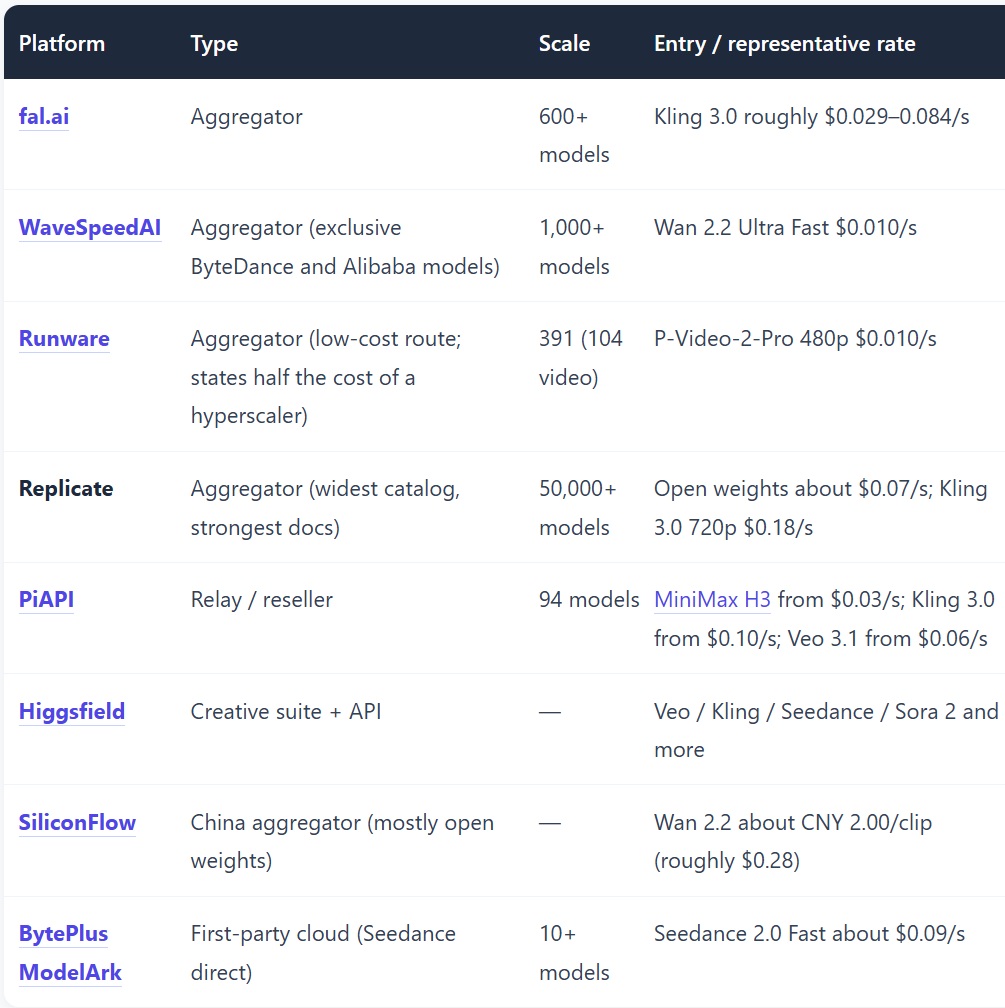
Section 4.1 compared the same SKU across channels; this section lays out the full published price list of third-party platforms — different tiers, resolutions and intermediaries included, which is why the ranges run far wider than 4.1. The eight platforms that matter today:
| Platform | Type | Scale | Entry / representative rate | Billing unit | Best for |
|---|---|---|---|---|---|
| fal.ai | Aggregator | 600+ models | Kling 3.0 roughly $0.029–0.084/s | Per output second | Lowest latency, real-time features |
| WaveSpeedAI | Aggregator (exclusive ByteDance and Alibaba models) | 1,000+ models | Wan 2.2 Ultra Fast $0.010/s | Per output second / per image | High-iteration batch testing |
| Runware | Aggregator (low-cost route; states half the cost of a hyperscaler) | 391 (104 video) | P-Video-2-Pro 480p $0.010/s | Per second | Budget-sensitive batch production |
| Replicate | Aggregator (widest catalog, strongest docs) | 50,000+ models | Open weights about $0.07/s; Kling 3.0 720p $0.18/s | Per GPU second / per output second | Self-hosting or trying niche models |
| PiAPI | Relay / reseller | 94 models | MiniMax H3 from $0.03/s; Kling 3.0 from $0.10/s; Veo 3.1 from $0.06/s | Per second or per clip | One gateway covering Chinese models |
| Higgsfield | Creative suite + API | — | Veo / Kling / Seedance / Sora 2 and more | Per generation | Creators; a rare Sora 2 resale route |
| SiliconFlow | China aggregator (mostly open weights) | — | Wan 2.2 about CNY 2.00/clip (roughly $0.28) | Per clip | China compliance and domestic compute |
| BytePlus ModelArk | First-party cloud (Seedance direct) | 10+ models | Seedance 2.0 Fast about $0.09/s | Per second | Enterprise SLA and 4K |
Put the same model side by side across sellers and the spread is hard to hide. These four shelves carry most of the third-party resale volume.
4.4 The same model, channel by channel
Veo 3.1: roughly 13x between direct and resold
| Channel | Type | Rate |
|---|---|---|
| Google Gemini API | Direct | Fast $0.10/s · Standard $0.40/s |
| Google Vertex AI | Direct, enterprise | Video only $0.20/s; Lite as low as $0.030–0.05/s |
| fal.ai | Aggregator | Lite $0.03–0.05 · Fast $0.08–0.10 · Standard $0.20–0.40 |
| PiAPI | Relay | From $0.06/s |
| WaveSpeedAI | Aggregator | veo-3-1-fast $0.15/s |
| Effective range | $0.03–0.40 (about 13x) |
Kling 3.0: 2.1x across platforms at 720p
| Channel | Type | 720p, no audio | 1080p, with audio |
|---|---|---|---|
| Kling official | Direct | $0.084/s | — |
| fal.ai | Aggregator | $0.084/s (Std) | $0.126–0.168/s (Pro) |
| WaveSpeedAI | Aggregator | $0.084/s | $0.168/s (Pro, with sound) |
| PiAPI | Relay | — | $0.20/s |
| Novita.ai | Aggregator | $0.168/s | $0.224/s |
| Replicate | Aggregator | $0.18/s | — |
| Effective range | $0.084–0.18 (2.1x) | $0.126–0.224 (1.8x) |
Seedance 2.0 / 2.5: roughly 31x across all channels
| Channel | Type | Rate |
|---|---|---|
| ByteDance ModelArk / BytePlus | Direct | Seedance 2.0 Fast about $0.09/s |
| Atlas (reseller) | Resale | As low as $0.022/s |
| PiAPI | Relay | 2.0 from $0.042/s; 2.5 from $0.15/s |
| WaveSpeedAI | Aggregator | seedance-2-0-fast $0.100/s |
| Runware | Aggregator | Seedance 2.5 480p $0.1025/s |
| fal.ai | Aggregator | Fast $0.2419/s (720p); Std $0.3034/s (720p) / $0.682/s (1080p) |
| Effective range | $0.022–0.682 (about 31x) |
Open-weight models: hosted per-second rates
| Platform | Representative models | Rate |
|---|---|---|
| Runware | MiniMax H3 / Wan 3.0 / LTX-2.5 | $0.046–0.12/s |
| fal.ai | Wan / Hunyuan / LTX | About $0.05/s |
| Replicate | Wan / Hunyuan | About $0.07/s |
| SiliconFlow | Wan 2.2 | About CNY 2.00/clip (roughly $0.28) |
Lesson 1: third-party pricing is layered, not uniform
First-party clouds (BytePlus / Volcano Engine / Google) sit at the bottom. Aggregators add 10–50% on top. Relay and creator platforms add another layer through their subscription credit systems. What that layer buys is one invoice, one key, and the ability to benchmark many models in one place. Below roughly 10,000 calls a month, the premium usually earns its keep.
Lesson 2: the fast and turbo tiers are where aggregators actually compete
The premium tier of the strongest models (Veo 3.1 Standard at $0.40, Seedance 2.5 at $0.68 for 1080p) is not where aggregators add value — that is plain resale and the comparison is uninteresting. The real spread lives in the 480p and 720p fast tiers: Wan 2.2 Ultra Fast at $0.010/s, P-Video-2-Pro at $0.010/s, MiniMax H3 Max Turbo at $0.025/s. For social short-form, keeping the budget in fast tiers lands you at $0.01–0.05/s.
Lesson 3: international resale of Chinese models can undercut the domestic direct price
Seedance 2.0 Fast runs about $0.09/s direct, yet resale routes reach as low as $0.022/s. That is not a subsidy — it is a billing-unit mismatch. The official surface bills on full 24fps token volume; resellers bill per output second. Convert both to the same unit before you compare, and do not assume the first party is automatically cheaper.
Four traps in third-party platform pricing
- Failed and retried generations still bill. Requests rejected by a content filter or lost to a render failure are still charged on some platforms, with no refund. Budget for that attrition on top of the 1.7 cost multiplier.
- Audio adds 50–100%. Kling 3.0 moves from $0.084/s silent to $0.126/s with sound (+50%); Veo 3.1 nearly doubles once audio is on. Treat native audio as its own cost switch.
- Tiers within one platform differ by 3–5x — more than platforms differ from each other. Pick the tier before you pick the platform. Choosing the wrong tier costs far more than choosing the wrong vendor.
- These numbers mix two sources. First-party rates come from each vendor’s own pricing page; resale and some aggregator rates come from third-party trackers (GenRates, AI Price Institute) and may lag or include promotional discounts. Collected September–October 2026 — confirm on the official page before ordering.
Decision rule: below roughly 10,000 calls a month, the convenience premium of an aggregator usually pays for itself; above it, the gap to going direct is wide enough to fund separate integrations.
5. Value Scoring (Unofficial)
5.1 Dimensions and weights
| Dimension | Weight | What it measures |
|---|---|---|
| Unit cost | 30% | Nominal per-second rate at 720p / the workhorse tier; lower scores higher |
| Picture quality | 25% | Artificial Analysis blind-vote Elo (text-to-video with audio board) |
| Spec ceiling | 15% | Max single take, top resolution, reference input limits |
| Audio-video | 15% | Native audio, multi-track output, lip-sync quality |
| Access and durability | 15% | Regional availability, payment, vendor longevity, SLA |
Dimension scores are integers from 0 to 10; the total is Σ(score × weight) ÷ 100. This scoring model is this report’s own procurement heuristic — not an official ranking and not investment advice. Where a dimension does not apply to a model it is marked N/A and the remaining weights are renormalised rather than scoring zero.
5.2 Overall value ranking
5.3 Dimension detail
| Model | Unit cost | Quality | Spec | Audio | Access | Weighted total |
|---|---|---|---|---|---|---|
| MiniMax H3 | 8 | 10 | 8 | 8 | 9 | 8.7 |
| Wan 2.7 | 8 | 9 | 8 | 8 | 9 | 8.4 |
| Kling 3.0 | 8 | 8 | 9 | 8 | 9 | 8.3 |
| Seedance 2.0 | 6 | 10 | 9 | 9 | 8 | 8.2 |
| Dreamina 3.0 | 9 | 8 | 8 | 7 | 6 | 7.9 |
| Gemini Omni Flash | 7 | 10 | 6 | 9 | 7 | 7.9 |
| PixVerse V6 / Vidu Q3 | 9 | 7 | 8 | 7 | 8 | 7.9 |
| Veo 3.1 Fast | 7 | 7 | 6 | 10 | 10 | 7.8 |
| Runway Gen-4.5 | 7 | 7 | 8 | 5 | 9 | 7.2 |
| Luma Ray 3 | 8 | 7 | 7 | 5 | 8 | 7.2 |
| Veo 3.1 Standard | 3 | 7 | 6 | 10 | 10 | 6.6 |
5.4 Dimension champions
About $0.039/second at 720p — under $2.40 per minute of output, the floor of the table.
Elo 1245, first globally, at a quarter of Veo Standard’s rate.
15-second takes, 4K, and generous reference inputs — fewest stitches for long or episodic work.
Native dialogue, lip-sync and sound design remain the benchmark — at a price.
Global availability, SLAs and enterprise procurement paths, at a premium.
Open weights drive long-run marginal cost toward electricity — if you own the GPUs.
5.5 Head-to-head
Dreamina 3.0 ($0.039/second) crushes everything on price, but caps concurrency at 2, sits a tier lower on quality and audio, and works only in mainland China. Seedance 2.0 ($0.17/second) costs four times more and buys first-tier quality, 15-second takes and multi-track audio. Verdict: for pure volume, Dreamina; for deliverable finished work, Seedance. The 4x gap buys “can I ship this as is”.
Veo 3.1 Fast is $0.10 direct and $0.24 through a reseller — but Vertex AI’s video-only SKU is $0.20 versus Gemini API’s $0.40 with audio. Verdict: the vendor’s own stack already contains several price paths. Exhaust the official SKUs before you consider an aggregator.
Veo 3.1 Standard at $0.40/second costs five times MiniMax H3 ($0.08) while scoring 143 Elo lower. Verdict: for “a good-looking short video”, the flagship premium is not worth it; for “cinematic lighting plus native 4K plus dialogue-grade audio”, it remains one of few options. Expensive and best are no longer the same thing in 2026.
Wan 2.7 and MiniMax H3 are both open-weight. At API rates of $0.06–0.08/second, 10,000 five-second clips a month costs roughly $3,000–4,000; an H100 cluster might cost less per year, but carries operations and model-maintenance labour. Verdict: the self-hosting break-even sits around 5,000–10,000 clips a month. Below that, buy the API.
6. Regions and Availability: The Real Global Menu
| Region | Platforms directly usable | Payment | Price level | Main obstacle |
|---|---|---|---|---|
| Mainland China | Dreamina, Kling, Volcengine, Wan, Vidu, PixVerse | Alipay / WeChat / corporate transfer | Lowest | Overseas models hard to access; outbound content needs international accounts |
| North America / Europe | Google (Veo / Omni Flash), Runway, Luma, fal.ai, Replicate | Credit card / procurement | Highest | Some Chinese models need an overseas entity; budget pressure |
| Southeast Asia | klingai.com international, MiniMax, Vidu, PixVerse | Card / local wallets | Low to mid | Some international endpoints need network setup; local payment rails incomplete |
| Middle East / Latin America | Mainly overseas platforms, with Chinese international portals secondary | Credit card | Mid to high | Cross-border payment cost; USD settlement and FX risk |
One structural fact is easily missed: producing on Chinese platforms and distributing globally can cost one third to one tenth of producing on overseas platforms. That is why content-export teams have broadly re-tooled their production side in 2026.
7. Hidden Costs and the Real Bill
7.1 Three worked scenarios (with the 1.7 factor applied)
Scenario one: a 30-second finished cut (at a 3:1 generation ratio, requiring 90 seconds of generated footage)
| Option | Nominal rate | 90 seconds generated | Real cost after ×1.7 |
|---|---|---|---|
| Dreamina 3.0 (720p) | CNY 0.28/s | CNY 25.2 | CNY 42.8 ≈ $6.0 |
| Kling 3.0 (720p silent) | CNY 0.6/s | CNY 54 | CNY 91.8 ≈ $12.8 |
| Veo 3.1 Fast (720p with audio) | $0.10/s | $9.0 | ≈ $15.3 |
| Seedance 2.0 (720p) | CNY 1.208/s | CNY 108.7 | CNY 184.8 ≈ $25.8 |
| Veo 3.1 Standard (1080p with audio) | $0.40/s | $36.0 | ≈ $61.2 |
Scenario two: 1,000 five-second clips a month (5,000 seconds, about 8,500 seconds with retries)
| Option | Nominal monthly | Adjusted monthly | Annualised |
|---|---|---|---|
| Dreamina 3.0 720p | CNY 1400 ≈ $196 | ≈ $333 | ≈ $3,990 |
| Kling 3.0 720p silent | CNY 3000 ≈ $420 | ≈ $714 | ≈ $8,568 |
| MiniMax H3 768p | $400 | ≈ $680 | ≈ $8,160 |
| Seedance 2.0 720p | CNY 6040 ≈ $845 | ≈ $1,437 | ≈ $17,244 |
| Veo 3.1 Standard 1080p | $2,000 | ≈ $3,400 | ≈ $40,800 |
The last column is the one to read: at the same output of 1,000 clips a month, the cheapest and the most expensive options differ by more than 10x over a year ($3,990 vs $40,800) — and the blind-vote quality gap between them is nowhere near 10x.
7.2 Four cost-optimisation moves
One: split draft from final
Iterate composition and prompts on the cheapest tier (Dreamina 720p / Gen-4 Turbo / Seedance mini), then render the locked shot on the workhorse tier. This typically removes 60%+ of wasted spend.
Two: switch off audio you do not need
The Kling audio tier costs about 50% more than silent and fails more often. Clips that will be scored anyway can be generated silent.
Three: match resolution to delivery
For social vertical video, the visual difference between 720p and 1080p is far smaller than the 2.5x price gap. Only open the higher tier when 1080p+ is explicitly required.
Four: go direct for API rates
Above roughly 10,000 calls a month, bypassing the aggregator layer typically removes another 10–25% of total cost.
8. Recommendations by Scenario
| Your need | Recommended option | Why |
|---|---|---|
| Absolute lowest cost, China only | Dreamina 3.0 720p | $0.039/second, the floor of the table; second packs lock the rate in further |
| Deliverable finished content | Seedance 2.0 / Kling 3.0 | First-tier quality, 15-second takes, generous reference inputs |
| Talking characters and voiceover | MiniMax H3 | Native joint audio-video, 2nd on blind Elo, at one fifth of flagship pricing |
| Explicitly cinematic / 4K delivery | Veo 3.1 Fast or Standard | Leading lighting and lens language, native 4K; step up to Standard only if budget allows |
| Volume drafting and A/B testing | Gen-4 Turbo / Seedance mini / Kling 2.6 | The $0.04–0.05/second band keeps trial cost minimal |
| Fast prototyping across many models | fal.ai | One key for 600+ models, mostly at vendor-level pricing |
| Own GPU cluster, long-run low cost | Wan 2.7 / MiniMax H3 self-hosted | Open weights drive marginal cost toward zero |
| Professional post-production integration | Runway Gen-4.5 | Premiere / After Effects panels, ProRes and alpha-channel exports |
9. Decision Framework
Profile A: individual creator, under $50 a month
Path: Dreamina 3.0 for drafts, MiniMax H3 for finals.
- Run every composition and prompt iteration on Dreamina 720p at under $0.2 a clip.
- Once the shot is locked, render on H3’s 768p tier — native audio removes the dubbing step.
- At this budget, stay away from the flagship tier: one Veo Standard clip costs as much as 20 iterations elsewhere.
Profile B: small team, under $500 a month
Path: Kling 3.0 as the workhorse, Seedance 2.0 for hero shots, free tiers for testing.
- Routine content on Kling 3.0 720p silent at CNY 0.6/second, where failures are not billed.
- Client-facing shots go to Seedance 2.0 or the Kling audio tier.
- Action point: put the 1.7 hidden-cost factor into your quotes — do not price from the sticker rate.
Profile C: volume production, over $5,000 a month
Path: direct vendor APIs, multi-model routing, and a self-hosting evaluation.
- Bypass the aggregator layer and negotiate direct volume pricing (Google Vertex, Volcengine and MiniMax all negotiate at scale).
- Build a three-tier router — draft, workhorse, flagship — assigned by shot importance. This is the only real cost lever at volume.
- Above 5,000–10,000 clips a month, evaluate the TCO of self-hosting Wan 2.7 or H3; open weights push marginal cost to electricity.
10. Key Findings
- A spread of over 30x. Mainstream text-to-video APIs in 2026 run $0.02–$0.75 per second; the same 5-second clip costs from $0.10 to $3.75.
- Quality and price have decoupled. Arena leaders Seedance 2.0 ($0.17/s) and MiniMax H3 ($0.08/s) are cheaper than Veo 3.1 Standard ($0.40/s) while scoring higher on blind preference.
- Picking the platform saves more than picking the model. One model spans 6x across channels (Seedance 2.0 at 1080p: $0.40 vs $2.40), and Runway Gen-4.5 spans 2.4x inside Runway’s own stack.
- Direct is usually cheapest, but vendor stacks are layered internally. Veo 3.1 costs $0.40/second on the Gemini API with audio versus $0.20 on Vertex’s video-only SKU.
- Chinese platforms are the price floor. Dreamina 720p at CNY 0.28/second, Kling 2.6 at CNY 0.3, Seedance 2.0 mini at CNY 0.605 — an order of magnitude below overseas peers, in CNY with no cross-border friction.
- Google’s best video model is not Veo. Gemini Omni Flash ranks first on blind Elo (1245) at $0.10/second — a quarter of Veo 3.1 Standard.
- Sora 2 shut down on 24 September 2026 with no replacement named. Vendor longevity is now a mandatory selection criterion.
- Multiply sticker prices by 1.7. With a 15–30% discard rate, 1.5–2x iteration, upscaling and bolt-on audio, real bills run about 70% above list.
- Annualised costs can differ 10x. At 1,000 clips a month the cheapest option is about $3,990 a year against $40,800 for the most expensive — while the blind-vote quality gap is far smaller.
- Self-hosting breaks even around 5,000–10,000 clips a month. Open weights for Wan 2.7 and MiniMax H3 push marginal cost to electricity, given GPUs and operational capability.
Data boundaries and disclaimer
- All prices come from public vendor pricing pages and official documentation, captured in September 2026. This market reprices monthly — check the official page before committing.
- CNY prices use 1 USD ≈ 7.15 CNY and exclude FX movement, taxes and cross-border payment fees.
- Blind Elo comes from the Artificial Analysis video arena (text-to-video with audio, August 2026 snapshot). Rankings move between snapshots, and blind voting reflects first-impression appeal on short clips — it does not measure API stability, consistency or vendor longevity.
- The value score in Section 5 is this report’s own five-dimension weighted model — not an official ranking and not investment advice. Different weights produce different results; readers should re-weight for their own business.
- “Per-second rate” covers generation cost only and excludes prompt engineering, failed renders, asset storage, labour and post-production.
If you are already paying for multi-language video
Generation is only half the chain. One video entering several markets still has to clear translation and dubbing.
Download DeepVideo for Desktop
Realistic AI Video Dubbing at Just $0.17/minHigh quality · Low price · Local client · Security
By DeepForgeHub Research