
Global Short-Video Platforms Report 2026
User Growth, Opportunities for New Creators, and Country Deep-Dives
Data as of September 2026 | Platforms covered: 13 | Countries and regions covered: 12 | Unit of analysis: platform × country
Cold start for new creators
Monetization thresholds
Country deep-dives
Opportunity index (unofficial)
Platform × country matrix
Video translation value
Executive Summary
This report answers one question: in 2026, on which platform and in which country does a brand-new creator have the highest chance of success? We do not write a platform ranking. We break the question into three layers: the platform layer (discovery headroom and monetization thresholds), the country layer (user growth and purchasing power), and the niche layer (where supply gaps still exist). Stacked together, these three layers produce a far more usable answer than “which platform is best”.
- The market has passed its wild-growth phase, but it is not out of opportunity. The global short-video application market is roughly USD 84.6 billion in 2026, forecast to reach USD 186.9 billion by 2033 (about 12% CAGR); global social ad spend is about USD 219 billion in 2026. The growth driver has changed from “more users” to “more revenue per user”.
- User growth has shifted decisively from the West to emerging markets. TikTok has roughly 1.99 billion MAU (crossing 2 billion in a single quarter in Q1 2026), but the growth is concentrated in Indonesia, Brazil, Mexico, Pakistan and Egypt. About 70% of incremental short-video downloads come from emerging markets. Whoever is still acquiring users is also the one handing out creator subsidies and traffic boosts.
- The range of monetization thresholds is enormous, and this is the first trap new creators hit. The lowest bars are Kwai (500 followers) and WeChat Channels (creator revenue share from 100 followers). The highest is TikTok Creator Rewards (10,000 followers plus 100,000 views in the past 30 days, and only videos longer than one minute qualify), while full YouTube Shorts ad revenue requires 1,000 subscribers plus 10 million Shorts views in 90 days, or 4,000 watch hours.
- “Can a brand-new account be seen at all” is the single biggest factor in platform choice. Measured average views on a first video from a zero-follower account: YouTube Shorts about 15,160, TikTok about 350, Instagram Reels about 625. Shorts is the standout cold-start engine, though its per-view rate is low. TikTok gives the fastest cold start because the algorithm ignores follower count, but competition there is the harshest.
- The platforms quietly paying best are the ones most creators overlook. WeChat Channels requires only 100 followers and its share rate is 1.5x Douyin’s; Snapchat Spotlight has a small creator pool and reported payouts of USD 1,000–5,000 per million views (unofficial figures); Kwai’s engagement and CPMs in Brazil and lower-tier Indonesian markets often beat Meta. What they share: the headroom has not closed yet.
- The country layer moves your income ceiling more than the platform layer. The same million-view video can be worth 5–10x more with a US or Japanese audience than with an Indian or Pakistani one (YouTube CPM around USD 0.5–3 for Indian audiences versus USD 5–15 for US-targeted content). The US is the largest single market by revenue (about USD 21.3 billion in short-video app revenue in 2026); the Middle East has strong willingness to pay but a high cultural bar.
- The reality is harsh: very few creators earn meaningful money. In China, about 65% of full-time self-media creators earn under CNY 1,800 per month, and the top 1% take 47% of all income. Globally, only about 4% of creators earn more than USD 100,000 a year. Strategy therefore must be built around “low threshold + fast validation + multi-platform distribution”, not around betting on one viral hit.
1. Methodology and Data Calibration
1.1 The three data tiers
| Tier | Typical sources | Characteristics and boundaries of use |
|---|---|---|
| Tier A: platform official | TikTok Newsroom, YouTube official blog, Meta Newsroom and official disclosures | Most credible, but platforms only publish the calibration that flatters them (monthly rather than daily actives, or including lite apps and merged properties). The same platform may also change its definition between years. |
| Tier B: third-party measurement | DataReportal, Sensor Tower, QuestMobile, CNNIC, eMarketer, Socialinsider | Relatively transparent methodology and the preferred basis for cross-platform comparison. Sampling and de-duplication differ, so the same metric often varies by 10%–60% between providers (every figure in this report is labelled). |
| Tier C: industry estimates | Market-research size forecasts, brokerage and consultancy models, industry white papers | Use only for direction, never for cross-comparison. The same research house has published materially different sizes for the same market on different pages (ranges are labelled where cited here). |
1.2 Worked examples of conflicting calibrations
| Metric | Calibration A | Calibration B | Why they differ |
|---|---|---|---|
| TikTok users in Indonesia | about 108 million (DataReportal) | about 180 million (another provider) | Whether Lite is included; whether accounts or unique people are counted |
| Douyin MAU | 1.009 billion | 1.029 billion | Different measurement months; whether the lite app is included |
| WeChat Channels DAU | about 500 million | about 670 million | Different disclosure dates within a single half-year, plus different definitions of “video consumer” versus “active user” |
| Kuaishou MAU | 680 million | 772 million | Whether the lite app and overseas Kwai/SnackVideo are consolidated |
| TikTok Creator Rewards rate | USD 0.20–1.00 per 1,000 views | USD 0.02–0.04 per 1,000 views | The latter is the retired Creator Fund figure, still widely misquoted |
Calibration caveats
- Country user figures here prioritise the DataReportal family (transparent methodology, comparable across platforms), and are shown alongside official platform disclosures where those differ. Market revenue figures are labelled as Tier C estimates.
- Monetization rates (RPM, earnings per thousand views) are almost never official; they are ranges compiled from creator community reports and third-party trackers. Platforms never publish a flat rate because it varies with audience country, niche and season. Every range in this report is labelled with its source type.
- Threshold figures (followers, views, watch hours) are taken from official help pages, and platforms roll them out country by country — “is this available where I live” matters more than “what is the number”.
- This is an opportunity analysis. It contains no revenue promise or earnings guarantee, and platform policies change frequently; verify current local availability on official pages before acting.
2. Global Platform Overview
| Platform | Scale (MAU) | Growth | Main battlegrounds | Primary monetization | Threshold for a new account |
|---|---|---|---|---|---|
| TikTok | 1.99 billion+ (2 billion crossed in Q1 2026) | Fastest-growing major platform | North America, Europe, Southeast Asia, Latin America | Creator Rewards, LIVE gifts, TikTok Shop affiliate, brand deals | 10,000 followers + 100,000 views in 30 days (video must exceed 1 minute) |
| YouTube Shorts | about 2 billion (YouTube official) | +38% (third-party) | India, Brazil, US, global | Shorts ad pool share, long-form funnel, Shopping, memberships | 1,000 subscribers + 10M Shorts views in 90 days (or 4,000 hours) |
| Instagram Reels | IG 2.3 billion+ (about 75% use Reels) | Reels watch time +139% | Europe, Latin America, India, North America | Brand deals (primary), Subscriptions, affiliate links | No open program (invite-only bonuses) |
| Facebook Reels | Not broken out separately | Growth mainly from older users | Southeast Asia, Latin America, Africa | Performance bonuses (market-dependent), in-stream | Invite or threshold-based, varies by market |
| Snapchat Spotlight | 850 million (Snap family) | Steady, small creator pool | US, Middle East, young European users | Spotlight share, Stories ad share, subscriptions | Conflicting: reported at 1,000 followers, officially invite-only |
| Kwai (Kuaishou overseas) | 300 million+ | Overseas revenue +32.7% in Q1 2025, first profitable quarter | Brazil, Mexico, Colombia, Indonesia, Pakistan, Middle East | Ad Revenue Program, paid tasks, LIVE gifts | 500 followers (lowest among major platforms) |
| Snack Video | 400 million+ in Indonesia (agency material) | Lower-tier market growth | Indonesia, Pakistan | Same stack as Kwai | Low, market-dependent |
| Moj (ShareChat) | 80–160 million (sources differ) | Indian regional-language growth | Indian tier 2/3 cities | Platform campaigns, brand tasks, short drama | Campaign-based, no universal follower bar |
| Lemon8 | Not disclosed (growth phase) | Algorithm boosts new accounts | US, Japan, Southeast Asia | Creator fund (invite-only), brand deals | No follower minimum (invite-only; reported USD 50–100/month for beginners) |
| Douyin | 1.009–1.029 billion | DAU 830–840 million, 112–118 minutes per day | Chinese mainland | Ad share, commerce commission, LIVE gifts, Xingtu marketplace | Verified ID + 18+ + 5,000 engaged followers in 30 days + 20 original posts since 2022 |
| WeChat Channels | 900 million+ (DAU 500–670 million) | Share rate 1.5x Douyin’s | Chinese mainland (incl. older users) | Creator revenue share, private-domain commerce, ads | 100 followers + verified ID + 30 clean days + 10 posts |
| Kuaishou | 680–772 million | DAU 410 million, strong LIVE and private domain | Chinese mainland lower-tier cities | LIVE gifts, private-domain commerce, ads | Tiered creator incentive programs |
| Xiaohongshu (RED) | 380–420 million | Daily time spent growing 23%, fastest in China | Chinese mainland, tier 1/2, female-skewed | Brand deals, shops, buyer livestreams | No universal bar (commercial posts must be disclosed) |
| Bilibili | 371–380 million | 119 minutes per user per day (highest) | Chinese mainland, young and knowledge-oriented | Creator incentives, charging, brand deals, commerce | Incentives tiered by views and engagement |
Note: the scale and growth columns mix Tier A and Tier B sources; sources are shown in Chapter 5 and in the calibration section. Differences between providers are listed in section 1.2. Chinese platform figures rely mainly on QuestMobile/CNNIC-family data and platform disclosures.
3. Platform by Platform: Strengths and Weaknesses for New Creators
WeChat Channels
Most new-creator friendly
WeChat Channels is the one platform whose bar is almost absurdly low while its scale is already large. Creator revenue sharing opens at just 100 followers with verified identity, 30 clean days and at least 10 published videos — which means positive feedback arrives during the cold-start phase, instead of after grinding to 10,000 followers on TikTok. More importantly, it runs on WeChat’s social graph: once a video is shared, it keeps rolling through acquaintance chains, a structure Douyin’s centralised feed does not have.
Strengths
- Revenue share from 100 followers — the lowest bar anywhere
- Share rate well above Douyin and Kuaishou; built-in social virality
- Strong private-domain handling; better repeat purchase and basket size than public-feed-only platforms
- Users aged 55+ are nearly one third of the base, and senior-oriented content is badly undersupplied
- Runs on WeChat’s 1.385 billion user pool, so the ceiling is high
Weaknesses
- Recommendation is weaker than Douyin’s; viral ceiling is lower
- Tone skews serious, leaving less room for entertainment-style hits
- Public-feed allocation is less transparent than Douyin, so ramp-up is hard to forecast
- Monetization leans on private domain and commerce; pure content share is modest in absolute terms
YouTube Shorts
Best cold-start exposure
The biggest value of Shorts for a new creator is not money but exposure: a zero-follower account averages about 15,160 views on its first video, roughly 24x Reels and 43x TikTok. The reason is that Shorts is served through the YouTube home feed and search rather than a social graph. The flip side is a very low per-view rate — about USD 0.03–0.15 per thousand views. The same million views might be worth thousands of dollars in long-form and only tens of dollars in Shorts. The correct play is therefore: use Shorts as the cold-start engine and funnel, and push viewers into long-form or off-platform conversion.
Strengths
- Cold-start exposure far ahead of rivals; no need to build a following first
- YouTube is the world’s second-largest search engine, so content keeps earning long-tail views
- Shorts-to-long-form funnel converts momentum into much higher RPMs
- YPP revenue sharing is transparent and predictable — one of the most stable creator incomes globally
- YouTube paid creators over USD 100 billion between 2021 and 2025; the ecosystem is mature
Weaknesses
- Shorts rates are low; a Shorts-only channel cannot support a living
- 10 million Shorts views in 90 days (or 4,000 watch hours) is a real bar
- In low-CPM markets such as India, views are plentiful and revenue is thin
- The platform is explicitly tightening distribution of low-quality AI content, so pure volume generation does not work
Snapchat Spotlight
Least competition
Spotlight is the classic overlooked platform: 850 million monthly users, Gen Z concentrated, and a very small creator pool. The reason is that it has long refused open applications, and most creators assume Snapchat is not a content platform. As a result the same content faces far fewer competitors than on TikTok, while Snapchat advertisers pay a premium for the 13–24 audience. One caveat must be stated plainly: reported eligibility and payout rules for Spotlight conflict sharply between sources (invite-only at 50,000 followers with 15,000 hours viewed versus reports of a 1,000-follower bar). Always treat your own dashboard eligibility as the truth.
Strengths
- Very low creator competition; an uncrowded pool
- Gen Z concentration drives advertiser premium and reported payouts well above TikTok’s
- Consistency-style bonuses can stack on top of view-based earnings
- Excellent as a third or fourth distribution channel at almost zero marginal cost
Weaknesses
- Opaque and contradictory eligibility rules; cannot be planned as primary income
- Vertical content needs separate adaptation (captions, framing, pacing)
- Narrow age structure; weak coverage of audiences over 25
- Weak off-platform traffic, so hard to build a private audience
TikTok
Fastest cold start
TikTok runs the only distribution system that genuinely ignores follower count, so a zero-follower account can still land a million views. That is its greatest attraction for a new creator — and also the harshest competition: creator supply outruns attention growth, and average engagement fell from 3.70% to 2.60% in the first half of 2026. Its monetization design also contains a trap: only videos longer than one minute qualify for Creator Rewards, while 15–30 second clips are what grow followers fastest. That is a structural mismatch — “the content that grows reach does not earn, and the content that earns does not grow reach”.
Strengths
- Algorithm ignores follower count; highest odds of a breakout from zero
- Widest global reach (150+ countries); one piece of content serves many markets
- Mature TikTok Shop ecosystem; US ecommerce projected at USD 23.41 billion in 2026 (+48%)
- One of the most concentrated pools of brand budget; sponsorship rates scale quickly
Weaknesses
- Engagement keeps declining; the most crowded platform of all
- Revenue sharing covers only about ten countries — outside that list, that income does not exist
- The one-minute rule conflicts with the formats that grow followers
- Privacy and regulatory risk (US operations restructured into a joint venture) makes policy less predictable than elsewhere
Kwai (Kuaishou overseas) and Snack Video
Lowest bar
Kwai’s positioning is clear: be the alternative in lower-tier markets TikTok either does not reach or does not serve deeply. The bar is 500 followers to join the ad revenue program, the lowest among major platforms; daily time in Brazil exceeds 70 minutes and CPMs are typically below Meta’s and TikTok’s. For creators that means the same content earns more exposure where there is less competition. The limitation is advertiser density: if your audience is mainly Western, payouts will sit below the headline ranges.
Strengths
- Monetization from 500 followers — ideal for seeing quick positive feedback
- Competition in Latin America and Southeast Asia well below TikTok’s
- Six stackable income lines: ad revenue, paid tasks, brand deals, tips, LIVE gifts, platform contracts
- Cross-posting existing content costs almost nothing because audience overlap is low
Weaknesses
- Lower advertiser density and basket size than TikTok or Reels; the ceiling is capped
- Weak Western coverage, so English-language content earns little
- Local language (Portuguese, Bahasa, Arabic) is required to fully capture traffic
- No official rate published; community-reported ranges swing widely
Douyin
Most complete commerce loop
Douyin has the most complete commerce loop in the industry: content, ecommerce, local services and payments are fully connected, giving it the highest commerce ceiling. One counterintuitive data point matters greatly to smaller creators: over 80% of total creator-driven sales come from accounts with fewer than one million followers — the money is not reserved for the top tier. The cost is competition. Its threshold requires 5,000 engaged followers in 30 days (not total followers), which eliminates a large share of accounts; distribution rules change often; and while 5.11 million new authors earned revenue on the platform last year, about 65% of full-time self-media creators in China earn under CNY 1,800 a month.
Strengths
- Most mature ecommerce and local-services loop; shortest path from content to sale
- Small and mid-size creators account for over 80% of commerce sales
- Best-in-class recommendation accuracy; content quality outranks follower count
- Complete commercial toolchain (editing, marketplace, analytics)
Weaknesses
- Highest competition anywhere; “100 posts stuck at 500 views” is normal
- High monetization bar (5,000 engaged followers) means a long unpaid runway
- LIVE gift commission of 50%–70%; commerce commission reduced by rating (40% cut at the lowest tier)
- Frequent distribution rule changes make income volatile
Xiaohongshu (RED)
Highest value per view
Xiaohongshu is smaller than Douyin but has high ad value per user and a low commercial bar: brand deals start in the low thousands of followers, with no long unpaid runway. Its nature has shifted from entertainment platform to consumption-decision tool — users arrive with purchase intent and search, which makes monetization far more efficient than generic entertainment traffic. For beauty, home, travel, parenting and career-growth creators, it is the highest-value-per-view option.
Strengths
- Clear purchase intent; strong conversion for brand deals
- Commercial collaboration from a few thousand followers; fast monetization ramp
- Strong search behaviour gives quality content a long tail
- Female consumer power drives basket sizes above industry average
Weaknesses
- Niches are concentrated (beauty, fashion, home); validating a new niche is slow
- High aesthetic bar raises production cost above talking-head content
- Strict controls on marketing content; commercial posts must be disclosed
- Smaller user ceiling than Douyin, so breakout scale is limited
Kuaishou
Deepest private domain
Kuaishou’s core asset is trust: the private-domain stickiness, repeat purchases and LIVE gifting that Douyin does not have. It has a clear edge in agriculture, local services, handicrafts and rural content, and its more inclusive distribution is friendlier to new accounts. The cost is slowing growth: Q2 2026 online marketing revenue rose only 4.4% while net profit fell 36%, and its editing templates and asset ecosystem lag Douyin’s, making the creator tooling experience weaker.
Strengths
- High private-domain trust; stable repeat purchase and LIVE gift income
- Inclusive distribution is relatively kind to new accounts; no dependence on viral hits
- Structural edge in agriculture, rural and handicraft niches
- Large lower-tier user base, avoiding head-on competition with Douyin
Weaknesses
- Platform growth is slowing; commercial budget growth is limited
- Creator tools and asset libraries iterate slowly
- Lower basket size makes premium categories difficult
- Fewer brand-deal budgets than Douyin or Xiaohongshu
Instagram Reels
Brand-deal gateway
Reels is where brands look before they sign you. It has almost no open revenue sharing and income comes mainly from brand deals and off-platform conversion, so treating it as a primary income engine will disappoint; treating it as brand credibility and a deal gateway is correct. Cold start is weak (about 625 views on a first video), but once work accumulates, deal rates sit well above short-form averages. For anyone targeting Western markets, Reels is a required presence.
Strengths
- Most concentrated brand-deal market; high rates per post
- Integrated with the IG ecosystem for audience retention and private-domain handling
- Complete product tagging and shopping features for direct conversion
- Essential for Western markets; a credibility signal of professionalism
Weaknesses
- No open revenue sharing, so views alone generate no income
- Weak cold start; zero-follower exposure far below Shorts
- Invite-only bonuses that start and stop unpredictably
- Content requires separate adaptation, so reuse costs more than elsewhere
Bilibili
Longest sessions, strongest loyalty
Bilibili’s value is not speed but depth: 119 minutes per user per day is the highest among major platforms, and both loyalty and content lifespan exceed short-video platforms — a strong video can keep generating views and deals two years later. The cost is production quality and effort: mid and long-form video demands far more scripting, editing and pacing work than vertical clips, and direct creator incentives are low. It suits creators willing to build a knowledge-based persona over time, not those chasing quick volume.
Strengths
- Highest session length; strong loyalty and long content lifespan
- Knowledge and review content builds defensible moats; comment sections become community assets
- A single hit keeps delivering for a long time, creating real compounding
- High brand recognition, suitable for professional positioning
Weaknesses
- DAU/MAU of only 30.6% means low frequency and slow follower growth
- High production cost; each video is far more expensive than a vertical clip
- Direct incentive income is low, so brand deals and private domain must carry the load
- The community is sensitive; content that misses the tone backfires
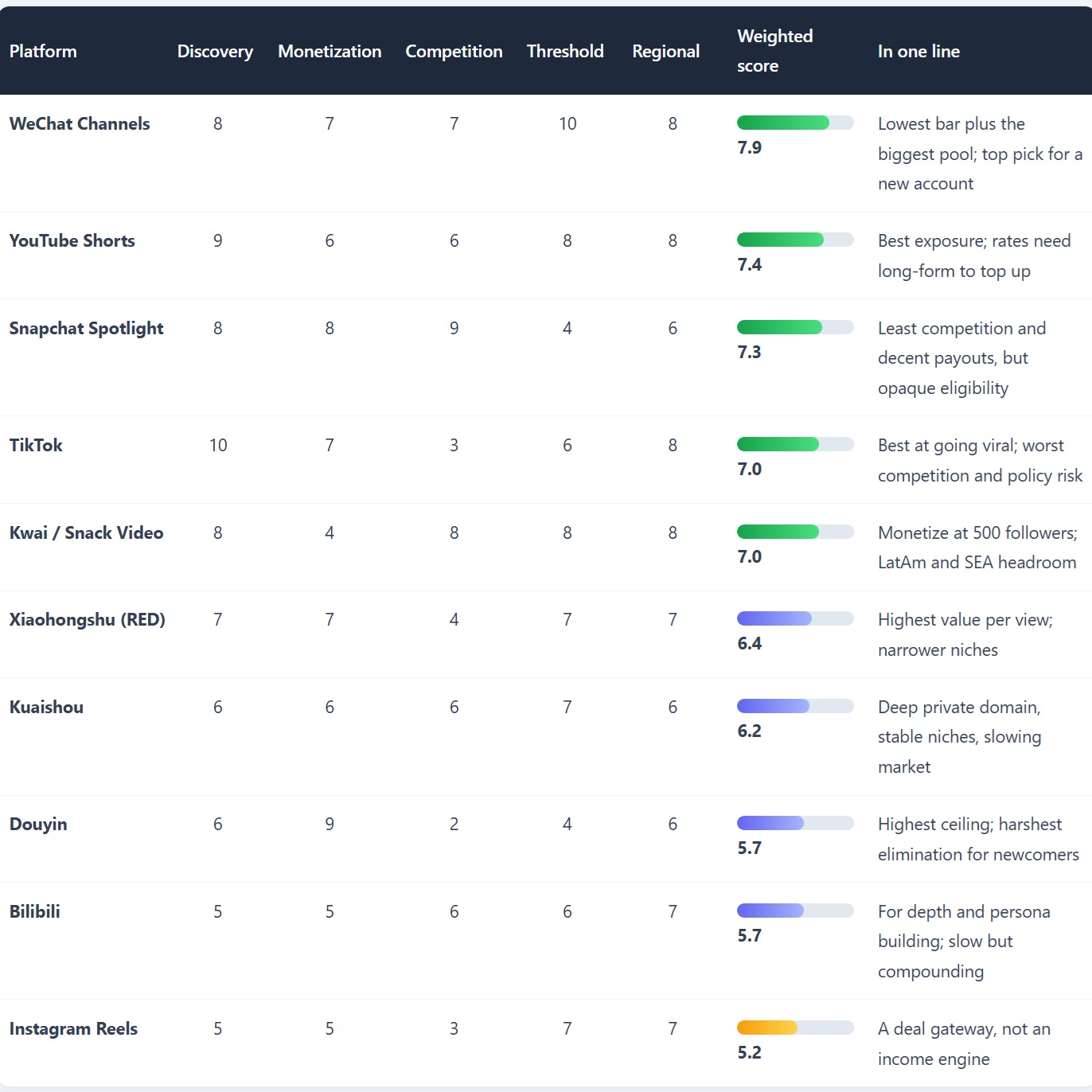
4. Opportunity Index for New Creators (Unofficial)
4.1 Dimensions and weights
| Dimension | Weight | Rationale for the weight |
|---|---|---|
| Discovery headroom (cold-start friendliness) | 25% | A new account’s core pain is “nobody watches what I post”. First-video exposure at zero followers, whether the algorithm depends on follower count, and whether newcomers get support decide survival through the first three months. |
| Monetization rate and settlement | 25% | The same million views can differ more than 10x in income depending on platform and audience country. This determines whether content investment gets covered. |
| Competition intensity (reverse-scored) | 20% | The ratio of creator supply to attention supply. The more crowded the field, the less exposure equal-quality content receives, and engagement rates decline year over year. |
| Threshold friendliness | 15% | Follower/view/duration requirements, eligible-country lists and account-type restrictions. A high threshold delays positive feedback by months. |
| Regional and niche headroom | 15% | Whether the platform is still in a growth phase in that market, and whether supply gaps remain (regional languages, senior-oriented content, knowledge content). |
4.2 Composite scores
| Platform | Discovery | Monetization | Competition | Threshold | Regional | Weighted score | In one line |
|---|---|---|---|---|---|---|---|
| WeChat Channels | 8 | 7 | 7 | 10 | 8 |
7.9 |
Lowest bar plus the biggest pool; top pick for a new account |
| YouTube Shorts | 9 | 6 | 6 | 8 | 8 |
7.4 |
Best exposure; rates need long-form to top up |
| Snapchat Spotlight | 8 | 8 | 9 | 4 | 6 |
7.3 |
Least competition and decent payouts, but opaque eligibility |
| TikTok | 10 | 7 | 3 | 6 | 8 |
7.0 |
Best at going viral; worst competition and policy risk |
| Kwai / Snack Video | 8 | 4 | 8 | 8 | 8 |
7.0 |
Monetize at 500 followers; LatAm and SEA headroom |
| Xiaohongshu (RED) | 7 | 7 | 4 | 7 | 7 |
6.4 |
Highest value per view; narrower niches |
| Kuaishou | 6 | 6 | 6 | 7 | 6 |
6.2 |
Deep private domain, stable niches, slowing market |
| Douyin | 6 | 9 | 2 | 4 | 6 |
5.7 |
Highest ceiling; harshest elimination for newcomers |
| Bilibili | 5 | 5 | 6 | 6 | 7 |
5.7 |
For depth and persona building; slow but compounding |
| Instagram Reels | 5 | 5 | 3 | 7 | 7 |
5.2 |
A deal gateway, not an income engine |
Method: weighted score = sum(dimension score × weight) ÷ 100, with dimension scores as integers from 0 to 10 and fixed weights of 25%/25%/20%/15%/15%. The score is intended only for relative comparison in a new-creator cold-start scenario and is not a ranking of platform strength.
4.3 Category leaders
The only distribution system that genuinely ignores follower count: a zero-follower breakout is normal on TikTok and exceptional elsewhere.
Content, ecommerce, local services and payments fully connected, with about CNY 4.4 trillion GMV; the deepest monetization per unit of traffic.
850 million monthly users but a tiny creator pool, so the denominator you compete against is far smaller than on TikTok.
Revenue sharing from 100 followers — the only double-digit follower bar among major platforms.
Content supply across 15+ Indian regional languages is far below demand; competition in local-language niches is much lighter than in English.
Far above TikTok’s roughly 350 and Reels’ roughly 625 — the most efficient cold-start entry point at zero followers.
5. Country Deep-Dives
5.1 Five market tiers
| Tier | Representative countries | Characteristics | Strategy for a new creator |
|---|---|---|---|
| Tier 1High value, high competition | United States, Japan, Germany, United Kingdom | Highest CPM and brand-deal rates, strong willingness to pay, but saturated supply and high localisation demands | Vertical depth plus premium categories (finance, tech, education); a long-run play |
| Tier 2High growth, mid value | Brazil, Mexico, Indonesia, Vietnam | Largest user increments, relatively low competition, low content cost, but mid-tier basket size and CPM | The best starting point: validate topics and instincts with low-cost content |
| Tier 3Huge scale, low revenue per user | India, Pakistan, Egypt, Bangladesh | Hundreds of millions of users and fast growth, but very low CPM (about USD 0.5–3 for Indian audiences) | Scale with regional languages and monetize via affiliate, commerce or drama; do not count on ad share |
| Tier 4High payment power, cultural bar | Saudi Arabia, UAE and the wider Middle East | Strong payment ability, good short-drama and LIVE gifting data, but demanding cultural fit and compliance | Build localised narrative content and rewrite rather than translate; respect religious and cultural rhythms |
| Tier 5Domestic stock-market competition | Chinese mainland | Biggest pool and most mature tooling, but the harshest competition, with 65% of full-time creators under CNY 1,800 a month | Lead with low-threshold platforms and differentiated niches; avoid saturated entertainment |
5.2 Country cards
United States Number one by revenue
Opportunity: the highest-paying market in the world, where finance, tech and education content earns two to three times entertainment CPMs. Brand budgets reach about USD 44 billion with roughly 70% of brands planning to increase creator spend, and nano creators (1,000–10,000 followers) post the highest engagement rate at 4.8%, meaning small accounts do get deals. Risk: competition is saturated, and TikTok’s ownership structure, platform regulation and privacy rules keep shifting, so policy risk exceeds other markets; disclosure and AI-labelling requirements are strict.
Japan High quality, high rates
Opportunity: strong willingness to pay, high CPMs, and heavy demand for practical information content from an ageing population that remains under-supplied; short video is tightly linked to retail and product discovery. Risk: localisation is demanding (language, aesthetics, pacing), quality expectations are high, and generic entertainment struggles to break through; Japanese users tolerate rough content poorly.
Germany / United Kingdom European baseline
Opportunity: high CPMs, mature payment habits, and significant demand for short drama and entertainment in the UK; German-language content faces far less competition than English content. Risk: the EU AI Act imposes the strictest transparency rules on AI-generated content, so AI dubbing or AI visuals must be disclosed; GDPR limits data use, and platform review is strict.
Brazil One of the best starting points
Opportunity: extremely high session times (close to 100 minutes daily), strong acceptance of emotionally driven content, and simultaneous headroom on both Kwai and TikTok. In overseas short-drama data Brazil ranks in the top five by revenue and top three by downloads, showing both scale and payment ability; widespread instant payments lower the barrier to low-price subscriptions and gifting. Risk: basket size and CPMs below Europe and the US; Portuguese localisation is a hard requirement; currency and purchasing-power swings affect income stability.
Indonesia Scale and growth together
Opportunity: the largest single market in Southeast Asia, with the tightest short-video-to-commerce link and a mature path to sales; users are young and mobile-first with long consumption sessions; SnackVideo opens a second headroom window in lower-tier segments. Risk: low basket size means monetization must come from scale and commerce commission rather than ad share; Bahasa Indonesia localisation is required; platform rules on commerce and content change relatively often.
Vietnam / Philippines Fast ramp, easy breakouts
Opportunity: low production and creator-collaboration costs make iteration fast; short video and short drama ramp quickly and break out easily, making these markets an excellent testbed for validating topic choices. Risk: monetization is ad-led with low rates, capping income; local language and cultural references must be genuinely understood, and translated content performs poorly.
India Biggest scale, hardest monetization
Opportunity: one of the largest and fastest-growing creator markets, with the creator base up 322% in four years; regional-language content (Hindi, Tamil, Telugu and others) faces far less competition than English, and local platforms such as Moj specifically serve tier 2/3 regional-language demand; YouTube pays Indian creators through YPP in rupees. Risk: TikTok has been unavailable in India since June 2020 and cannot be part of the plan; CPMs are one tenth to one third of US levels; local platforms can collapse (Josh fell from about 150 million MAU to under 10 million), so platform survival risk is real.
Saudi Arabia / UAE Strong payment, high cultural bar
Opportunity: high willingness to pay, with ample budgets from luxury, automotive and telecom advertisers; Snapchat’s very high penetration in the Middle East combined with Spotlight’s low competition is a conspicuous mismatch; short drama and LIVE gifting generate healthy revenue structures. Risk: cultural fit is a hard constraint — content must be rewritten rather than translated, avoiding religious and value conflicts and respecting rhythms such as Ramadan; brands audit content safety and cultural fit strictly.
Egypt / Pakistan Population dividend, not revenue
Opportunity: large and fast-growing user bases with low competition density, ideal for quickly accumulating views and account authority; a blue ocean for Arabic and Urdu content. Risk: ad revenue value is extremely low, so chasing volume alone will not cover costs; if income is the goal, these markets function as distribution channels only, with monetization coming from commerce, affiliate or off-platform sales.
Chinese mainland Biggest pool, most intense competition
Opportunity: the most mature toolchain (AI editing, digital humans, dubbing all available), the most diverse monetization paths and the largest pool; WeChat Channels and Xiaohongshu offer new-creator-friendly thresholds and high value per view. Risk: the most intense competition, MCN registration growth at a ten-year low (2.5%) with nearly 80% of MCNs seeing margin compression; pure entertainment is effectively closed to new accounts; content review and compliance are the strictest anywhere.
6. Regional Comparison
| Region | Revenue structure | Growth driver | Opportunity for new creators | Main risks |
|---|---|---|---|---|
| North America | Highest single-market revenue (US short-video apps about USD 21.3 billion) | Low growth, high monetization | Vertical depth plus high-CPM niches; nano-creator brand deals | Saturated competition, strict compliance, policy swings |
| Europe | Germany and the UK are inside revenue-sharing lists; high CPMs | Steady | German and local-language content faces less competition; strong short-drama demand | EU AI Act transparency, GDPR |
| Asia-Pacific (Japan, Korea) | Second-tier rates, mature payment habits | Japan steady, Korea active | Practical information and senior-oriented content gaps | High localisation and quality bars |
| Southeast Asia | Indonesia and Vietnam large but low basket size | The main growth engine | Fast ramp, easy breakouts, tight commerce and drama integration | Low rates; local language essential |
| South Asia (India et al.) | India about USD 6.4 billion (2026E) with very low revenue per user | Fastest growth | Regional-language blue ocean; creator ecosystem expanding rapidly | Low CPMs, platform survival risk, TikTok unavailable |
| Latin America | Brazil online video advertising about USD 3.2 billion | High | Emotion-driven content accepted widely; dual Kwai/TikTok headroom | Currency volatility, mid-tier basket size |
| Middle East | Saudi USD 1.4 billion plus UAE USD 1.2 billion (2026E) | High (strong payment power) | Short-drama payment plus a Snapchat low-competition mismatch | Hard cultural constraints, strict review |
| Africa | South Africa about USD 1.0 billion (2026E) | Mobile-first, large increments | Very low competition; good for early influence building | Payments and infrastructure limits; thin monetization |
7. Country × Platform Matrix
| Country / region | TikTok | YouTube Shorts | Instagram Reels | Kwai / Snack | Local and other |
|---|---|---|---|---|---|
| United States | ◆ | ◆ | ◇ | ○ | Snapchat Spotlight ◇ |
| Japan | ◆ | ◇ | ◇ | ○ | LINE ecosystem ◇ |
| Germany / UK | ◆ | ◇ | ◇ | ○ | — |
| Brazil | ◆ | ◇ | ◇ | ◆ | — |
| Mexico | ◆ | ◇ | ◇ | ◇ | — |
| Indonesia | ◆ | ◇ | ◇ | ◇ | — |
| Vietnam / Philippines | ◆ | ◇ | ◇ | ○ | — |
| India | ○ unavailable | ◆ | ◆ | ○ | Moj ◇ / ShareChat ◇ |
| Saudi / UAE | ◆ | ◇ | ◇ | ◇ | Snapchat ◆ |
| Egypt / Pakistan | ◆ | ◇ | ○ | ◇ | — |
| Chinese mainland | ○ unavailable | ○ restricted | ○ restricted | ○ | Douyin ◆ / WeChat Channels ◆ / Kuaishou ◇ / Xiaohongshu ◇ / Bilibili ◇ |
Stacked opportunities (two platforms strong in the same market, so one piece of content serves both)
- US: TikTok + Shorts — one for virality and brand deals, one for search long tail and stable revenue share.
- India: Shorts + Reels — the vacuum left by TikTok, with both platforms dominant and regional-language supply scarce.
- Brazil: TikTok + Kwai — Kwai is a genuine primary battleground in Brazil, not a substitute, with a 500-follower monetization bar.
- Saudi Arabia: TikTok + Snapchat — high payment power plus low competition, the most obvious mismatch in the whole report.
- Chinese mainland: Douyin (scale) + WeChat Channels (low-bar start) — validate on Channels first, then scale on Douyin.
Combinations to deprioritise or drop
- India + TikTok: unavailable; do not design around it.
- Egypt/Pakistan + ad-revenue monetization: you can build scale but not income; do not expect ad share to cover costs.
- Western markets + Kwai/SnackVideo: weak coverage; low return on effort.
- Chinese mainland + generic entertainment: a red ocean with almost no room for new accounts.
8. Niche Selection: Where the Supply Gaps Are
| Gap type | How it shows up | Why it still exists | How to enter |
|---|---|---|---|
| Regional-language content | Supply in Hindi, Tamil, Telugu, Bahasa Indonesia, Arabic and Portuguese is far below English and Chinese | English content travels globally, so creators have little incentive to produce single-market language content | Pick one large, lightly contested language market and produce native-level content; avoid the English red ocean |
| Senior-oriented content | Users aged 55+ are nearly a third of WeChat Channels, yet quality content for them is scarce | The creator base skews young and understands senior needs poorly | Health, life skills, family relationships, collectible topics; calmer pacing, clear information |
| Practical and knowledge content | Education and how-to Shorts earn CPMs of about USD 0.08–0.15, well above entertainment | Knowledge and tutorial content is expensive to make and demands real expertise | Choose topics phrased as searchable questions; long-tail traffic can last months or years |
| Localised narrative (short drama) | In overseas short drama, translated titles still exceed 60% while locally produced titles sit at only 33%–36% | Rewriting costs more than translating and requires local participants, raising the bar above machine translation | Do localisation rewrites that “keep the payoff, rebuild the pain point”; avoid literal translation and translated memes |
AI content: risk on both sides (important)
- Opportunity side: the AI anime-short-drama market grew from about USD 100 million in 2025 to an expected USD 650 million in 2026 (roughly 6x), with clear cost-reduction gains.
- Risk one (platform demotion): platforms including YouTube have stated they are expanding systems to reduce distribution of low-quality AI content. Bulk-generated, homogeneous content gets suppressed by the algorithm rather than handed free reach.
- Risk two (homogenisation): industry feedback is that “AI content volume exploded while revenue did not keep pace”, with audience fatigue appearing and content lifespans shortening.
- Risk three (compliance): the EU AI Act‘s transparency requirements for AI-generated content become fully enforceable from 2 August 2026, with substantial penalties for missing disclosure; AI dubbing, AI face replacement and AI-generated visuals must be labelled.
- Conclusion: use AI in the efficiency layer (dubbing, subtitles, editing, batch testing), not as a replacement for editorial judgement and localisation rewriting. Treating AI as an amplifier rather than a generator is the most durable approach in 2026.
9. Video Translation Value by Platform
There are only two levers a new creator can actually copy: multi-platform distribution and multi-language distribution. The first moves the same content onto more platforms; the second sells the same content into entirely different markets — and it requires no new research and no new shooting, just one translation pass. This chapter is not about how translation works technically. It answers one question: on the platforms you picked, what does translation actually buy you, how should you use it, and when is it not worth it.
9.1 Three tiers: know what the platforms already give you for free
| Tier | What the platform already provides | Examples | What is left for you |
|---|---|---|---|
| Native | Automatic caption translation plus official dubbing tracks, free of charge | YouTube (multi-language audio and auto-dubbing across 27 languages), TikTok (captions can be auto-translated and served to other-language users) | Almost nothing — just turn it on |
| Semi-native | Captions only, no dubbing | Instagram Reels, Snapchat (auto-captions) | Free if captions are enough; if it must “sound local”, you need external dubbing |
| Not provided | No multi-language infrastructure, or it does not cover your target language | Kwai / Snack Video (Brazil, Indonesia), Moj / ShareChat (22 Indian languages), the Middle East (Arabic) | You have to do it yourself — and these are exactly the highest-growth markets |
The key implication: native platform features are rapidly eating the “low-quality translation” segment. YouTube already offers free auto-dubbing in 27 languages, and TikTok’s caption translation is free as well. That is good news for creators — a zero-cost second market now exists — but it means external tools only hold two remaining pockets of value: language pairs the platforms do not cover, and voice quality the platforms cannot deliver. If your target language is already on the “native” list, use the free option first. Where it is not, the tool landscape varies widely — see our comparison of 18 video translation tools before committing.
9.2 Platform by platform: what translation actually buys
| Platform | Form of translation | What it buys | Return on effort |
|---|---|---|---|
| YouTube / Shorts | Multi-language audio plus localised title and description | Puts one video into non-English search and recommendation pools; long-form ad revenue can be stacked across language versions — the highest-leverage revenue multiplier available | ★★★★★ |
| TikTok | Local-language captions plus dubbing, posted to separate country accounts | An entry ticket to high-CPM markets (US, UK, Japan); running the same asset in several languages also reveals which market will break out | ★★★★☆ |
| Snapchat Spotlight | Arabic version (captions and dubbing) | The Middle East (Saudi Arabia, UAE) is today’s least contested market with strong paying power, and supply is thin | ★★★★☆ |
| Kwai / Snack Video | Portuguese or Indonesian dubbing | Brazil and Indonesia reward local language so strongly that dubbing becomes an entry ticket rather than a bonus | ★★★★★ |
| Indian regional platforms (Moj and others) | Hindi, Tamil and other local languages | Close to the only way into these language pools; but payouts are low — good for follower growth, poor for income | ★★★☆☆ |
| Instagram Reels | Captions plus a version in the brand’s language | A brand-deal channel: agencies need ready-to-run localised assets. Not a natural-traffic income engine | ★★★☆☆ |
| Chinese platforms (Douyin / Kuaishou / WeChat Channels / Xiaohongshu / Bilibili) | Used in reverse: turn Chinese hits into foreign-language versions for export | In-platform translation adds little (a single language pool); the value is the export door — re-cutting one hit into a foreign-language version for TikTok or YouTube | ★★★☆☆ |
How to read the stars: they measure the marginal return on the act of translating, not how large the platform opportunity is (that is Chapter 4’s calibration). A platform can be a great opportunity while translation adds nothing there; conversely, a smaller platform can be a five-star translation play simply because local language is the only way to get volume.
9.3 The most overlooked prerequisite: burned-in subtitles
If your source video has burned-in subtitles, translating it directly produces double subtitles — the new language stacked on top of the old. This is not a translation-tool problem, it is a source-asset problem. The correct order is to remove the original subtitles first with video inpainting (results vary a lot between models — see our subtitle removal model comparison), then add the new captions or dub. Skip this step and the foreign-language version immediately looks a tier worse, and completion rate follows. Before any multi-language push, check the master for burned-in text.
9.4 Cost: captions are almost free, dubbing is where you pay
| Item | Local captions | AI dubbing |
|---|---|---|
| Cost per 60-second video | Close to zero (handled automatically) | On the order of $0.17 per minute (processed on a local client, footage never uploaded) |
| Time per video | Minutes | Minutes |
| Effect on completion rate | Small to moderate (viewers split attention to read) | Moderate to large (“sounds local” is what keeps people watching) |
| Right stage | Cold start, market testing | After traffic is already proven — then scale |
Pricing models differ sharply between tools (per minute, per subscription, per export). For a line-by-line comparison, see the AI video translation pricing report (DeepVideo vs 11 competitors).
9.5 Three judgements
The expansion of native multi-language capability has been the defining trend of the past two years: YouTube opened auto-dubbing for free, and TikTok is internalising translation. The floor for translation is dropping, but what is genuinely scarce has moved up — naturalness of voice, coverage of minority languages and rare language pairs, and batch-processing throughput. Translation that only achieves “understandable” will keep losing ground to free native features.
Captions solve “can I understand it”; dubbing solves “do I want to stay”. Multi-language dubbing generally lifts completion more — but if the voice is unnatural, viewers leave faster than they would with captions. The right rhythm: test the market with cheap captions first, then upgrade to dubbing only on the lines that are already performing, instead of dubbing everything into five languages from day one.
Many new creators ship five language versions at once and end up with no data in any of them. The correct order: prove 2–3 pieces in your native language or in English → translate only those into the target markets’ languages → watch completion and non-native viewer share for 30 days → then decide whether to open a dedicated account per language. Translation amplifies validated content; it cannot amplify content that has not been validated.
If you do only one thing
What to do: take the one or two videos that already performed best, produce three target-market language versions — Latin America (Spanish or Portuguese), Southeast Asia (Indonesian), the Middle East (Arabic) — post them under your existing TikTok or YouTube account, and let them run for 30 days.
- Watch three numbers: whether completion of the new-language cuts approaches the original; whether non-native viewer share rises; whether new followers come from the target countries.
- All three positive: then consider dedicated per-language accounts and make the path repeatable.
- Only one positive: fix the content first and do not increase translation spend — the problem is the idea, not the language.
10. Decision Framework
TikTok’s algorithm can push your content to a million people at zero followers, but that traffic is one-off, revenue sharing covers only about ten countries, and videos must exceed one minute. Shorts gives higher first-video exposure at zero followers, keeps earning long-tail views through search, and has a transparent revenue model — but its per-view rate is far lower. Conclusion: if you can only pick one long-term asset, pick Shorts; if you want to find out fast whether your content works, start on TikTok. They are not substitutes — posting the same content to both is the standard approach.
Douyin has the best monetization ceiling and toolchain, but its revenue-share bar is “5,000 engaged followers in 30 days”, which can mean six unpaid months. WeChat Channels shares revenue from 100 followers, its social structure lets content roll through acquaintance chains, and senior-oriented content is badly undersupplied. Conclusion: get positive feedback and revenue sharing on Channels first, then scale validated content on Douyin. Going straight at Douyin as a beginner has a very high elimination rate.
US audience CPMs are 5–10x Indian ones, but Western competition is saturated, localisation is costly and compliance is strict; Brazil, Indonesia and Vietnam offer long sessions, low competition and low content cost. Conclusion: validate content and instincts in emerging markets (cheap iteration), earn in Western markets (migrate once proven). Doing it the other way round — forcing your way into the US first — is the most common way new creators waste their resources.
Multi-platform distribution has an extremely low marginal cost (especially on Kwai and Spotlight, where audience overlap is low), but each platform’s algorithm, caption norms and pacing differ, so crude reposting drags down performance everywhere. Single-platform depth builds account authority but concentrates policy risk. Conclusion: a 3+1 structure — three primary platforms tuned to their own norms, plus one low-threshold platform (Kwai, WeChat Channels or Spotlight) as incremental income and a testbed.
9.2 Recommended paths for three profiles
Profile A: no experience, wants positive feedback fast
Path: WeChat Channels (100-follower bar) + YouTube Shorts (best exposure) + Kwai (500-follower bar).
- Month 1: post daily on Channels to close the loop from topic to publish to feedback; cross-post to Shorts to test how appealing the content is.
- Months 2–3: go deeper on the three best-performing topic directions; keep pumping volume on Kwai to capture the low-threshold revenue share.
- Key metrics: completion and share rate on Channels, three-second retention on Shorts, follower growth on Kwai.
Profile B: some content ability, targeting income
Path: YouTube (Shorts for reach, long-form for revenue) + Xiaohongshu or Douyin (high-monetization battleground) + one distribution channel.
- Use Shorts for cold start and funneling, pushing viewers into long-form or off-platform sales, since long-form RPMs are dozens of times higher.
- In China choose Xiaohongshu (fast brand-deal ramp) or Douyin (highest commerce ceiling); for commerce overseas choose TikTok Shop.
- Key metrics: Shorts views (acquisition), long-form RPM (income), brand-deal conversion rate.
Profile C: team or studio, aiming for scale
Path: multi-market matrix + localisation rewrites + AI for efficiency (not as a substitute for judgement).
- Content matrix: produce each topic in English, Portuguese, Bahasa and Arabic to cover the US, Japan, Brazil, Indonesia and the Middle East.
- Monetization mix: ad revenue (Kwai/Shorts as a floor) + commerce (TikTok Shop/Douyin) + short drama or paid knowledge (Middle East and Southeast Asia).
- Red lines: use AI only for dubbing, subtitles, editing and batch testing; localisation rewrites must be reviewed by people who understand the local culture, avoiding translated memes and value conflicts.
- Key metrics: per-content multi-market ROI, localisation cost share, platform concentration (no single platform above 50% of revenue).
11. Key Findings
- A new creator’s first survival test is not content quality but whether anyone sees it. Average first-video views at zero followers: Shorts about 15,160, Reels about 625, TikTok about 350. Pick the wrong platform and the same content gets 40x less exposure.
- The monetization bar ranges from 100 to 10,000 followers — a 100x spread, and the most underestimated selection factor. WeChat Channels at 100 followers, Kwai at 500, TikTok at 10,000 followers plus videos over one minute, and full YouTube revenue sharing at 1,000 subscribers plus 10 million Shorts views in 90 days.
- “Lowest threshold” and “highest rate” almost never coincide, so they must be combined. Channels and Kwai provide early positive feedback and cash flow; Douyin and YouTube long-form provide the income ceiling.
- The country layer outweighs the platform layer. US and Indian audience CPMs differ by 5–10x (USD 0.5–3 versus USD 5–15), so changing countries moves your income more than changing platforms.
- The strategic direction is validate in emerging markets, monetize in developed ones. About 70% of growth comes from emerging markets (India, Indonesia and Brazil lead downloads), while most revenue comes from the US, Japan, the UK and other developed markets.
- In a stock-market phase, gaps are worth more than effort. Regional-language content, senior-oriented content, practical knowledge content and localised short-drama rewrites are the four directions still undersupplied.
- Small and mid-size creators are not shut out — over 80% of Douyin commerce sales come from accounts under one million followers, and US nano creators post the highest engagement rate at 4.8%. Yet only about 4% of creators worldwide earn above USD 100,000 a year, and 65% of full-time creators in China earn under CNY 1,800 a month: earning real money remains a minority outcome.
- The three biggest risks are platform policy change (TikTok country eligibility, platform survival), AI content demotion and compliance labelling, and income concentration on a single platform. The corresponding strategies are multi-platform distribution, AI as an amplifier only, and keeping any single platform below 50% of revenue.
Data boundaries and disclaimer
- Platform user scale, growth and revenue figures come from public sources (official platform disclosures, DataReportal, Sensor Tower, the QuestMobile/CNNIC family, and third-party industry reports). Calibrations differ substantially between sources; section 1.2 lists the main conflicts, and any citation should carry the calibration with it.
- All monetization rates (RPM, earnings per thousand views, brand-deal prices) are range estimates or creator community reports, not official platform commitments. Actual earnings depend on audience country, niche and seasonality, and may deviate significantly.
- The Opportunity Index in Chapter 4 is a weighted five-dimension score built by this report. It is not an official ranking and not investment advice; it is intended only for relative comparison in a new-creator cold-start scenario.
- Platform policies (revenue-share thresholds, eligible countries, rules) change frequently. Verify current local availability and the latest terms on official platform pages before acting.
Going multilingual? Fix “does it sound right” first
For growth markets such as Brazil, Indonesia and the Middle East, local-language dubbing quality directly determines completion rate.
Download DeepVideo for Desktop
Realistic AI Video Dubbing at Just $0.17/min
High quality · Low price · Local client · Security
Free tier: 18 minutes total + 2 minutes daily · Local processing, no cloud upload
This report is a creator opportunity analysis, not an official ranking or investment advice · Data as of September 2026
Produced by DeepForgeHub Research · More platform and tool comparisons on the blog