
Global Text-to-Video AI Models Research Report
Comprehensive Comparison and Market Analysis of Mainstream AI Video Generation Models in 2026 | Research Date: September 2026
1. Executive Summary
Text-to-Video technology has emerged as one of the most breakthrough directions in generative AI during 2024-2025. This report provides a comprehensive analysis of mainstream global text-to-video models based on Artificial Analysis benchmark tests, industry evaluations, and practical application feedback.
? Key Findings
- Market Landscape: Google Veo, ByteDance Seedance, OpenAI Sora, and Kuaishou Kling form the first tier
- Technology Benchmark: ByteDance Seedance 2.5 (released July 2026) is the latest global version, generating 30-second videos in a single pass with support for 50 multimodal references
- Video Quality: Google Veo 3 leads in 4K resolution, physical simulation, and audio integration
- Narrative Capability: OpenAI Sora 2 excels in story coherence and prompt understanding
- Motion Fidelity: Kuaishou Kling maintains detail integrity in fast-motion scenes
- Market Size: Global AI video generation market expected to reach $2.56 billion by 2032, with 40% CAGR
2. Global Text-to-Video Model Overview
2.1 Model Tier System
Based on technical capabilities, generation quality, and market recognition, we categorize mainstream models into three tiers:
| Tier | Representative Models | Core Advantages | Use Cases |
|---|---|---|---|
| S-Tier Top | ByteDance Seedance 2.5 Google Veo 3.1 |
Native 4K, physical simulation, native audio, 30-second single generation, industry benchmark leadership | Commercial advertising, film production, premium content |
| A-Tier Excellent | Kuaishou Kling 3.0 OpenAI Sora 2 MiniMax H3 Pika 3.0 |
Native 4K, audio-visual sync, physical simulation, multi-shot generation, user-friendly | Social media, marketing content, creative videos |
| B-Tier Good | Alibaba Wan 3.0 Runway Gen-4 Adobe Firefly Luma Dream Machine |
Professional tools, commercial safety, ecosystem integration, rapid iteration | Professional workflows, enterprise applications, educational content |
2.2 Technical Architecture Comparison
Current mainstream text-to-video models are primarily based on the following technical routes:
- Diffusion Models: Used by Sora, Veo, Kling, etc., generating video frames through progressive denoising
- Transformer Architecture: Some models use pure Transformer or hybrid architectures for temporal information processing
- Autoregressive Models: Pika and others use frame-by-frame generation to ensure temporal consistency
- Multimodal Fusion: Unified generation framework combining text, images, and audio (e.g., Veo 3)
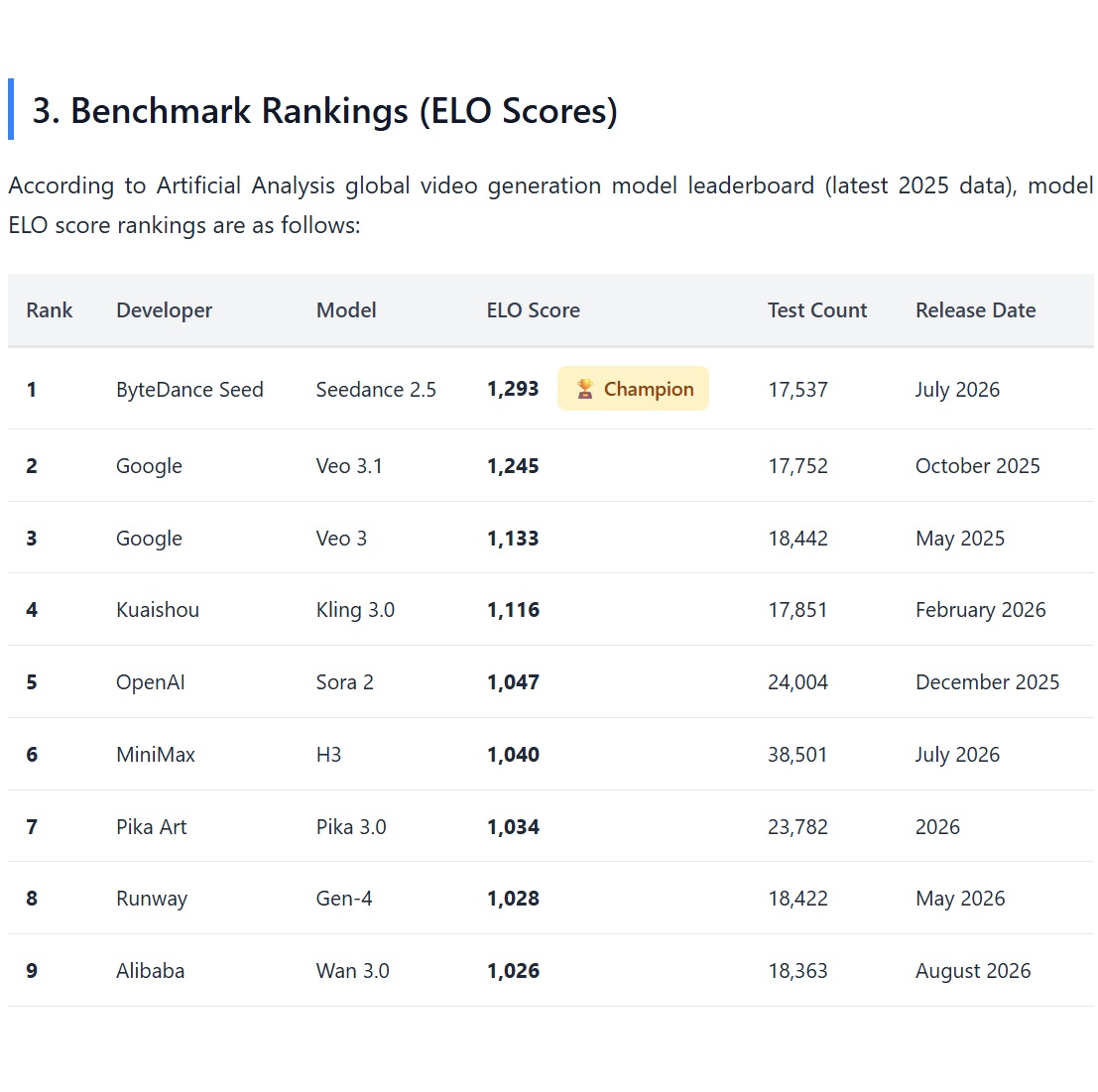
3. Benchmark Rankings (ELO Scores)
According to Artificial Analysis global video generation model leaderboard (latest 2025 data), model ELO score rankings are as follows:
| Rank | Developer | Model | ELO Score | Test Count | Release Date |
|---|---|---|---|---|---|
| 1 | ByteDance Seed | Seedance 2.5 | 1,293 ? Champion | 17,537 | July 2026 |
| 2 | Veo 3.1 | 1,245 | 17,752 | October 2025 | |
| 3 | Veo 3 | 1,133 | 18,442 | May 2025 | |
| 4 | Kuaishou | Kling 3.0 | 1,116 | 17,851 | February 2026 |
| 5 | OpenAI | Sora 2 | 1,047 | 24,004 | December 2025 |
| 6 | MiniMax | H3 | 1,040 | 38,501 | July 2026 |
| 7 | Pika Art | Pika 3.0 | 1,034 | 23,782 | 2026 |
| 8 | Runway | Gen-4 | 1,028 | 18,422 | May 2026 |
| 9 | Alibaba | Wan 3.0 | 1,026 | 18,363 | August 2026 |
? Key Insights
- ByteDance Seedance 2.5 (released July 2026) is the current latest global version, generating 30-second videos in a single pass with support for 50 multimodal references, representing Chinese manufacturers’ technological breakthrough in the global text-to-video field
- Google’s dual models in top 3, with Veo 3.1 and Veo 3 occupying 2nd and 3rd positions respectively
- Kuaishou Kling series shows technical stability with multiple versions in top 10
- OpenAI Sora 2 remains competitive despite later release, thanks to narrative capabilities
- Chinese manufacturers occupy half the positions, with ByteDance, Kuaishou, MiniMax, and Alibaba holding 4 seats in top 10
4. S-Tier Models
Developer: ByteDance Seed Team | Release: July 2026 | Resolution: Native 4K | Duration: 30 seconds single generation, multi-round extension | Audio: Native integration
? Strengths
- Global ELO #1 ranking, best benchmark performance
- 30-second single generation, supports multi-round extension for minutes of coherent content
- 50 multimodal references (30 images + 10 videos + 10 audio) joint generation
- New video local editing capabilities (precise background/product/character modification)
- Native 4K video generation, native support for 10+ languages
- New white model/green screen references, suitable for industrialized creation
- Extended applications to smart driving, embodied AI, e-commerce overseas expansion
? Weaknesses
- API pricing increased ~50% from 2.0 (70 yuan/million tokens for pure text-to-video)
- Complex motion physics rationality still has room for improvement
- Stability needs improvement in extremely multi-subject interaction scenes
One-take commercial ads, multi-shot narrative, industrial-grade content production (driving/education/e-commerce), multi-language multi-version batch generation, long videos requiring character consistency
Developer: Google DeepMind | Release: October 2025 | Resolution: 4K | Duration: Up to 120 seconds | Audio: Native integration
? Strengths
- 4K resolution, industry’s highest visual fidelity
- Native audio generation (dialogue, sound effects, music), no post-production needed
- Veo 3.1 new additions: reference image support, multi-person dialogue scenes, scene expansion, vertical video support
- Industry-leading physical simulation and lighting effects
- Accurately understands cinematic terminology (“timelapse”, “aerial shots”)
- Google ecosystem integration (YouTube training data, Flow tools)
- Long video generation capability (120 seconds)
? Weaknesses
- Higher pricing, primarily targeting enterprise users
- Some modes limit default video duration
- Steep learning curve
- Limited public access (requires advanced AI plan)
- Veo 2 discontinued (offline June 2026)
Film-grade B-roll, high-end commercial advertising, enterprise-level content production, videos requiring native audio, documentaries, premium brand marketing, multi-person dialogue scenes
5. A-Tier Models
Developer: OpenAI | Release: December 2025 | Resolution: 1080p | Duration: Up to 25 seconds (Pro version) | Audio: Native integration
? Strengths
- Highest physical simulation accuracy, accurately simulates buoyancy, rigid body dynamics, elasticity, etc.
- Native audio generation (dialogue, sound effects, ambient sounds)
- Best narrative capability, understands complex story prompts
- Supports character insertion feature (Cameo), integrating real people into generated scenes
- High visual fidelity, close to real filming effects
- API open: sora-2 (fast version) and sora-2-pro (high-quality version)
? Weaknesses
- Consumer version closed April 26, 2026, only API retained
- API will go offline September 24, 2026
- High-resolution output limited (only 1080p)
- Higher pricing: Sora 2 Pro 1080p $0.70/second
- Low user retention rate (30-day Pro user retention <8%)
- Slower generation speed (about 5 minutes)
API integration development, physical simulation scenes, narrative content creation, brand story videos, applications requiring realistic physical effects
Developer: Kuaishou | Release: February 2026 | Resolution: Native 4K | Duration: 15 seconds (extendable) | Audio: Native integration (5 languages)
? Strengths
- Native 4K output, world’s first AI video model supporting native 4K
- Native audio-visual sync, supports Chinese/English/Japanese/Korean/Spanish 5 languages + dialects
- Smart storyboarding, AI automatically understands multi-scene multi-shot instructions
- All-round reference, upload reference videos to extract character visual + voice features
- Multi-person frame + character reference (3+ people), solving reference confusion problem
- Serving 60 million+ creators globally, cumulative 600 million+ videos generated
- Supports 30-second high-difficulty action one-take (motion capture feature)
? Weaknesses
- Single generation duration limit (15 seconds), requires extension feature
- Only Ultra subscription users can early access 3.0
- Weaker English prompt optimization
- Complex lighting scenes may flatten
Multi-language ad production, smart storyboarding direct output, character-themed videos, image-to-video, content requiring lip sync, budget-conscious creators
Developer: Pika Art | Release: 2026 | Resolution: 1080p | Duration: 16 seconds | Audio: Lip sync support
? Strengths
- Pika 3.0 new additions: Scenes multi-shot generation, lip sync
- Fastest generation speed (about 45 seconds), suitable for rapid iteration
- Cheapest price ($0.69/minute)
- User-friendly interface, easy to learn
- Suitable for stylized content (animation, special effects)
- Higher reliability score (89.8%)
- Active Discord community
? Weaknesses
- Lower physical fidelity (7.2/10)
- Visual quality not as good as S-Tier models
- No camera control
- Average prompt adherence
- Not suitable for realistic content
Social media content, rapid prototyping, stylized videos, animated content, high-volume needs with limited budget
6. B-Tier Models
Developer: Runway | Release: May 2026 | Resolution: 1080p | Duration: 16 seconds
? Strengths
- Cross-scene character consistency, same character maintains unified appearance across different shots
- Turbo version faster generation speed, suitable for batch creation
- Professional workflow complete, integrated editor, Motion Brush, Director Mode
- Fine-grained motion control
- Supports reference image input
- API access supports automation
- Highest reliability (98.2%)
- Fast generation speed (90 seconds)
? Weaknesses
- Realism slightly lower than S-Tier
- Physical world understanding not as good as Sora
- Credit-based pricing may be costly
- Maximum duration relatively short
Professional video production, VFX concepts, projects requiring precise control, TikTok/Reels content, design-driven visuals
Developer: Alibaba | Release: August 2026 | Resolution: Native 4K | Duration: 30 seconds
? Strengths
- Wan 3.0 new additions: document-to-video, 30-second long video generation, native 4K output
- Open source model, can be locally deployed, community support (LoRA, ControlNet)
- Excellent Chinese prompt understanding
- Cost controllable (self-built infrastructure)
- Strong customization capability
? Weaknesses
- Requires technical capability for deployment
- Visual quality not as good as commercial models
- Steep learning curve
- No official support
Technical team self-build, requires high customization, Chinese content creation, cost-sensitive large-scale applications
7. Technical Specifications Comparison
| Model | Max Resolution | Max Duration | Camera Control | Lip Sync | Audio Generation | Free Trial |
|---|---|---|---|---|---|---|
| Seedance 2.5 | Native 4K | 30 seconds (single) | ? | ? | ? (Native) | ? |
| Veo 3.1 | 4K | 120 seconds | ? | ? | ? (Native) | ? (Waitlist) |
| Sora 2 | 1080p | 25 seconds (Pro) | ? | ? | ? (Native) | ? (API only) |
| Kling 3.0 | Native 4K | 15 seconds (extendable) | ? | ? | ? (5 languages) | ? |
| Pika 3.0 | 1080p | 16 seconds | ? | ? | ? (Lip sync) | ? |
| Runway Gen-4 | 1080p | 16 seconds | ? | ? | ? | ? |
| Adobe Firefly | 1080p | 5 seconds | ? | ? | ? | ? |
| Wan 3.0 | Native 4K | 30 seconds | ? | ? | ? | Open source |
8. Use Case Recommendations
Recommended Models: Google Veo 3 (4K quality) ? Seedance 2.5 (motion fidelity) ? Sora 2 (narrative capability)
Reason: Requires highest visual quality, physical realism, brand consistency
Recommended Models: Pika 3.0 (speed + cost) ? Kling 3.0 (character + motion) ? Runway Gen-4 (workflow)
Reason: Rapid iteration, cost-effectiveness, suitable for platform formats
Recommended Models: Google Veo 3 (4K + audio) ? Sora 2 (narrative) ? Seedance 2.5 (long video)
Reason: Highest quality, long video support, native audio
Recommended Models: Kling 3.0 (cost-effectiveness) ? Runway Gen-4 (reliability) ? Pika 3.0 (fast)
Reason: Cost controllable, batch production, rapid updates
Recommended Models: Kling 3.0 (image-to-video) ? Sora 2 (product narrative) ? Runway Gen-4 (precise control)
Reason: Product animation, multi-angle display, rapid iteration
Recommended Models: Runway Gen-4 (editor) ? Pika 3.0 (stylization) ? Sora 2 (imagination)
Reason: Creative freedom, experimental space, rapid prototyping
9. Cost and Pricing Analysis
For a detailed comparison of video translation tool pricing, see our Video Translation Pricing Report.
| Model | Starting Price | Per-minute Cost | Billing Model | Value Rating |
|---|---|---|---|---|
| Pika 3.0 | $8/month | $0.69 | Subscription + Credits | ????? |
| Kling 3.0 | $10/month | $3.00 | Subscription + Credits | ???? |
| Runway Gen-4 | $12/month | $7.20 | Subscription + Credits | ???? |
| Sora 2 | $20/month | $12.00 | Subscription | ??? |
| Veo 3 | $20/month | $7.50 | Subscription + Per-second | ???? |
| Seedance 2.5 | $10/month | $1.00 | Subscription + Credits | ????? |
| Wan 3.0 | Open source free | Self-hosted cost | Self-hosted | ????? (technical teams) |
? Cost Optimization Recommendations
- Light usage (10 videos/month): Pika 3.0 ($0.69/video) or Seedance ($1.00/video)
- Medium usage (50 videos/month): Kling Pro ($0.74/video) or Runway Pro ($0.56/video)
- Heavy usage (200+ videos/month): Runway Unlimited or self-hosted Wan 3.0
- Enterprise applications: Consider open-source model self-build or enterprise custom solutions
10. Market Trends and Outlook
10.1 Technology Trends
- 4K Popularization: Google Veo 3 has achieved 4K, other models will follow
- Audio Integration: Native audio generation becomes standard, eliminating post-production needs
- Long Video Generation: Evolving from seconds to minutes (Veo 3 already supports 120 seconds)
- Multimodal Fusion: Unified generation framework for text + image + video + audio
- Physical Realism: Continuous improvement in physical simulation accuracy
- Real-time Generation: Developing from minutes to seconds generation speed
10.2 Market Trends
- Rise of Chinese Manufacturers: ByteDance, Kuaishou, Alibaba occupy global leading positions
- Continued Cost Reduction: 30-50% reduction annually, 2025 costs only 35% of 2024
- Specialization Differentiation: General models vs. vertical domain models (e.g., digital humans, e-commerce)
- Open Source Ecosystem: Open-source models like Stable Diffusion, Wan lowering barriers
- Commercialization Acceleration: Kling Q1 revenue 150 million yuan, business model validated
10.3 2025-2026 Outlook
- 8K Resolution: Expected emergence of 8K video generation models in 2026
- Real-time Preview: Real-time visualization of generation process, rapid iteration
- Personalized Customization: LoRA, fine-tuning technology popularization, personal/brand exclusive models
- Workflow Integration: Deep integration with professional tools like Premiere, After Effects
- Legal Compliance: Clarification of training data copyright, generated content ownership issues
- Democratization: Individual creators can also use film-grade tools
? Selection Decision Framework
Quality First: Veo 3 ? Seedance 2.5 ? Sora 2
Speed First: Pika 3.0 ? Runway Gen-4 ? Kling 3.0
Cost First: Pika 3.0 ? Kling 3.0 ? Seedance 2.5
Feature First: Runway Gen-4 ? Veo 3 ? Kling 3.0
Customization: Wan 3.0 (self-build) ? Runway API ? Kling API
Conclusion
Text-to-video technology is in a rapid development period, with 2025 being a key turning point. ByteDance Seedance, Google Veo, OpenAI Sora, and Kuaishou Kling form the first tier, each with different focuses. Model selection should be based on specific application scenarios, budget, and technical requirements.
For most users:
- Entry Learning: Pika 3.0 (low cost, fast speed)
- Professional Creation: Kling 3.0 or Runway Gen-4 (balance quality and cost)
- Commercial Projects: Veo 3 or Seedance 2.5 (highest quality)
- Technical Teams: Consider open-source model self-build (Wan 3.0)
The AI video generation market is expected to reach $25.6 billion by 2032, with a 40% compound annual growth rate. Now is the best time to use it�tools are mature enough, costs continue to decline, and application scenarios keep expanding.
Report completion date: September 4, 2026
Data sources: Artificial Analysis, industry evaluations, official documentation, user feedback
Next update: Q4 2026
Powered by DeepForge Team
[…] Global Text-to-Video AI Models Research Report 2026 […]
[…] data verified September 3, 2026 from official pricing pages and third-party reviews. Also read our Global Text-to-Video AI Models Research Report 2026. Prices may change. Always confirm on the vendor’s official pricing page before purchasing. […]