
MiniMax H3 Acceleration LoRAs
A Global Comparison of Six Acceleration Options — September 2026
4–8 Step Distillation · VRAM · Quality · Licensing
Executive Summary
MiniMax H3 (Hailuo 3.0) launched on July 31, 2026, with open weights following in early August: a 33B dense single-stream transformer that emits video and 32 kHz stereo audio in a single forward pass, running locally at 768p short edge, 4–15 seconds, 24 fps. It samples in roughly 20 steps by default (SGLang benchmark recipes list 50), so a five-second clip can take over ten minutes. In under two months the global community grew an entire layer of “acceleration LoRAs” to compress sampling down to 4–8 steps.
There are currently only three independent acceleration lines worldwide; everything else is a derivative or a packaging: LightX2V / ModelTC (Apache-2.0, covering FL2VA and Ref2VA in 4-step and 8-step variants), larryvrh (a community single-file Turbo LoRA, with v4-600 EMA as the current default), and Alibaba PAI’s PDD Acc-LoRAs (Apache-2.0, 8 steps, no CFG). drbaph’s pruned conversions, Kijai’s ComfyUI packaging, and FastVideo’s FastH3 Dense 4-Step all build on one of these.
Key findings:
- Step count matters more than checkpoint choice: every author recommends 6–8 steps; 4 steps is a floor, not a sweet spot, and breaks first on fast motion
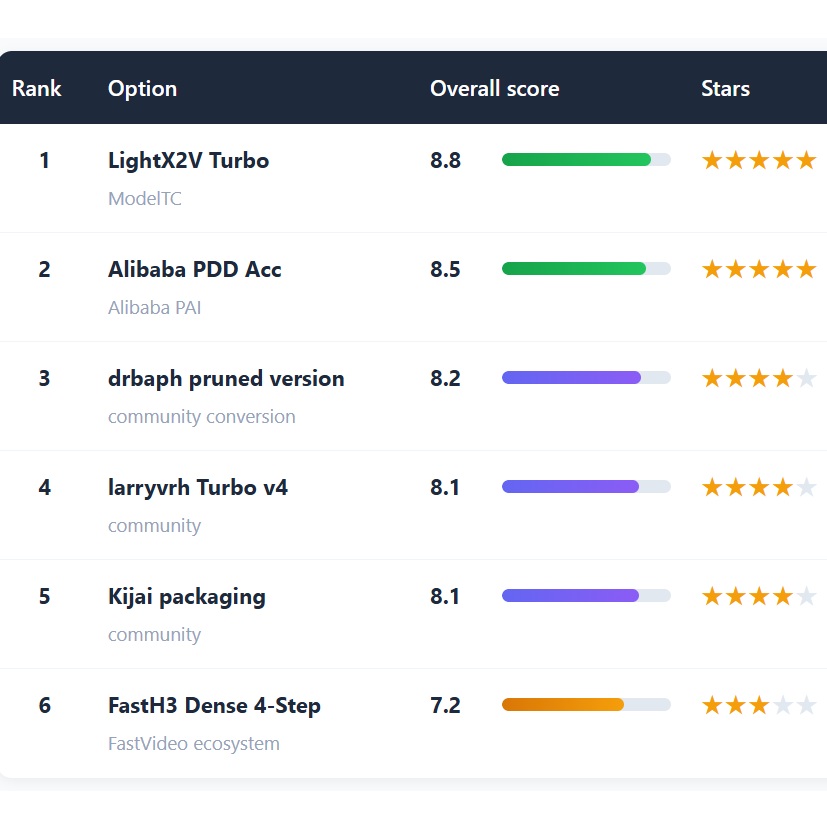
- Overall score (7 weighted dimensions): LightX2V Turbo leads at 8.8, Alibaba PDD at 8.5, drbaph at 8.2; larryvrh ranks #1 on quality alone but sits at 8.1 due to install barrier and license
- Most downloaded: Alibaba PAI’s Acc-LoRAs (13,767 downloads last month) — acceleration is the real demand
- Head-to-head speed: on an RTX 4090, LightX2V 8-step edges out Alibaba PDD 8-step (268s vs 291s, both at 44 GB VRAM)
- Distillation can beat the base model: Turbo 8-step + TeaCache cut 33 minutes to 10 on a 4070 Ti SUPER, with quality going up, not down
- Distillation LoRAs do not stack — mixing them breaks interval alignment and degrades silently
- Acceleration LoRAs are mostly Apache-2.0, but the H3 base model uses a separate community license with its own restrictions
1. First, Sort Out the Three Kinds of H3 LoRA
More than thirty LoRAs now surround H3, and mixing them up guarantees wrong settings. One distinction has to be drawn first — some of these LoRAs do not act on H3 at all.
| Type | Base model | What it actually does | Examples |
|---|---|---|---|
| Prompt-rewrite LoRA | Qwen (not H3) | Expands a short prompt into a structured, H3-oriented description | LightX2V Prompt Rewriter (Qwen3.6-27B / Qwen3-VL-8B / Qwen2.5-Omni-7B) |
| Acceleration LoRA | H3 | Compresses sampling from ~20 steps to 4 or 8 | LightX2V Turbo, larryvrh Turbo, Alibaba PDD Acc |
| Function / style LoRA | H3 | Changes motion, physics, viewpoint, style, characters | Equi360 (360° panorama), character and motion-control LoRAs |
This article covers only the second category — the real acceleration LoRAs. The first is prompt engineering with no bearing on speed; the third changes content without reducing step count.
2. The Global Landscape
| Option | Author / Org | Base | Trained steps | Recommended steps | License | LoRA size | Score |
|---|---|---|---|---|---|---|---|
| Minimax-h3-Turbo | LightX2V / ModelTC (China) | FL2VA + Ref2VA | 4 / 8 | 4–8 | Apache-2.0 | 1.3–1.9 GB | 8.8 |
| MiniMax-H3-Turbo-Lora | larryvrh (community) | FL2VA | 4 | 6–8 | Inherits base | ~744 MB | 8.1 |
| MiniMax-H3-Turbo-Lora-ComfyUI | drbaph (community) | FL2VA (pruned) | 4 | 6–8 | Inherits base | ~312 MB (compressed) | 8.2 |
| MiniMax-H3-experimental | Kijai (community) | FL2VA | 8 | 8 | Inherits base | ~1.7 GB | 8.1 |
| FastH3 Dense 4-Step | FastVideo ecosystem (community) | FL2VA | 4 | 4 | Inherits base | — | 7.2 |
| MiniMax-H3-Acc-LoRAs | Alibaba PAI (China) | FL2VA + Ref2VA | 8 (4 optional) | 8 | Apache-2.0 | 1.4 GB | 8.5 |
Three independent lines: LightX2V / ModelTC, larryvrh, and Alibaba PAI PDD. drbaph and Kijai are derivatives and packaging; INT8 / CMF / SVD compression variants descend from the two community lines.
3. Deep Dive, One by One
LightX2V / ModelTC · Minimax-h3-Turbo Widest coverage Score 8.8
The most formalized line: the whole project sits under Apache-2.0, weights ship in both Diffusers and ComfyUI formats, and the repo includes ready-made text-to-video, image-to-video, and reference-to-video workflows. Training uses DMD with a published config (video_flow_shift=6, audio_flow_shift=3, LoRA alpha 128, guidance-free). The timeline is clean: H3 inference support on August 7, the 4-step v1.0 768p on August 11, the 8-step v1.0 768p on August 27, and the Ref2VA 8-step v1.0 768p on September 4 — both FL2VA and Ref2VA trunks are now complete.
Pros
- Apache-2.0 — the cleanest commercial terms
- Full FL2VA + Ref2VA coverage, in both 4-step and 8-step
- Native ComfyUI support, no custom nodes needed
- Fastest in the RTX 4090 head-to-head
- Ships example workflows — fastest path to a result
Cons
- Ref2VA 8-step v1.0 landed latest, so fewer community validations
- The 4-step build still breaks on fast motion
- Larger files (8-step ComfyUI bf16 around 1.9 GB)
larryvrh · MiniMax-H3-Turbo-Lora Community default Score 8.1
The most-discussed single-file line on Reddit. One LoRA file covers every base — full bf16 / int8_convrot plus the pruned pruned_int8 / pruned_fp8 — and the node auto-detects a pruned base and re-injects the time-conditioning at run time. v4 uses a new training recipe with a static-frame enhancement; micro-detail (faces, fingers, texture) improved markedly and the earlier v1 “over-sharpened / plastic” look is fully resolved. The author recommends 6–8 steps, strength 1.0, simple scheduler, CFG 1.0; past 8 steps there is no gain, only sharpening artifacts.
Pros
- One file fits every base — no version matching
- v4 has the best micro-detail, no over-sharpening
- Leads on static and low-motion shots
- v1-850 remains the friendlier pick at 4 steps with heavy motion
- Ships a standalone Python script — runs without ComfyUI
Cons
- Needs a custom sampler node — a higher bar
- 4 steps plus heavy motion causes trailing ghosting (documented)
- FL2VA only, no Ref2VA
- Still a preview; audio and fast motion are being improved
drbaph · MiniMax-H3-Turbo-Lora-ComfyUI Low-VRAM lifesaver Score 8.2
A tensor-mapped conversion of larryvrh’s v4 weights so they load through ComfyUI’s native Load LoRA node, with compatibility work specifically for Pruned / Curve-form bases — the original LoRA, mounted on a pruned model, can crash frames or inject audio noise because of a time-conditioning layer mismatch, and drbaph’s build fixes that. With an Euler sampler plus Beta scheduler, strength 1.0, and 6–8 steps, it is the cleanest-sounding, best lip-sync build on mid-to-low-VRAM (12–16 GB) cards today. An exact SVD dynamic-rank compression variant cuts file size by roughly 80%.
Pros
- Top choice for 12–16 GB VRAM with a pruned base
- No custom nodes — plugs into a native workflow
- Fixes audio noise on pruned bases
- SVD-compressed build at 312 MB (99.92% cosine similarity)
Cons
- Essentially a conversion of larryvrh — hostage to upstream timing
- No extra benefit over the full base model
Kijai · MiniMax-H3-experimental Ecosystem packaging Score 8.1
Kijai’s value is engineering, not novel algorithms: it packages DiT loading, VAE decode, and the Turbo scheduler into unified standard nodes, dramatically lowering the bar for wiring a graph by hand. Its ComfyUI-MiniMax-H3 node ecosystem is many players’ first step into H3, and the 8-step file’s quality matches the base model — the main advantage is an out-of-the-box end-to-end workflow. Best for creators who would rather not tune sampler parameters and want to stand up T2V / I2V pipelines quickly.
Pros
- Mature node packaging, workflows work out of the box
- Quality on par with the base model, stable
- Kept in step with ComfyUI releases
Cons
- Tied to the Kijai node architecture — migration cost
- Not an independent algorithmic contribution
- Larger files
FastVideo · FastH3 Dense 4-Step 4-step extreme Score 7.2
Another 4-step route; a community converter turns the four-step adapters into ComfyUI-compatible LoRAs so loading returns to native nodes. Its positioning is narrow and clear: maximum single-shot speed, on the explicit assumption that 4-step quality is acceptable. Ecosystem maturity and documentation trail the three main lines — a “tinkerer’s” option for users who enjoy fiddling and whose work is mostly static shots or small motion.
Pros
- Pure 4-step — the most aggressive single-shot speed
- Converter returns it to native node loading
- Good for batch previews of static shots
Cons
- Thinnest ecosystem and docs; few validations
- Highest crash risk at 4 steps with heavy motion
- No Ref2VA coverage
Alibaba PAI · MiniMax-H3-Acc-LoRAs (PDD) #1 downloads Score 8.5
Strictly speaking, this is not an ordinary LoRA. Each 1.4 GB file carries two things: a regular rank-64 trunk LoRA, plus a PDD head bank — 32 per-interval copies of the final-layer video and audio projections for each modality, fused by sigma. That creates the fundamental difference from Turbo LoRAs: Turbo changes how the model thinks; PDD dictates what each interval should output. The method comes from the paper by Neta Shaul et al. (arXiv:2607.26004), applied by Alibaba to H3, delivering complete audio-video in 8 steps (or 4), with no CFG. At 13,767 downloads last month it is the most-downloaded acceleration option.
Pros
- Most downloaded — the most community-validated
- Interval-level distillation is highly stable — almost no stray textures or color shifts
- 8 steps, no CFG, audio and video in one pass
- Apache-2.0, clean commercial terms
- Both FL2VA and Ref2VA trunks covered
Cons
- Requires the dedicated node — a plain LoRA loader cannot read it (and drops the distillation silently)
- Only 8 / 4 / 6 steps accepted; the node rejects other counts
- Cannot stack with other distillation LoRAs or step-caching
- Slightly slower than LightX2V in testing
- Single-shot instruction adherence may be slightly lower (it added a camera move on its own)
4. Head-to-Head Matrix
| Option | Rec. steps | Base coverage | Node dependency | Stacks with other distill | License | Target VRAM |
|---|---|---|---|---|---|---|
| LightX2V Turbo | 4–8 | FL2VA + Ref2VA | None | No | Apache-2.0 | 12 GB+ |
| larryvrh Turbo v4 | 6–8 | FL2VA | Custom node | No | Inherits base | Depends on base |
| drbaph converted | 6–8 | FL2VA (pruned) | None | No | Inherits base | 12–16 GB first pick |
| Kijai packaged | 8 | FL2VA | Kijai nodes | No | Inherits base | Depends on base |
| FastH3 Dense 4-Step | 4 | FL2VA | None (after convert) | No | Inherits base | Depends on base |
| Alibaba PDD Acc | 8 (or 4 / 6) | FL2VA + Ref2VA | Dedicated node required | No | Apache-2.0 | Depends on base (34 GB baked build) |
5. Measured Data: The Part Most Write-ups Get Wrong
No “speedup multiple” multiplies cleanly. Every author uses a different GPU, resolution, duration, sampler, precision, and whether loading time is included. Below are three independently sourced measurements for cross-reference.
5.1 Head-to-Head: LightX2V vs Alibaba PDD
| Option | Inference time | VRAM | Quality notes |
|---|---|---|---|
| LightX2V 8-step + kitchen attention | 268 s | 44 GB | Video / audio / timeline adherence all rated “good” |
| Alibaba PDD Acc + kitchen attention | 291 s | 44 GB | More stable; almost no stray artifacts |
Conditions: RTX 4090 24G + 64G RAM, 14 s at 528×768, 8 steps, both with comfy kitchen attention. LightX2V is slightly faster; overall quality is close, and the real divergence is single-shot instruction adherence — given a prompt that explicitly says “static shot, no push-in,” LightX2V held it the whole way while PDD added a push-in on its own. The choice depends on whether your work fears “breaking” or “disobeying” more.
5.2 The Speedup Chain: Base → Caching → Distillation
| Option | Steps | Time | Relative speedup | Quality |
|---|---|---|---|---|
| Original GGUF Q4_K_M | 20 | ~33 min | 1× (baseline) | Normal |
| Original + TeaCache | 20 (~50% skipped) | ~15 min | 2.2× | ~equal to base |
| Turbo 8-step LoRA + TeaCache | 8 | ~10 min | 3.3× | Better |
Conditions: RTX 4070 Ti SUPER 16GB, 576×1024, 15 s at 24 fps (362 frames), base H3-FL2VA-Pruned-Q4_K_M.gguf. The counterintuitive part: quality improved after distillation. Plausible reasons — fewer steps means less accumulated approximation error; the distillation teacher’s outputs were quality-filtered; the LoRA’s training resolution matches the inference size; and a bf16 LoRA over a Q4 base preserves full precision on the most important difference signal.
5.3 Same-Card Long-Form Comparison
| Option | Steps | Inference time |
|---|---|---|
| Base model | 20 | 1363 s (~22 min) |
| Alibaba PDD Acc + kitchen attention | 8 | 464 s (~8 min) |
| LightX2V 8-step + kitchen attention | 8 | 400 s (~7 min) |
Conditions: RTX 4090 24G + 64G RAM, 10 s at 1280×736 (0.9 MP), 44 GB VRAM.
6. Scoring and Head-to-Head Verdicts
The previous sections analyzed each option qualitatively; this one puts numbers on it. The scoring below is not an official benchmark — it is a composite judgment drawn from public model cards, author notes, the ComfyUI Wiki, and community measurements. Seven dimensions are each scored out of 10 and weighted into a single overall score. Results will vary with GPU, resolution, and workflow, so treat this as a starting point for ranking, not the final word.
6.1 Scoring Dimensions and Weights
| Dimension | Weight | What it measures |
|---|---|---|
| Speed | 20% | Wall-clock time at 8 steps, speedup vs. the 20-step base, whether 4 steps is supported |
| Quality retention | 20% | Detail, skin and lighting, audio quality, and fidelity to the base model |
| Stability | 15% | Resistance to breakdown, artifacts and color shifts; consistency across long clips and shots |
| Prompt adherence | 15% | Fidelity to camera, motion and composition intent — does it improvise? |
| Usability | 10% | Install barrier, node dependencies, documentation and examples |
| Ecosystem maturity | 10% | Downloads, community discussion, release cadence, validation samples |
| License clarity | 10% | Whether commercial terms are clear, whether it is Apache-2.0, hidden restrictions |
6.2 Overall Scoreboard
| Rank | Option | Overall score | Stars | One-line verdict |
|---|---|---|---|---|
| 1 | LightX2V Turbo ModelTC |
8.8
|
★★★★★ | First on both speed and adherence, cleanest license — best overall |
| 2 | Alibaba PDD Acc Alibaba PAI |
8.5
|
★★★★★ | Most stable with the largest ecosystem, at the cost of a dedicated node |
| 3 | drbaph pruned version community conversion |
8.2
|
★★★★★ | Easiest on low VRAM, native node plug-and-play, cleanest audio |
| 4 | larryvrh Turbo v4 community |
8.1
|
★★★★★ | Best quality in the field, dragged down by install barrier and license |
| 5 | Kijai packaging community |
8.1
|
★★★★★ | Turnkey and least effort end-to-end; algorithm follows upstream |
| 6 | FastH3 Dense 4-Step FastVideo ecosystem |
7.2
|
★★★★★ | Most aggressive pure 4-step; weakest stability and documentation |
Overall score = sum of dimension scores × weights (out of 10). Ranks 4 and 5 tie at 8.1 — the real decision comes back to “do you value quality or convenience more?”
6.3 Seven-Dimension Breakdown
| Option | Speed | Quality | Stability | Adherence | Usability | Ecosystem | License | Overall |
|---|---|---|---|---|---|---|---|---|
| LightX2V Turbo | 9.0 | 8.5 | 8.0 | 9.0 | 9.0 | 8.5 | 10.0 | 8.8 |
| Alibaba PDD Acc | 8.0 | 8.5 | 9.5 | 7.5 | 7.0 | 9.5 | 10.0 | 8.5 |
| drbaph pruned | 8.5 | 8.5 | 8.5 | 8.5 | 9.5 | 7.0 | 6.0 | 8.2 |
| larryvrh Turbo v4 | 8.5 | 9.0 | 7.5 | 8.5 | 7.0 | 9.0 | 6.0 | 8.1 |
| Kijai packaging | 8.0 | 8.5 | 8.5 | 8.0 | 9.5 | 8.0 | 6.0 | 8.1 |
| FastH3 Dense 4-Step | 9.0 | 7.0 | 6.5 | 7.0 | 8.0 | 6.0 | 6.0 | 7.2 |
Green marks the top tier in each column, amber a clear weakness, red the weakest. Note that licensing pins all four community versions at 6.0 — the most substantive gap between the community options and the two official Chinese releases.
6.4 Category Champions
Same card, same spec on a 4090: 268 s at 8 steps vs. Alibaba PDD’s 291 s — about 8% faster, and wider on long clips (400 s vs 464 s).
Best micro-detail (faces, fingers, texture); the early “over-sharpened / plastic” look is gone. Leads on static and slow-motion shots.
Interval-level distillation delivers the strongest consistency — almost no stray texture, sudden color shift, or creepy background motion.
With “static shot, no push-in” written into the prompt, it holds all the way through — no improvising a camera move.
One ships mature standard nodes ready to use, the other plugs straight into native Load LoRA — no sampler tuning required.
13,767 downloads last month — the most-downloaded acceleration option, with the richest community validation.
6.5 Head-to-Head Verdicts: Four Matchups
① Speed
Same card, 10 s at 1280×736: base 20-step 1363 s → LightX2V 8-step 400 s → PDD 8-step 464 s. LightX2V wins, about 14% faster than PDD. FastH3 nominally runs a pure 4 steps, but pays in quality and stability.
② Quality
On a 4070 Ti SUPER, 8-step distillation + TeaCache vs. base 20 steps: the distilled version comes out cleaner, with sharper micro-detail and no plastic look. Fewer steps mean less accumulated approximation error — the most counterintuitive result on H3.
③ Stability
PDD vs. the Turbo family: PDD is rock-solid, with almost no stray artifacts or color shifts; Turbo at 4 steps smears and artifacts under fast motion — a documented failure mode.
④ Adherence
Same prompt with “static shot, no push-in”: LightX2V holds the shot, while PDD adds a push-in on its own. Pick Turbo for obedience, PDD for stability — the sharpest dividing line between the two lines.
Verdict summary: there is no all-round champion, only a best fit per scenario —
- Best overall / leads on speed, adherence and license: LightX2V Turbo (8.8)
- Most stable, largest ecosystem, safest against breakdowns: Alibaba PDD Acc (8.5)
- 12–16 GB VRAM, wants native nodes: drbaph pruned version (8.2)
- Maximum quality, 24 GB+, okay installing nodes: larryvrh v4-600 (8.1, #1 in quality)
- Zero tinkering, wants turnkey: Kijai packaging (8.1)
- Only wants single-shot speed, tolerates 4-step quality: FastH3 Dense 4-Step (7.2)
7. Supporting Acceleration: It’s Not Only the LoRA
A 4- or 8-step LoRA turns the “step count” knob, but it is not the only lever. The following can be combined — though the gains do not multiply.
| Method | What it solves | Reference gain | Quality risk | Barrier | Best use |
|---|---|---|---|---|---|
| Lower resolution / shorter duration | Fewer pixels and frames | Scales clearly with spec | Output spec drops directly | Lowest | Finding composition, seeds |
| Quantization (GGUF / INT8 / NVFP4 / NF4) | Cuts VRAM and transfer pressure | Hardware-dependent, not always faster | Mild to moderate | Low | Running on consumer GPUs |
| SageAttention | Faster attention at each step | ~2× claimed; ~1.66× in community samples | Low | Medium | Always-on acceleration |
| Spectrum & cache prediction | Skip or predict partial features | ~1.4–1.6× in community samples | Moderate; sensitive to high motion | Medium | Batch previews, seed hunting |
| TeaCache | Feature-cache step skipping | ~2.2× | ~equal to base | Low | The workhorse alongside LoRAs |
| comfy kitchen attention | Attention-backend optimization | Commonly stacked with LoRAs in tests | Low | Low | Near-default always-on item |
| 4-step / 8-step LoRA | Directly reduces sampling steps | 60–80% fewer steps vs the 20-step template | v0.1 detail still needs work | Low to medium | First pick — high-frequency iteration and batch generation |
Key caution: Do not simply multiply these numbers. SageAttention’s 1.66× times Spectrum’s 1.6× times a 4-step LoRA does not equal a solid tenfold speedup. Especially once a Turbo LoRA leaves only 4 steps, caching methods have very little computation left to skip — more aggressive prediction yields diminishing returns while quality risk grows.
TeaCache parameter trap: start_step must be 2, not 0. The first two steps are the model’s most critical denoising phase, and skipping them collapses the frame. Also, BasicScheduler.steps and TeaCache.total_steps must match, and CreateVideo.fps is locked at 24 (H3’s audio VAE is hard-coded).
The other half of the VRAM battle: the official BF16 weights total roughly 120 GB. ComfyUI noticed the model’s modulation weights are about 40% of total parameters and can be precomputed and cached, so it prunes them into an equivalent lookup table; with int8 quantization and a custom kernel, overall memory drops 66%. Community quantizations now cover every VRAM tier: GGUF Q2_K to Q5_K_M, NVFP4, INT4 ConvRot, mixed INT4/INT8, OrbitQuant’s W4A4, and ModelScope’s DiffSynth-Studio NF4 (8 GB minimum), with MLX support for Mac users.
8. Recommendations by Scenario
12–16 GB VRAM, want it clean
With an INT8/FP8 pruned base and no third-party sampler node needed, it produces the cleanest audio and most stable lip-sync.
24 GB+, chasing maximum quality
With the full base and the dedicated Turbo Sampler node, it delivers the best skin texture and lighting detail.
Commercial use, licensing matters
Both are Apache-2.0 with the cleanest commercial terms. Note the H3 base model carries its own separate license.
Fear of broken frames — need stability
Interval-level distillation yields the strongest stability, with almost no stray textures, color shifts, or background drift.
Reference-to-video (Ref2VA)
Ref2VA distillation options are scarce — only these two plus the earlier 4-step v0.1. Essential for multi-image / reference-video / reference-audio workflows.
No node installs, want out-of-the-box
Mature node packaging; T2V / I2V pipelines import in one click, for creators who would rather not tune samplers.
Tight on budget and VRAM — just get it running
On 16 GB it measured 33 minutes down to 10 — the best value combination.
Heavy, fast-motion scenes
Use the base model’s first two steps to lock composition and motion, then a Turbo LoRA for detail — it fixes flicker and structural collapse.
Decision Framework
1. Start with VRAM: 12–16 GB → drbaph pruned; 24 GB+ → larryvrh v4 or LightX2V on the full base
2. Then the task: FL2V only → all four lines work; Ref2V → only LightX2V and Alibaba PDD
3. Fear breaking or disobeying? Breaking → Alibaba PDD; strict camera-intent adherence → LightX2V
4. Commercial use? → pick Apache-2.0: LightX2V or Alibaba PDD
5. How many steps? Static shots 4–6; general 6–8; heavy motion → go straight to two-stage
6. Want it even faster? → stack TeaCache (start_step=2) and kitchen attention
7. Don’t want to tinker? → import a Kijai ecosystem workflow
8. Still undecided? → go straight to the overall scores: LightX2V (8.8) for best overall, Alibaba PDD (8.5) for maximum stability, drbaph (8.2) for low-VRAM convenience
9. Pitfalls and Licensing
1. Distillation LoRAs do not stack. When switching to Alibaba PDD you must remove other distillation LoRAs (especially Turbo) and must not add step-caching nodes — both break interval alignment and degrade silently rather than erroring. Character / style LoRAs can stack normally.
2. The silent strength-0.0 trap. Setting the PDD LoRA strength to 0.0 on a non-baked base raises no error but renders an undistilled model. Check the pdd_acc_baked flag in the file metadata.
3. Sigma shift must be exact. PDD’s recipe is an Euler sampler, CFG 1.0, and a sigma shift of exactly 12.0 / 3.0; the sigmas emitted by the Apply node are the trained interval boundaries and cannot be changed freely.
4. Four steps is not the recommended value. Both major authors list 6–8 as noticeably better. Four works only on static shots, slow pans, and single-person dialogue framing; heavy motion breaks first.
5. “5× faster” is not 5× wall-clock. It describes sampling steps (~20 → 4). Model loading, text encoding, VAE encode/decode, and audio decode do not shrink alongside it.
6. The base-model license is a separate matter. Acceleration LoRAs are mostly Apache-2.0, but the H3 base model itself is under the MiniMax H3 Community License — not an OSI open-source license. Local deployment in the United States, the European Union, the United Kingdom, and the Republic of Korea requires separate written authorization, and organizations above roughly $20M in annual revenue face an additional gate. When serving third parties, mind the hosting obligations.
Key Findings
1. The global acceleration ecosystem converges on three independent lines. LightX2V / ModelTC, larryvrh, and Alibaba PAI PDD; drbaph, Kijai, and FastVideo are derivatives or packaging. Understanding how these three differ is more efficient than trying versions one by one.
2. Step count beats checkpoint choice. Every author points to 6–8 steps. If 4-step output looks smeared or ghosted, that is a documented failure mode — raise the steps before changing checkpoints.
3. Distillation can beat the base model. Under the right resolution and precision combination, an 8-step distillation looks cleaner than a 20-step base run — fewer steps means less accumulated approximation error.
4. Chinese teams lead this layer. LightX2V / ModelTC and Alibaba PAI both ship formal Apache-2.0 releases covering the full FL2VA and Ref2VA task set, with clearer licensing than the community builds.
5. Stability and adherence are a trade-off. PDD’s interval-level distillation buys stronger stability, at the possible cost of slightly lower single-shot instruction adherence; the Turbo lines follow prompts more faithfully but are more prone to noise and artifacts under heavy motion.
6. Licensing is the hidden trap. An Apache-2.0 acceleration LoRA does not mean the base model is freely commercializable. Regional deployment limits and revenue gates on the base model will stall a project faster than model speed — check the whole chain before launch.
7. Read the scores as a ranking, not an absolute. After seven-dimension weighting: LightX2V 8.8 > Alibaba PDD 8.5 > drbaph 8.2 > larryvrh 8.1 ≈ Kijai 8.1 > FastH3 7.2. Licensing is the shared weakness of all four community versions (all at 6.0), and the key divide between them and the two official Chinese releases.
Put AI Video Translation to Work
Reading about acceleration is step one. DeepVideo by DeepForgeHub translates any video into 30+ languages with Voice Clone and lip-sync — a Windows & Mac desktop app that runs locally, so your footage never leaves your machine.
Free tier: 18 minutes total + 2 minutes daily · Local processing, no cloud upload
© 2026 DeepForgeHub Research. Sources: MiniMax official releases, Hugging Face model cards, the alibaba-pai / lightx2v / larryvrh / drbaph / Kijai repositories, ComfyUI Wiki, and community measurements. Versions, measurements, and community figures as of September 2026.