
Video Dubbing Demand: Market Analysis
Six Continents · Content Distribution Platforms — A Two-Dimension Demand Map
September 2026 | Methodology: public market data + estimation models | Unit of analysis: Continent × Platform
Executive Summary
This report answers one specific question: where in the world is the demand for video dubbing and translation most real, most intense, and most worth investing in? We split demand into two orthogonal dimensions — geography (six continents with key-country drill-downs) and channel (content distribution platforms) — and produce a demand map that can be ranked and acted upon.
- Total demand: The global AI video dubbing market is approximately USD 444 million in 2026 (Definition A: all-scenario AI dubbing, 20.0% CAGR). The OTT-specific segment is about USD 750 million (Definition B: Mordor Intelligence, 26.71% CAGR). Including human-led services, the broader dubbing services market is roughly USD 3.80 billion (Definition C). These three figures use different statistical boundaries; each is labelled at the point of citation throughout this report.
- Geographic distribution of demand: Asia-Pacific leads localization market share at 33% and is the fastest-growing region, followed by North America at 31%. The Middle East and Africa has the smallest base (around 5.6%) but is the fastest-growing emerging market (approx. 7.1% CAGR, reaching 8.2% in the anime dubbing segment).
- The real new demand is on the platform side: On 4 February 2026 YouTube opened auto-dubbing to all creators (27 languages). By December, more than 6 million viewers per day watched at least 10 minutes of auto-dubbed content. This is the single largest platform-level demand catalyst on record — it turned dubbing from a “big-studio privilege” into a “default expectation.”
- Short-drama exporters are the most aggressive demand side: Non-China short-drama revenue is projected to grow from USD 2.7 billion to USD 3.6 billion in 2026, reaching USD 9.5 billion by 2031. ReelShort holds 29% and DramaBox 21%. This content category structurally requires 10+ synchronized language versions.
- The core demand-side mismatch: the regions with the most urgent demand (Middle East, Latin America, Southeast Asia) are precisely those with the thinnest voice talent pools and the least-resourced languages. Meanwhile the strongest supply regions (North America, Western Europe) have already-saturated demand. That mismatch is the largest opportunity window for AI dubbing.
- Continent opportunity ranking: Middle East & Africa (fastest growth, weakest supply) > Latin America (second-fastest growth, deep dubbing tradition, rising willingness to pay) > Asia (largest volume but heavily fragmented) > Europe (stable demand, high compliance barriers) > North America (largest volume, decelerating growth) > Oceania (small and shallow, not an independent opportunity market).
- Platform opportunity ranking: YouTube (full auto-dubbing rollout, demand subsidized by the platform) > short-drama platform matrix (most rigid demand, most direct payment) > TikTok / Meta Reels (largest volume, lowest unit price) > Netflix / Prime / Disney+ (highest unit price, highest barriers) > Chinese platforms going global (Bilibili internationalization, window-of-opportunity dividend) > regional platforms (Shahid, Viki, OSN+, deep regional moats).
1. Methodology and Data Definitions
This is not a general “dubbing industry overview” but a demand-side positioning tool. Before presenting data, we set out the methodology so readers do not conflate figures built on different definitions.
1.1 The two-dimension analytical framework
Demand for video dubbing is determined by two orthogonal variables: who is watching (geography and language community) and where they watch (content distribution platform rules and ecosystems). The same asset posted to YouTube and to ReelShort faces completely different demand intensity, language priorities, and quality thresholds. This report therefore uses a two-dimensional matrix:
- Dimension 1 — Continent: Asia, Europe, North America, Latin America, Middle East & Africa, Oceania. Each is analysed across five elements — market size and growth, demand drivers, language composition, dubbing preference and quality thresholds, and key-country drill-down. (Per the confirmed brief, each continent drills down into 2–3 key countries.)
- Dimension 2 — Platform: content distribution platforms only (end channels), focused on their multilingual policy, demand-side characteristics, creator ecosystem, and opportunity rating. Tool and vendor platforms are out of scope.
1.2 Three market definitions that must not be mixed
“How big is the video dubbing market” has no single answer because institutions draw boundaries differently. The three definitions cited in this report are listed in parallel and never merged:
| Definition | Scope | 2026 size | CAGR | Source and notes |
|---|---|---|---|---|
| A AI video dubbing (all scenarios) |
AI-driven video dubbing across entertainment, education, corporate training, marketing and more | USD 444M | 20.0% | PW Consulting; 2025 base of USD 380M, reaching USD 1.362B by 2032. 2025 regional split: North America 151.8M / Asia-Pacific 103.3M / Europe 94.8M / Latin America 18.7M / MEA 11.4M |
| B AI dubbing for OTT |
AI dubbing facing OTT/streaming platforms only; excludes corporate training and marketing | USD 750M | 26.71% | Mordor Intelligence; USD 530M in 2025 reaching USD 2.45B by 2031. Cloud deployment accounts for 63.34%. Narrower scope, faster growth |
| C Video dubbing services (incl. human) |
Full AI plus traditional human dubbing services, including foreign-language and native-language adaptation | USD 3.80B | 3.2% | 360 Market Updates; USD 5.972B by 2035. Lower growth reflects the large share of high-unit-price, slow-growing human services |
Definitions A/B/C come from three different research firms with non-overlapping boundaries (A ⊂ C; B ⊂ C, while A and B partially intersect). Where this report discusses regional share, it uses localization market share (Vitrina 2026: Asia-Pacific 33%, North America 31%). Where it discusses market size, the definition is always stated. All figures are third-party public data and not original estimates by this report.
1.3 Four-factor demand intensity scoring
For comparability, this report assigns each region and platform a “demand intensity score” (0–10), a weighted sum of four dimensions:
| Factor | Weight | Meaning and basis of judgement |
|---|---|---|
| Demand volume | 30% | Video-consuming user base and viewing hours in the market, determining the total addressable pool |
| Growth momentum | 25% | User growth, content supply growth and platform investment intensity, determining the marginal change in demand |
| Dubbing preference rigidity | 25% | How strongly audiences in the market prefer dubbing over subtitles, determining whether dubbing is “mandatory” |
| Monetization | 20% | ARPU, subscription and in-app purchase maturity, and ad monetization efficiency, determining whether demand converts to revenue |
Note: this scoring model is an analytical tool built by this report for decision support, not an official market ranking. Weights follow the practical logic of prioritizing volume, then growth, then preference, then monetization. Readers whose business centres on monetization should raise that weight themselves (see the sensitivity test in Section 12).
2. Asia: The Largest and Most Fragmented Demand Arena
Asia Demand 9.0Fastest growing
Nature of demand: Asia is not “one market” but at least four distinct markets stacked together — China’s inbound demand (foreign content entering China), Japan and Korea’s outbound demand (their own content going global), Southeast Asia’s import demand (consuming Chinese, Korean and US content), and India’s multilingual domestic demand (local content distributed across languages within India). These four have entirely different language combinations, quality thresholds and payment capacity. Treating them as one whole is the most common mistake in planning.
Demand drivers
- Continued Korean content spillover: South Korea’s Ministry of Science and ICT supported AI dubbing across 1,200 K-content titles (1,400 hours) in English, Spanish and Portuguese, reaching 100 million cumulative viewers across 22 countries within 5 months. A government-led template for scaled dubbing demand.
- India’s multilingual structure: A single asset is distributed across Hindi, Tamil, Telugu and Bengali. This is a structural necessity, not a marketing choice.
- Southeast Asia is mobile-first: Indonesia, Vietnam, Thailand and the Philippines watch primarily on phones. Small screens widen the advantage of dubbing over subtitles, which perform poorly at that size.
- Japan is the highest-value single market: Short-drama revenue there is forecast to exceed USD 1.2 billion by 2030, but audience quality expectations are extremely high and poor localization is rejected immediately.
Dubbing preference characteristics
Preference varies sharply within Asia. Most Southeast Asian markets accept time-sync voice-over rather than full lip-sync dubbing, which significantly reduces production cost. India requires full lip-sync — more expensive, but also a competitive moat. Japanese and Korean audiences show lower acceptance of dubbing than subtitles (K-drama fans in particular prefer original voices), yet demand the highest precision of localization. This is a “low preference rigidity but high quality threshold” combination, unlike any other region.
Key-country drill-down
| Country | Demand positioning | Core languages | Dubbing threshold | Key judgement |
|---|---|---|---|---|
| China | Inbound + outbound dual track | Mandarin ⇄ EN/ES/PT/ID | Medium | Both the largest content producer (85% share of short-drama going global) and an importer of foreign content. Bilibili’s international app relaunch and AI speech translation (zh↔en) are landmark moves |
| India | Domestic multilingual demand | Hindi, Tamil, Telugu | High (full lip-sync required) | Listed by multiple research firms as one of the highest-value target languages for AI dubbing (Hindi). English penetration is not low, but vernacular content converts to payment better |
| Japan | High value, small volume | Japanese | Extremely high | Short-drama revenue forecast above USD 1.2B by 2030; no substitute language, native dubbing is mandatory; high cost but high revenue per user. Substandard quality is eliminated immediately |
Opportunities
- Largest volume, and the only region strong in both content export and import
- Southeast Asia is cost-sensitive, so AI dubbing’s price-performance advantage is most readily accepted
- Government-level programmes (Korea’s 1,400 hours, Malanshan translation hub) bring stable, scaled orders
- Short drama going global turns dubbing from “optional” into a production-line standard
Risks
- Severe language fragmentation — “one solution for the whole region” does not hold
- Japan’s quality bar is high; low-quality AI dubbing actively damages brands
- India requires lip-sync, raising both technical barriers and cost
- Wide regulatory differences within the region; Chinese content going global faces two-way compliance
3. Europe: Mature Demand, the Highest Compliance Barriers
Europe Demand 7.3Highest compliance bar
Nature of demand: European dubbing demand is sustained by decades of dubbing tradition rather than by growth. Germany, France, Spain and Italy all have mature dubbing industries and audience habits — audiences are used to watching dubbed versions, which makes demand rigid and stable. But precisely because the tradition runs deep, the human dubbing industry and unions are strong, and AI penetration is actually slower than in Asia-Pacific.
Demand drivers
- Rigid dubbing preference: Audiences in Germany, France and Spain have long preferred dubbed content. These are markets where dubbing is a prerequisite for entry, not an alternative to subtitles.
- Public language policy: Dubbing into regional languages such as Catalan receives funding from local government language departments (for example, Netflix and Disney+ releasing Catalan dubbing batches), creating policy-driven incremental demand.
- Regulation leads the market: The EU has the strictest disclosure requirements for synthetic speech and AI-generated content. Dubbing products must build in compliance capability — a barrier, and also a moat.
Key-country drill-down
| Country | Demand positioning | Core language | Dubbing threshold | Key judgement |
|---|---|---|---|---|
| Germany | Most rigid dubbing preference | German | High (strong tradition) | One of Europe’s largest dubbing markets, with very high acceptance of dubbed versions. The human dubbing industry is mature, so AI must enter with a “cost reduction” rather than “replacement” narrative |
| France | Cultural protection + dubbing tradition | French | High | Strong language-protection policy including content quota requirements for domestic-language content; localization is an access requirement |
| Spain | Multi-layered language market | Castilian Spanish + regional languages | Medium | Clear separation between “European Spanish” and “Latin American Spanish”, plus government-funded dubbing into regional languages such as Catalan — one of the few markets where policy pays the bill |
Opportunities
- One of the most stable, highest-paying mature markets
- Rigid dubbing preference means demand will not be replaced by subtitles
- Regional languages (Catalan etc.) receive public funding — a rare policy-funded scenario
- Once compliance capability is established it becomes a barrier against less compliant competitors
Risks
- Strict disclosure and copyright requirements for synthetic speech raise compliance costs
- Human dubbing unions are strong and actively resistant
- Growth below Asia-Pacific and the Middle East — not the incremental battleground
- Multilingual compliance (GDPR + AI Act) substantially increases product design complexity
4. North America: The Largest Cash Cow, with Decelerating Growth
North America Demand 8.2Highest unit price
Nature of demand: North America is a two-way funnel. On one side it is the world’s largest content exporter, needing to dub its English content into dozens of languages for global distribution. On the other it is the largest single import market for Korean dramas, Spanish-language series and Chinese short dramas (North America accounts for 59% of ReelShort’s revenue; the US alone contributes 37% of global short-drama in-app purchase revenue in a single quarter). North American dubbing demand therefore has both “export processing” and “import consumption” characteristics.
Demand drivers
- Localization budgets at streaming headquarters: Netflix’s 2025 content localization spend is estimated above USD 400 million (Media Partners Asia estimate), with dubbing taking the majority. Prime Video states it can offer up to 22 dubbed languages and 36 subtitle tracks across 240 countries and territories.
- Explosive short-drama import demand: The US is the largest single market outside China for short drama, forecast at USD 3.7 billion by 2031. This content requires high-frequency, low-cost batch dubbing.
- Huge creator economy base: Since YouTube opened auto-dubbing, North American creators are the largest user group, treating the platform capability as free infrastructure.
- Emerging platform competition: Prime Video began a hybrid pilot in March 2025 across 12 licensed films and series in English and Spanish; Netflix has trialled AI dubbing on Latin American Spanish animation. Big-studio experimentation is itself incremental demand.
Key-country drill-down
| Country | Demand positioning | Core languages | Dubbing threshold | Key judgement |
|---|---|---|---|---|
| United States | Largest single market globally | English export + Spanish domestic | High (strict content standards) | Short drama contributes 37% of global in-app purchase revenue in a single quarter; North America is 59% of ReelShort’s revenue. Also home to YouTube and Netflix headquarters, so platform policy radiates globally from here |
| Canada | Bilingual structure + subsidies | English + French | Medium | English-French bilingualism is a legal requirement and French content receives policy funding; localization is a condition of entry rather than a choice |
Opportunities
- Largest market globally, strongest payment capacity, highest unit prices
- Home of platform headquarters — entering here means being close to the rule-makers
- Rapidly growing short-drama import demand is a new source of batch demand
- Mature creator economy with a large base of self-paying individual users
Risks
- Growth below Asia-Pacific and the Middle East — not the incremental battleground
- Highest risk of demand internalization as major platforms build their own AI dubbing
- Strict content quality standards make suboptimal output hard to place in mainstream channels
- Active copyright claims from actors’ and voice actors’ unions
5. Latin America: The Underrated High-Growth Dubbing Market
Latin America Demand 8.4Second-fastest growth
Nature of demand: Latin America is the world’s most underrated dubbing market. It combines two advantages rarely found together: first, extremely high audience acceptance of dubbing — decades of dubbed Hollywood films and domestic telenovelas have made dubbing the default viewing mode rather than a substitute; second, explosive growth momentum — Brazil’s short-drama downloads grew more than 40x in two years, taking it into the global top five by revenue. Rigid demand plus growth momentum simultaneously is a combination few other regions offer.
Demand drivers
- Deep dubbing tradition: Latin American audiences have long consumed dubbed content and accept it readily. Dubbing is mainstream, not niche. This contrasts sharply with Asia’s “subtitle camp”.
- Short-drama explosion: Brazil is already a global top-five short-drama revenue market; Latin America as a whole saw downloads grow more than 40x in two years. Short drama structurally requires high-frequency multilingual dubbing.
- Content export capability: Mexico, Brazil and Argentina are regional localization hubs, and Spanish/Portuguese content can be exported globally in reverse, creating two-way demand.
- Delivery cost advantage: Colombia and Mexico are emerging as outsourcing hubs thanks to lower labour costs and a growing talent pool.
Key-country drill-down
| Country | Demand positioning | Core language | Dubbing threshold | Key judgement |
|---|---|---|---|---|
| Brazil | Region’s top growth market | Brazilian Portuguese | High (full lip-sync expected) | Global top-five short-drama revenue market. Brazilian and European Portuguese differ markedly and must be produced separately. Audiences have a clear expectation of full lip-sync — a classic “high barrier, high return” case |
| Mexico | Regional content hub | Latin American Spanish | Medium-high | Both a dubbing outsourcing hub (cost advantage + talent pool) and a producer of Spanish-language content — a dual “demand + supply” role |
| Argentina / Colombia | Emerging capacity and demand | Latin American Spanish | Medium | Governments offer tax incentives for creative industries and modern recording facilities, making these regional outsourcing bases with lower labour costs than Brazil |
Opportunities
- Dubbing preference rigidity among the highest globally; demand will not be replaced by subtitles
- 40x growth in short-drama downloads — the fastest-growing new source of demand
- Reverse content export (Spanish/Portuguese to the world) creates two-way demand
- Low local production costs allow it to double as a supply hub, lowering delivery cost
Risks
- ARPU below North America; limited revenue per user
- Brazilian Portuguese and Latin American Spanish must be produced separately, doubling cost
- Higher economic volatility across the region affects subscription and payment stability
- Variation between national Spanish dialects requires local review
6. Middle East & Africa: Smallest Base, Fastest Growth
Middle East & Africa Demand 8.6Fastest growth globally
Nature of demand: This is the report’s most noteworthy structural opportunity. The Middle East and Africa has the smallest base (localization share around 5.6%, AI dubbing only USD 11.4M), yet it is the fastest-growing region and faces the most severe supply shortage — the limited local voice talent pool forces the region to bring in external capacity, and AI dubbing fills exactly that gap. Rapidly growing demand plus severely insufficient supply equals the steepest supply-demand gap.
Demand drivers
- Young demographics plus rapid internet adoption: Broadband and 5G infrastructure is expanding quickly across GCC nations, and a young population has strong appetite for international entertainment — the underlying engine.
- Regional streaming expansion: Shahid, StarzPlay and OSN+ continue to expand their catalogues, while Netflix and Prime are also expanding Arabic content. Every new slate generates dubbing demand.
- Government cultural investment: Saudi Vision 2030 funds local dubbing infrastructure; UAE free zones offer tax and registration advantages attracting international dubbing partners. Demand driven by government spending.
- Multi-dialect requirement: The Arabic-speaking world often needs several dialect versions simultaneously (Modern Standard, Egyptian, Gulf Arabic). One platform’s multi-language release generates multiple tracks.
- Talent shortage forces technology adoption: Local talent scarcity makes AI speech synthesis a “must choose” rather than a “cheaper choice”.
Key-country drill-down
| Country | Demand positioning | Core languages | Dubbing threshold | Key judgement |
|---|---|---|---|---|
| Saudi Arabia | Policy-driven, high-spend market | Arabic (Standard + Gulf) | High (strict cultural review) | Vision 2030 funds local dubbing infrastructure; Gulf states have high per-capita digital spending, making this the highest-quality paying audience |
| UAE | Regional dubbing hub | Arabic + English | Medium-high | Free-zone policy attracts international dubbing partners; Dubai Media City concentrates high-end recording facilities, making it the production centre serving regional demand |
| Egypt | Capacity and talent base | Egyptian Arabic (strongest entertainment tradition) | Medium | Home to the core Arabic voice talent pool with competitive costs, serving both Middle East and North Africa. Egyptian Arabic has the highest acceptance for entertainment content |
Cultural adaptation requirements unique to this region
Dubbing demand in MENA carries cultural review costs that do not exist elsewhere and must be budgeted for in both time and money:
- Religious references, alcohol depiction, intimate scenes and gender dynamics require additional cultural review. Content that passes unchanged in India or Southeast Asia may need re-dubbing or script rewriting for MENA
- Arabic’s right-to-left script and longer average word length create timing mismatches against Chinese dialogue, requiring creative adaptation rather than literal translation
- Dialect choice directly affects audience reception: Modern Standard Arabic has the widest reach, Egyptian Arabic the strongest entertainment tradition, Gulf Arabic the highest-spending viewers. Choosing the wrong dialect means choosing the wrong market
Opportunities
- Fastest growth globally (dubbing 7.1%, anime dubbing 8.2%) — strongest momentum
- Thin local talent pool makes AI dubbing a necessity rather than an option, so demand is highly rigid
- Government funding (Saudi Vision 2030, UAE free zones) directly supports dubbing infrastructure
- High per-capita digital spending (especially in the Gulf) means payment capacity exceeds what market size alone suggests
Risks
- High cultural review requirements add cost and time to every project
- Multi-dialect structure requires multiple tracks for a single asset, raising cost
- Infrastructure and payment systems remain incomplete in parts of North Africa
- Political and regulatory certainty lower than in mature markets
7. Oceania: Small and Shallow — Not an Independent Opportunity Market
Oceania Demand 5.4English-speaking market
Nature of demand: Oceania (Australia and New Zealand) is an English-speaking market. Its audiences do not need dubbing for English content, so local dubbing demand comes from only two directions: exporting local content to non-English markets (limited volume) and immigrant communities’ demand for mother-tongue content (small scale). Lacking a distinct scale, growth profile or language structure, this report does not treat it as an independent opportunity market — in practice it is handled within the “English-speaking bloc”.
Why it is listed but rated lowest
- Single-direction demand: primarily export dubbing rather than import, so total volume is small
- No language entry barrier: English content is directly consumable, so dubbing is not a condition of access
- No policy-driven funding: unlike European regional languages or Saudi Vision 2030, there is no public funding support
- Low market concentration: population size means even high penetration would not support independent localization investment
The value of listing Oceania separately is avoiding misjudgement: its payment capacity (high English-bloc ARPU) is easily misread as “a market worth investing in independently”, yet real demand-side intensity does not support a standalone strategy. The correct approach is batch processing within the English-speaking bloc.
What to do
Fold Australia and New Zealand into unified English-bloc operations: share one set of English content and acquisition strategy with North America and the UK, without producing dedicated dubbing versions for the region.
What not to do
Do not design a dedicated localization plan or commit dedicated dubbing capacity for Oceania because of “high English-bloc ARPU” — the demand volume does not justify it.
8. Cross-Continent Comparison
Compressing the six chapters above into one rankable table. Scores use the four-factor demand intensity model from Chapter 1 (demand volume 30% + growth momentum 25% + dubbing preference rigidity 25% + monetization 20%), each scored 0–10.
| Continent | Volume 30% |
Growth 25% |
Preference 25% |
Monetize 20% |
Overall | One-line characterisation |
|---|---|---|---|---|---|---|
| Asia | 10 | 9 | 7 | 9 | 9.0 | Largest volume and strong in both directions, but internally divided — one solution cannot cover the region |
| Middle East & Africa | 5 | 10 | 9 | 10 | 8.6 | Smallest base but fastest growth and thinnest talent — the steepest gap, most worth moving early |
| Latin America | 7 | 9 | 10 | 7 | 8.4 | Most rigid dubbing preference globally plus 40x short-drama growth — an underrated high-certainty market |
| North America | 10 | 6 | 7 | 10 | 8.2 | The cash cow on scale and unit price, but growth is flattening and platform self-build risk is highest |
| Europe | 8 | 5 | 9 | 8 | 7.3 | Stable demand, rigid preference and strong payment, but clear compliance barriers and growth ceiling |
| Oceania | 4 | 4 | 3 | 9 | 5.4 | English-speaking; dubbing is not a condition of access. Pays well but volume does not support a standalone strategy |
Overall score = volume×0.30 + growth×0.25 + preference×0.25 + monetization×0.20. This score is a decision-support tool built by this report, not an official market ranking; individual dimension scores are subjective assessments intended for ranking rather than precise measurement. See Chapter 12 for weight sensitivity testing under different business objectives.
33% localization share, global #1; USD 103.3M AI dubbing. The only region strong in both content export and import
Dubbing CAGR 7.1%, anime dubbing 8.2% — both highest globally. Government funding directly supports dubbing infrastructure
Decades of dubbed film and telenovela tradition have made dubbing the default viewing mode, not a substitute — the most rigid preference globally
USD 151.8M AI dubbing market, the largest globally; short drama contributes 37% of global in-app purchase revenue in one quarter; highest ARPU
9. The Platform Dimension: Who Creates Dubbing Demand
Continents answer “where is the demand”; platforms answer “who triggers it and in what form”. This is one of the report’s core judgements: the largest increment in dubbing demand in 2026 does not come from more viewers, but from distribution platforms turning dubbing into a default capability. When platforms absorb the cost of dubbing, creator-side demand is released instantly. The platforms below are ordered by demand-trigger intensity.
9.1 YouTube — The Single Largest Demand Catalyst
YouTube Platform score 9.4Auto-dubbing for all
Demand impact: This is the most important platform-level change in the entire report. YouTube turned dubbing from “a process you pay to outsource” into a default capability the platform provides automatically — no sign-up, no waitlist, no manual approval. Two consequences follow: creator-side demand is released at near-zero cost (previously only large channels could afford multi-language versions), and viewer expectations are reset — once platforms offer dubbing by default, audiences begin to treat the absence of multi-language versions as the content owner’s failing.
Supporting mechanics (determining how demand lands)
- Preferred Language setting: viewers choose original or dubbed audio, with the preference tied to their account. This hands the choice to viewers and gives dubbed versions a stable audience segment.
- Smart filtering: automatically detects content unsuitable for dubbing (music videos, silent vlogs), avoiding wasted dubbing and reducing noise.
- Discovery-friendly: YouTube officially states auto-dubbing has no negative impact on the original video’s discovery algorithm, and may even help discovery in other languages. This removes creators’ biggest concern.
- Creator control: creators can upload their own dubs or disable auto-dubbing entirely.
- Lip Sync pilot: aligning mouth movements with translated audio is in testing (not publicly available, no date announced).
- Per-track analytics: Studio shows performance by language track, turning “which language is worth investing in” into a measurable question.
Where the platform stops (and the opportunity begins)
YouTube states plainly that at this stage creators cannot directly fine-tune the generated voice tracks. Auto-dubbing also applies only to in-platform long-form uploads. This leaves three clear external spaces:
- Scenarios needing fine control over subtitles and dubbing scripts (auto-dubbing offers no script-level adjustment)
- Scenarios needing an exported MP4 for Shorts, Reels and TikTok — cross-platform distribution
- Scenarios involving off-platform source material (assets not uploaded to YouTube)
What it means for demand-side buyers
If your main channel is YouTube and your content is long-form, the native capability is already sufficient and no additional dubbing service is needed. External solutions are only required for cross-platform distribution or script-level control.
What it means for supply side
YouTube’s role is educational rather than substitutive: it makes a vast number of creators aware for the first time of the value of multi-language versions. When those creators grow to need cross-platform, controllable finished output, demand spills out — the DeepVideo User Guide is the lowest-friction starting point.
9.2 The Short-Drama Platform Matrix — The Most Rigid, Most Directly Paying Demand
Short-drama platforms (ReelShort · DramaBox · DramaWave · NetShort · GoodShort) Platform score 9.2Most rigid demand
Demand impact: Short drama is the platform category with the most rigid dubbing demand and the most direct payment. Three reasons: content volume is large (tens to hundreds of episodes per title), so dubbing scales with episode count; timeliness is critical — the traditional pipeline of subtitle erasure + human translation + dubbing takes about half a month, by which point the domestic hype has passed, whereas AI translation compresses the cycle enough for “global simultaneity”; and the number of languages required means a single title must ship 10+ versions simultaneously, which is infeasible with human labour on cost grounds.
Demand drivers
- Cost structure forces the shift: AI hands translation, dubbing and lip-sync “entirely to the model”, driving process cost towards zero. This is the technical precondition that makes short-drama exports viable at all, not an optional optimization.
- Batch production model: studios such as Zhengzhou Shougu Culture produce AI dramas at scale for Europe, the US, India and Mexico, with compute plus labour cost per title compressed to roughly CNY 20,000 — a high-frequency, low-price structure.
- Platform-side language strategy: ReelShort’s Asia growth is the fastest (12% of its total revenue, forecast to reach 14% by 2027), achieved through partnerships in Indonesia and the Philippines plus local production and distribution deals in Japan and Korea. Every new market means a new language track.
- Localized originals rising: the translated-drama dividend is peaking, and custom localized originals are becoming the new moat — meaning an upgrade from “translate and dub” to “localize and create”.
Specific dubbing requirements by market
| Market | Dubbing method | Language requirements | Operational notes |
|---|---|---|---|
| Southeast Asia | Time-sync voice-over acceptable | Indonesian, Thai, Vietnamese, Filipino | Most markets accept narration overlay rather than full lip-sync, so cost and turnaround are significantly lower than India — the best-value first market |
| Latin America | Full lip-sync required | Brazilian Portuguese and Latin American Spanish (separately) | Audiences have a strong dubbing tradition and full lip-sync is the expected standard. Brazilian ≠ European Portuguese; Latin American ≠ Castilian Spanish |
| MENA | Full lip-sync + cultural review | Arabic (Standard / Egyptian / Gulf dialects) | Requires additional cultural review (religion, alcohol, intimacy, gender dynamics); Arabic word length causes timing mismatch needing script adaptation |
| Japan | Native professional dubbing | Japanese (no substitute) | Extremely high quality expectations; poor localization is rejected immediately. High cost but high revenue per user — suited to a premium strategy |
| North America | High-quality English | English | Largest single market (59% of ReelShort revenue), high quality bar and the most intense competition |
Why this is the highest-quality demand side
Short-drama platforms treat dubbing as a production cost rather than a marketing expense, and purchase in batches by episode. Demand is stable, predictable and repetitious, and acceptance of AI solutions is naturally highest because the cost structure demands it.
Risks to note
Profitability across the category is not yet proven: several leading companies are loss-making (Chinese Online reported a 2025 net loss attributable to shareholders of CNY 671 million; ReelShort’s parent is also loss-making). Demand is real, but payment capacity and payment terms require careful assessment.
9.3 TikTok and Meta (Reels / Facebook) — Largest Volume, Lowest Unit Price
TikTok · Instagram Reels · Facebook Platform score 7.8Largest short-form volume
Demand impact: Short-form platforms generate the largest number of dubbing demand units, but each unit is worth the least. The real driver comes from algorithmic and compliance pressure: by 2026 TikTok’s algorithm explicitly favours high-fidelity regional audio and suppresses “machine-translated dubbing with badly mismatched lip movements”, categorising it as “reused/unoriginal content” or “manipulated media”. This turns dubbing from a nice-to-have into a necessary action to avoid suppression.
Demand drivers
- Ad efficiency directly linked: creatives with localized dialect and synchronized audio show significantly lower swipe-away rates in the first two seconds, directly improving CPA. This is quantifiable, attributable ROI.
- Cross-border e-commerce: batch localization of TikTok Shop ads has become standard practice for cross-border sellers, extending demand from “content” to “commercial assets”.
- Algorithmic penalty mechanism: audio-visual misalignment is judged spam content and suppressed, making “doing it properly” a threshold rather than an option.
- Native lip-sync capability: Instagram and Facebook Reels already offer lip alignment, raising the baseline expectation viewers have for short-form dubbing.
Opportunities
- Largest number of demand units, naturally high-frequency (daily/weekly campaign cadence)
- Quantifiable ROI (CPA −53%, watch time 3.6x), short client decision chains
- E-commerce and advertisers pay from marketing budgets rather than production budgets
- Algorithmic penalties create rigid “must do it” demand
Risks
- Low revenue per unit; requires scale to amortize acquisition cost
- Short asset lifespan (days to weeks), so repeat business depends on continuous spend
- Advertiser budgets swing with platform policy and the economic cycle
- Platform-native capability keeps descending the stack, potentially squeezing baseline demand
9.4 Netflix · Prime Video · Disney+ — Highest Unit Price, Highest Barriers
Netflix · Amazon Prime Video · Disney+ Platform score 7.4Price ceiling
Demand impact: This is the unit-price ceiling of the dubbing market, and also where AI adoption is most cautious. Platforms use a hybrid model — AI-generated first pass plus human localization review. Key evidence: Prime Video’s 2025 Latin American Spanish AI-dubbed anime trial drew criticism over emotional range, rhythm and natural delivery, and the company labelled it a beta feature to manage quality expectations. This shows that premium scripted streaming content remains an area where human review is irreplaceable.
Boundaries of demand (what uses AI and what does not)
| Content type | AI suitability | Reason |
|---|---|---|
| Major franchise / theatrical features | Low (human-led) | Character-driven premium content requires emotional fidelity and cultural nuance, needing native-language voice performance and cultural oversight that AI cannot yet reliably reproduce |
| Reality / competition shows | High | Delayed release destroys relevance once results circulate online; the need for speed outweighs the need for subtlety |
| Animation / returning series | Medium-high | Animation dubbing is high-volume and batch-friendly; a new season also drives re-localization of prior seasons and catalogue titles |
| Documentary / educational | High | Information transfer takes priority and emotional subtlety requirements are lower, so AI output clears the bar |
The hybrid model is the proven optimum
The combination of AI first pass plus human cultural review delivers 40–60% cost reduction and dramatic timeline compression while maintaining broadcast-quality output for mid-tier content. Neither pure AI nor pure human is the 2026 optimum.
What the entry barrier really consists of
The barrier is not technical capability but compliance capability: voice cloning raises IP and talent rights issues that must be resolved contractually before production, not after delivery. Vendors with built-in consent frameworks hold a structural compliance advantage.
9.5 Chinese Platforms Going Global — A Window-of-Opportunity Dividend
Bilibili International · Douyin Global · Kuaishou Global Platform score 7.6Window open
Demand impact: Chinese platforms going global create a reversed direction of dubbing demand — not “Chinese content dubbed into foreign languages” but “foreign content dubbed into Chinese” (bilibili Studio’s inbound auto-translation), alongside “Chinese content dubbed into foreign languages” (international app AI dubbing). Two-way demand stacks, and the platform voluntarily absorbs the translation layer, making the barrier extremely low for individual creators. This is a window-of-opportunity dividend that only appeared in 2026.
Demand drivers
- Entry barrier collapses: removing passport/ID verification and allowing email or phone sign-up opens the upload channel to overseas creators — the number of demand-side participants expands instantly.
- Platform absorbs the translation layer: bilibili Studio offers automatic translation into Chinese, so creators reach Mandarin audiences without procuring translation or dubbing themselves. This lowers the barrier for demand-side buyers and means the platform intercepts the upstream of the demand chain.
- Global hiring map: community manager roles in Los Angeles, London, Mexico City, São Paulo, Istanbul and Tokyo — the hiring map directly corresponds to target markets, and those six cities are the language priorities.
- Language coverage still early: speech translation is currently Chinese↔English only; Japanese and Korean have not entered the product. This is a clear capability gap window.
Definitional discipline when citing this channel
On Chinese platforms going global, distinguish platform statements from delivered capability:
- App store copy describing “AI dubbing, watch without subtitles” is a product statement, not proof that a full language list has shipped
- As of August 2026, public reporting describes Bilibili’s speech translation as Chinese↔English with more languages “planned” — do not expand this into “a dozen languages already supported”
- The English-language website is described as “coming soon” and is not the same thing as the live international app
Opportunities
- Clear window-of-opportunity characteristics: capability just launched, narrow language coverage, ecosystem not yet fixed
- Two-way demand (content inbound to China + content outbound) stacks
- The hiring map directly reveals target-market language priorities for planning
- The platform subsidizes the translation layer, educating the market quickly
Risks
- High risk of upstream interception as the platform builds its own translation capability
- Monetization path for overseas creators remains unclear
- Language coverage is still early; actual demand volume may be below the marketing impression
- Cross-border content requires two-way compliance handling
9.6 Regional and Vertical Platforms — Deep Moats, Small Volume
Shahid · Viki · OSN+ · StarzPlay · local broadcasters Platform score 6.8
Demand impact: Regional platforms have limited volume but the deepest localization requirements. Shahid, OSN+ and similar platforms directly require multi-dialect Arabic dubbing (Modern Standard, Egyptian, Gulf) with cultural review. These platforms are often the mandatory gateway into a specific regional market — bypassing them means failing to reach the core audience. Viki represents another model: community-driven crowdsourced subtitles, fast and cheap, but quality and consistency depend on community management, and its substitution effect on dubbing is worth noting.
Opportunities
- Mandatory gateway into specific regional markets, carrying channel value
- Multi-dialect demand suits AI multi-track generation, where human solutions are prohibitively costly
- Intensifying regional competition (Netflix/Prime entry) forces them to increase localization investment
Risks
- Small individual volume; limited contribution per client
- Highly regionalized and hard to cover with a single solution
- Community models like Viki substitute for commercial dubbing services
- Settlement and compliance rules vary by country, raising operating cost
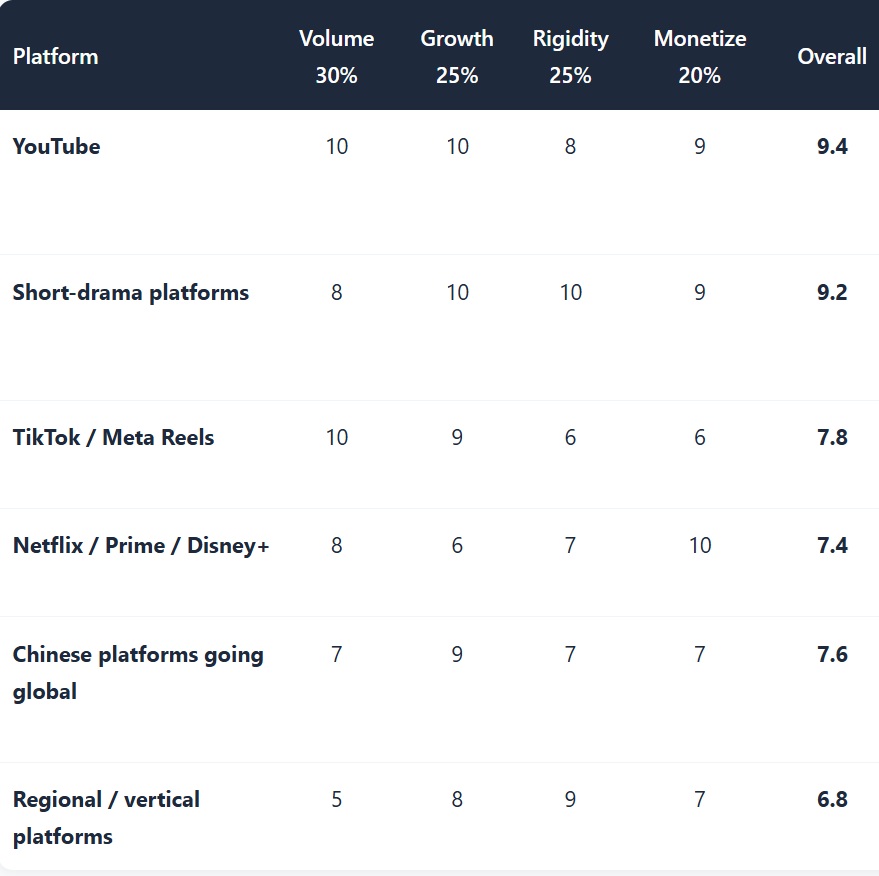
10. Cross-Platform Comparison and Priority
The same four-factor model from Chapter 8, applied to platforms. Note the difference in meaning: continent scores measure “where demand is”, while platform scores measure “that channel’s demand-trigger intensity and reachability” — the latter includes a layer of “ease of access”, so the largest volume does not automatically mean the highest score.
| Platform | Volume 30% |
Growth 25% |
Rigidity 25% |
Monetize 20% |
Overall | Key judgement |
|---|---|---|---|---|---|---|
| YouTube | 10 | 10 | 8 | 9 | 9.4 | The only channel where the platform absorbs cost and demand is released instantly; the February 2026 full rollout is the year’s biggest variable |
| Short-drama platforms | 8 | 10 | 10 | 9 | 9.2 | Dubbing is a production cost, not a marketing expense — the most rigid demand; but category profitability is unproven, so assess payment terms |
| TikTok / Meta Reels | 10 | 9 | 6 | 6 | 7.8 | Largest number of demand units with quantifiable ROI (CPA −53%), but low unit price and short asset lifespan |
| Netflix / Prime / Disney+ | 8 | 6 | 7 | 10 | 7.4 | Unit-price ceiling, but premium scripted content remains human-reviewed; the barrier is compliance, not technology |
| Chinese platforms going global | 7 | 9 | 7 | 7 | 7.6 | Window-of-opportunity dividend with stacked two-way demand; but language coverage is narrow and upstream interception risk is real |
| Regional / vertical platforms | 5 | 8 | 9 | 7 | 6.8 | Mandatory gateway into their regions with the deepest localization requirements; small volume but high channel value |
In platform scoring, “rigidity” means how necessary dubbing is for effective distribution on that channel; “monetization” includes the paying capacity and willingness of that channel’s clients. This table is a decision-support tool, not an official ranking.
4 Feb 2026 full rollout + 27 languages + 6M daily viewers; turned dubbing from a paid process into a platform default
Dubbing is a production cost rather than a marketing expense, purchased in batches by episode; 10–14 synchronized languages is the industry standard
Netflix alone spends over USD 400M per year on localization; Prime covers 22 dubbed languages across 240 countries
Largest number of demand units; localized ads achieve 53% lower CPA and 3.6x watch time
11. Region × Platform Cross Matrix: Where Opportunity Actually Stacks
Looking at continents or platforms alone misses the most important information — real demand value appears where the two overlap. The same platform can differ several-fold in demand intensity across regions, and the same region differs across platforms. This chapter crosses the two dimensions to identify “high-demand region + high-trigger platform” combinations.
11.1 Cross-opportunity matrix (◆ strong / ◇ medium / ○ weak)
| Region \ Platform | YouTube | Short-drama | TikTok / Meta | Netflix / Prime | Chinese intl. | Regional | Row avg |
|---|---|---|---|---|---|---|---|
| Asia | ◆ | ◆ | ◆ | ◇ | ◆ | ◇ | 8.5 |
| Middle East & Africa | ◇ | ◆ | ◆ | ◇ | ○ | ◆ | 7.4 |
| Latin America | ◇ | ◆ | ◆ | ◆ | ◇ | ◇ | 7.9 |
| North America | ◆ | ◆ | ◆ | ◆ | ◇ | ○ | 8.2 |
| Europe | ◇ | ○ | ◇ | ◆ | ○ | ◇ | 5.6 |
| Oceania | ◇ | ○ | ◇ | ○ | ○ | ○ | 3.1 |
| Column avg | 7.2 | 7.4 | 7.7 | 6.3 | 3.7 | 4.8 | — |
The matrix is a quantified expression of qualitative judgement (◆ = 9 / ◇ = 6 / ○ = 3), used to identify stacking opportunities rather than as precise data. Asia has the widest spread across high-trigger platforms (four ◆); Oceania shows weak demand on every platform.
11.2 Four stacking opportunities that must be captured
Stacking opportunity 1 · Most rigid demand
The most rigid dubbing preference globally (decades of dubbing tradition) + short-drama downloads up 40x in two years + Brazil already a global top-five revenue market. Dubbing is a condition of entry and growth is the fastest. Note that Brazilian Portuguese and Latin American Spanish must be produced separately, doubling cost.
Stacking opportunity 2 · Steepest supply gap
Fastest growth globally (7.1% CAGR) + the thinnest local talent pool + government funding + high per-capita digital spending in the Gulf. Fast-growing demand and insufficient supply coexist — the steepest gap. Cultural review cost and multi-dialect production cost must be budgeted.
Stacking opportunity 3 · Largest volume
33% localization share, global #1 + the only region strong in both content export and import + the largest user bases for YouTube and TikTok. The highest number of demand units, but severe language fragmentation means a sub-regional sourcing strategy is mandatory.
Stacking opportunity 4 · Highest unit price
The largest AI dubbing market at USD 151.8M + home of platform headquarters (where the rules are made) + fast-growing short-drama import demand. Both unit price and scale are high, but growth is flattening and the risk of platform self-build is highest — compete on compliance and quality, not price.
11.3 Three combinations to deliberately abandon
Oceania × Short-drama platforms (abandon)
An English-speaking market with no dubbing entry barrier; Oceania’s short-drama user scale cannot support dedicated language tracks. Handle within the English-speaking bloc.
Europe × Short-drama platforms (abandon)
Short-drama acceptance and scale in Europe are significantly below North America and Latin America, and multilingual compliance costs are high. Lower priority than other regions — not recommended as a primary direction.
MENA × Chinese platforms going global (abandon)
Chinese platforms’ language coverage is still mainly Chinese-English, mismatched with MENA’s Arabic needs, and two-way compliance is too complex. Re-evaluate once platform language capability expands.
12. Weight Sensitivity Test: How Weight-Dependent Are the Conclusions?
The rankings in Chapter 11 depend on the weights set in Chapter 1 (volume 30% / growth 25% / preference 25% / monetization 20%). Any weighting is subjective, so we must test whether the conclusions hold under a different set. Below, regional rankings are recalculated under three business profiles.
| Profile | Weights | Ranking (top four) | Does the conclusion change? |
|---|---|---|---|
| Baseline (report default) |
Volume 30% / Growth 25% Preference 25% / Monetize 20% |
Asia 9.0 → MENA 8.6 → LatAm 8.4 → North America 8.2 | Baseline |
| Monetization-first (revenue is the primary goal) |
Monetize 40% / Volume 25% Growth 20% / Preference 15% |
Asia 9.3 → North America 9.0 → MENA 8.5 → Europe 8.1 | MENA drops from #2 to #3, North America rises to #2, Europe overtakes Latin America |
| Growth-first (capture emerging markets) |
Growth 40% / Preference 25% Volume 20% / Monetize 15% |
MENA 9.4 → LatAm 9.0 → Asia 8.6 → North America 7.5 | MENA takes first place and North America falls clearly behind; Asia remains in the top three |
Three conclusions from the sensitivity test
1. Robust conclusions. Asia remains in the top three under all three profiles. MENA ranks in the top two under both the baseline and growth-first profiles, making it the only region to do so under two profiles. The priority of these two regions can be relied upon.
2. Weight-dependent conclusions. North America shows the widest swing (4th baseline, 2nd under monetization-first, 4th under growth-first). If your target is revenue, North America is a must-win; if your target is growth, its priority drops markedly. The judgement depends entirely on your business objective — there is no universal answer.
3. Conclusions that need caution. Europe falls to fifth under the growth-first profile, above only Oceania. If your goal is growth rather than stable revenue, Europe should not be listed as a primary direction — even though its absolute scale and payment capacity are both respectable.
13. Three Structural Mismatches on the Demand Side
Beyond the data, this report identifies three structural mismatches that run through the whole analysis. They are not short-term fluctuations but underlying structures that determine where long-term opportunity lies.
Mismatch 1: Where demand is most urgent is where supply is thinnest Largest opportunity
Observation: MENA has the fastest growth globally (dubbing 7.1%, anime dubbing 8.2%) yet the most limited local voice talent pool. Latin America has the second-fastest growth, but dual-track Brazilian Portuguese and Latin American Spanish demand exceeds normal local capacity. Southeast Asia is linguistically fragmented, and single-language market sizes do not support the economics of human dubbing.
Implication: part of the reason these regions grow fast is precisely that past supply shortages depressed the base. Here AI dubbing is not a “cheaper alternative” but the enabling technology that makes the demand feasible for the first time. This is where AI dubbing’s structural advantage over traditional human dubbing is greatest — it opens markets that did not previously exist rather than seizing share in existing ones.
Mismatch 2: Where demand is strongest is where quality thresholds are highest Core risk
Observation: Japan has extremely high quality expectations and rejects poor localization immediately; Latin American audiences expect full lip-sync; North American content standards are strict; MENA carries cultural review requirements.
Implication: AI dubbing’s price-performance advantage is most easily realized in cost-sensitive markets (Southeast Asia, India, mid-to-low-tier Latin American content) and hardest to realize in quality-sensitive markets (Japan, mainstream North America, European premium content) — because savings there may be offset by brand damage. This means a “use AI to cut cost” strategy must be paired with market selection: validate scale effects in cost-sensitive markets first, then move gradually into quality-sensitive markets. Doing it the other way round (attacking high-barrier markets first) risks losing the entire market to isolated quality failures.
Mismatch 3: The stronger the platform’s subsidy, the smaller the external supply space Requires continuous tracking
Observation: YouTube already absorbs the cost of in-platform long-form dubbing; bilibili Studio absorbs the translation layer for content entering China; Netflix and Prime are building their own AI dubbing; TikTok and Meta have native lip alignment.
Implication: the stronger the platform, the more likely baseline demand is internalized. External suppliers survive in the parts platforms are unwilling or unable to do well: cross-platform distribution (YouTube only handles in-platform), script-level fine control (YouTube explicitly offers no voice-track tuning), off-platform source material, compliance and cultural review (platforms tend to push responsibility to content owners), and languages beyond platform coverage (Bilibili is currently Chinese-English only). This boundary is dynamic — platform capability expands every year, so it must be tracked continuously rather than judged once.
14. Trends and Key Findings
14.1 Three forward judgements
| Trend | Certainty | Basis and implication |
|---|---|---|
| Dubbing moves from “process” to “default” | High | YouTube has opened auto-dubbing to all creators and states it does not affect discovery. As default capability spreads, viewers will begin treating the absence of multi-language versions as the content owner’s failing. Implication: the question is no longer “whether to do it” but “how many languages and how well” |
| The hybrid model becomes mainstream | High | AI plus human review achieves 40–60% cost reduction while maintaining broadcast-quality output, clearly outperforming both pure AI and pure human. Implication: pure AI suits cost-sensitive markets, pure human suits premium content; hybrid capability in the middle is the scarcest |
| Compliance becomes an entry barrier | Medium-high | Voice cloning raises IP and talent rights issues that must be resolved contractually before production; the EU has the strictest synthetic-speech disclosure requirements; standards are not harmonized across jurisdictions. Implication: vendors with built-in consent frameworks hold a structural advantage, and compliance shifts from cost item to moat |
14.2 Key findings
- The biggest variable in demand is on the platform side, not the audience side. In February 2026 YouTube opened auto-dubbing to all creators (27 languages; over 6 million viewers per day watching ≥10 minutes). This is the largest single platform-level demand catalyst on record, turning dubbing from a big-studio privilege into a default expectation.
- Regional opportunity ranking: MENA > Latin America > Asia > North America > Europe > Oceania. Note however that Asia is the absolute leader on demand volume (33% localization share) — it is only internal fragmentation that drags down its execution-efficiency score. North America leads on scale and payment capacity but its growth is flattening.
- The most underrated opportunity is MENA. Fastest growth globally (dubbing 7.1%, anime dubbing 8.2%), the thinnest local talent pool, government funding (Saudi Vision 2030, UAE free zones) and high per-capita digital spending in the Gulf. Four factors pointing at the same region simultaneously is unique worldwide.
- Platform opportunity ranking: YouTube > short-drama platforms > TikTok/Meta > Chinese platforms going global > Netflix/Prime/Disney+ > regional platforms. Short-drama platforms score slightly below YouTube but their demand is the most rigid — dubbing is a production cost rather than a marketing expense, purchased in batches by episode, with 10–14 synchronized languages as the standard.
- Structural mismatches are the real opportunity window. The regions with the most urgent demand (MENA, Latin America, Southeast Asia) are precisely those with the weakest supply and least-resourced languages. In these markets AI dubbing is not a cheaper substitute but the enabling technology that makes demand feasible for the first time — it opens markets that did not previously exist.
- Do not apply one strategy to every market. Southeast Asia accepts time-sync voice-over (low cost), India requires full lip-sync (high cost), Japan requires native professional dubbing (extremely high cost), Latin America requires full lip-sync with dual-track production. Cost differences across these requirements can reach several multiples; conflating them leads to severe miscalculation of investment.
- Beware demand internalization through platform self-build. YouTube already absorbs in-platform dubbing, Bilibili absorbs the inbound translation layer, and Netflix/Prime are building their own AI capability. External supply space lies in what platforms will not or cannot do well: cross-platform distribution, script-level control, off-platform assets, compliance review, and languages beyond platform coverage.
- Short-drama demand is real, but payment capacity requires careful assessment. Non-China short-drama revenue is projected at USD 3.6 billion in 2026 and USD 9.5 billion by 2031, with the top five holding about 79%. But several leaders remain loss-making (Chinese Online reported a 2025 net loss of CNY 671 million; ReelShort’s parent is also loss-making). Demand rigidity is high, but payment terms and collection risk need separate assessment.
- Figures must always be cited with their definition. “How big is the video dubbing market” has no single answer: all-scenario AI dubbing USD 444 million (20.0% CAGR), AI dubbing for OTT USD 750 million (26.71% CAGR), dubbing services including human labour USD 3.80 billion (3.2% CAGR). The three differ by nearly 9x; mixing them leads to serious miscalculation.
Data boundaries and usage notes
- Market size figures come from third-party research firms whose statistical boundaries do not overlap and differ substantially (see Section 1.2). This report performs no original estimation; every figure is cited with its source and applicable definition.
- The demand intensity scores and opportunity matrix are analytical tools built by this report. Dimension scores are subjective assessments intended for ranking and communication, not precise measurement. Readers are encouraged to adjust weights to their own business objectives (see the sensitivity test in Chapter 12).
- Platform policies are time-sensitive: YouTube auto-dubbing, TikTok algorithmic rules and Bilibili’s language coverage are all changing rapidly. Verify the latest official announcement dates when citing.
- Regional data has definitional overlap: some firms fold Oceania into Asia-Pacific, or place Turkey in Europe or the Middle East, producing small differences in regional share figures.
- This is a demand-side analysis and does not include supply-side product capability or pricing comparisons. For tool capabilities and pricing, see DeepForgeHub’s comparison reports: AI Video Translation Pricing (DeepVideo vs 12 competitors) · Video Translation Software Landscape (18 tools) · Why DeepVideo Is So Much Cheaper.
Turn demand insight into deliverable multilingual cuts
The opportunity regions identified in this report — MENA, Latin America and Southeast Asia — share two traits: demand is growing while local dubbing capacity is insufficient. DeepVideo offers Voice Clone in 30+ languages plus 100+ preset voices, with fully local processing and no cloud upload, suited to multilingual distribution where both asset confidentiality and cost matter.
Download DeepVideo Free
Realistic AI Video Dubbing at Just $0.17/minHigh quality · Low price · Local client · Security
Free tier: 18 minutes total + 2 minutes daily · Local processing, no cloud upload
Produced by DeepForgeHub Research | September 2026
Sources: PW Consulting, Mordor Intelligence, Vitrina AI, DataEye, Media Partners Asia, 360 Market Updates, YouTube official blog, platform public announcements. All third-party data is cited with its definition; this report performs no original estimation.