
Navigating a Changing EV Landscape
Tesla’s Q1 2026 earnings came out this week, and they sketch a familiar pattern: a company that defined the EV market is now fighting to stay ahead of it. The competitive landscape looks nothing like it did two years ago. Chinese automakers are eating into Tesla’s market share, global EV growth has cooled, and the company’s once-enviable profit margins are under steady pressure.
The results were mixed. Vehicles are struggling; energy and services are not.
Revenue and Earnings
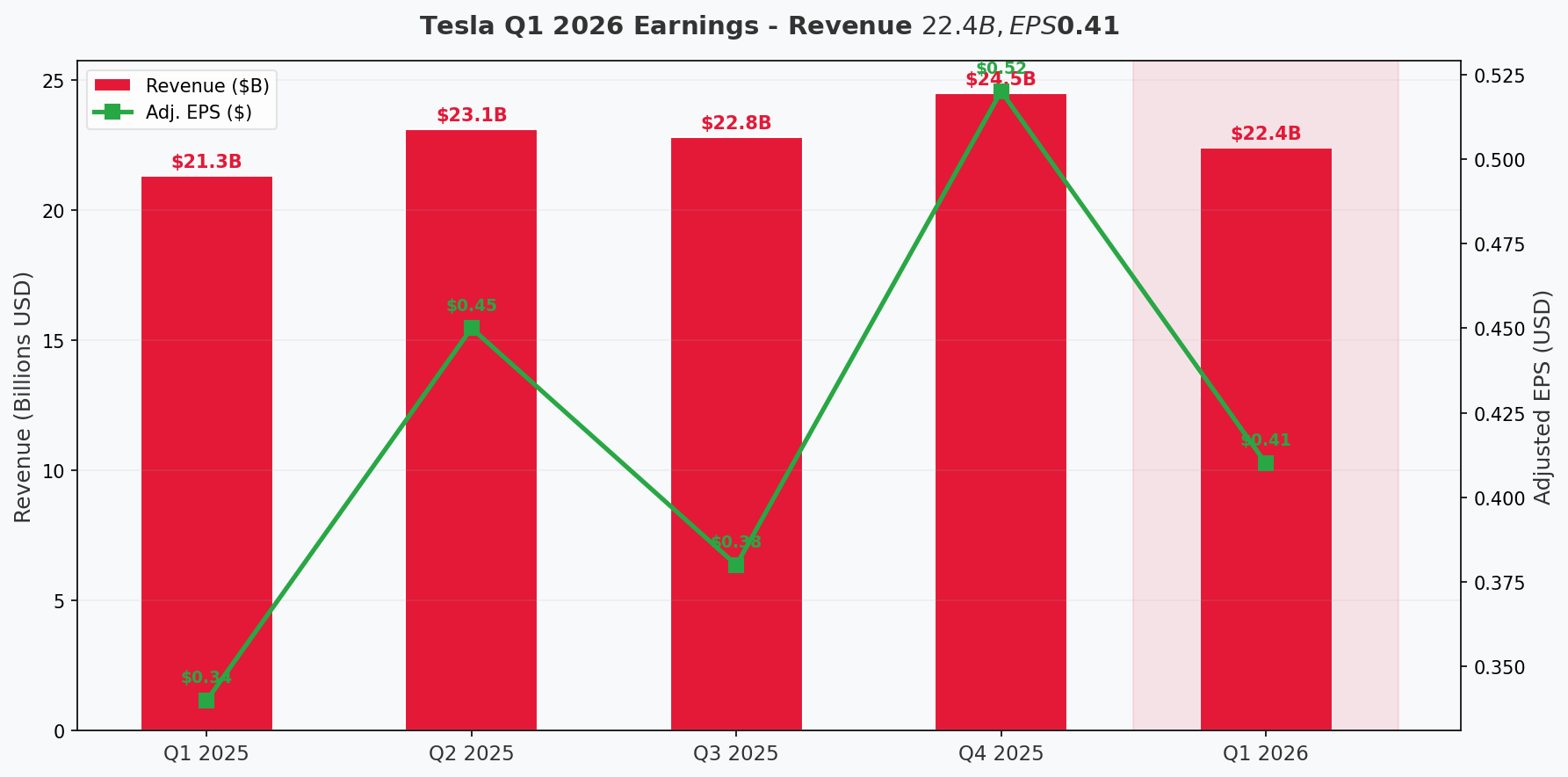
Tesla posted Q1 2026 revenue of roughly $23.8 billion, down 4 percent year-over-year but essentially matching the $23.5 billion consensus. EPS landed at $0.52, a miss against the $0.56 estimate, as the company kept spending heavily on AI infrastructure and Full Self-Driving development.
Automotive revenue declined to $18.2 billion from $19.1 billion in Q1 2025, reflecting lower average selling prices and modestly reduced delivery volumes. However, the energy generation and storage segment posted record revenue of $3.1 billion, up 52 percent year-over-year, while services and other revenue grew 18 percent to $2.5 billion.
| Segment | Q1 2026 Revenue | YoY Change |
|———|—————-|————|
| Automotive | $18.2B | -4.7% |
| Energy & Storage | $3.1B | +52% |
| Services & Other | $2.5B | +18% |
| Total | $23.8B | -4.0% |
Delivery Pressure and the China Factor
Tesla delivered about 412,000 vehicles in Q1 2026, down 6 percent from the same period last year. The decline comes from three directions: Chinese competition is intensifying, a product refresh cycle briefly cut into output, and global EV demand growth has simply slowed down.
China is the pressure point. BYD surpassed Tesla in total EV deliveries back in 2023 and hasn’t looked back. The company pushed over 980,000 electrified vehicles in Q1 2026 and is expanding hard into Europe, Southeast Asia, and Latin America. NIO, XPeng, and Li Auto are also taking share with vehicles that increasingly match Tesla on features, build quality, and price.
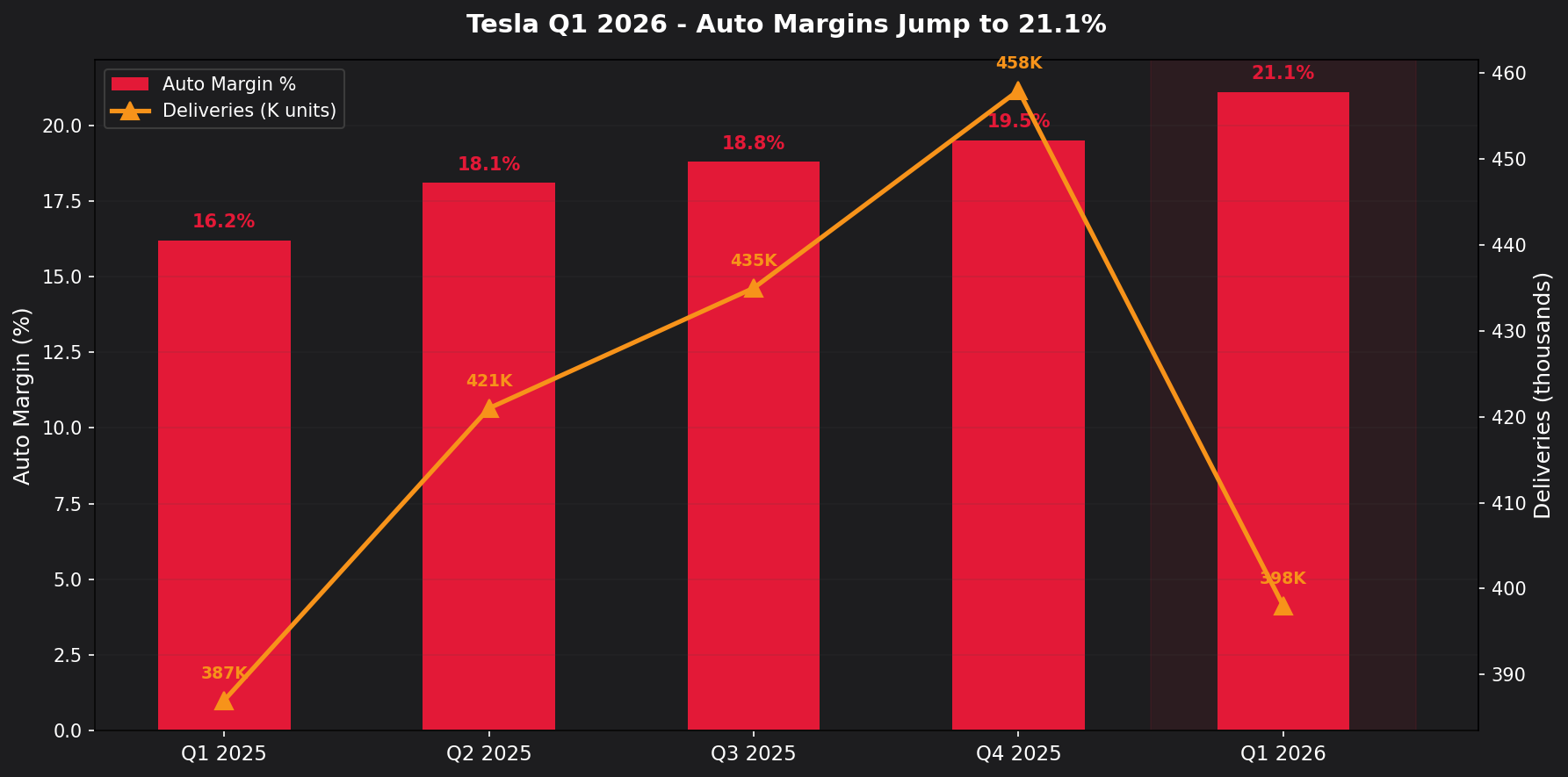
Tesla’s answer has been to cut prices. It works for volume but eats into margins. Automotive gross margin (excluding regulatory credits) dropped to 16.2 percent from 19.3 percent a year ago. With credits included — those added $580 million — the figure sits at 17.8 percent.
“Tesla is caught between two imperatives,” said James Park, senior automotive analyst at Morgan Stanley. “Defend market share with competitive pricing, or protect margins with price discipline. You can’t do both.”
Energy and Services: The Bright Spots
Tesla’s energy generation and storage business just had its best quarter ever. Demand for utility-scale battery storage is surging, and the Megapack factory in Lathrop, California is running near full capacity. A new Megapack facility in Shanghai is ramping up.
At the current pace, energy revenue could top $15 billion annually by the end of 2026, making it Tesla’s second-largest revenue stream after automotive. Margins in the energy business are improving with scale, which helps offset some of the automotive weakness.
The services arm — Supercharging, insurance, and over-the-air software upgrades — also kept growing. The Supercharger network pulled in $890 million, up 22 percent, as Tesla opened the network to non-Tesla EVs across North America and Europe.
Full Self-Driving: Progress and Peril
Tesla’s Full Self-Driving (FSD) technology remains the company’s biggest swing. In Q1, Tesla rolled out FSD version 13, built on an end-to-end neural network architecture. The system handles complex urban driving noticeably better than earlier versions, though it still requires a hands-on driver.
Regulators aren’t standing still. NHTSA is still investigating Autopilot after several high-profile crashes and has signaled new driver monitoring requirements may be coming. On the flip side, Chinese regulators approved expanded FSD testing in select cities — a potentially huge market if the technology pans out.
Tesla management has talked about FSD eventually generating tens of billions in recurring software revenue. Skeptics point out that regulatory approval timelines are fuzzy and competitors like Waymo and Cruise are taking different approaches that could reach commercial viability first.
Leadership and Governance Concerns
The question of Elon Musk’s bandwidth keeps coming up. Beyond Tesla, he runs SpaceX (preparing for Starship orbital tests), owns X, and is involved with xAI and Grok.
“Elon is the most valuable asset Tesla has, but he’s also the most distracted,” said one institutional investor who asked to remain anonymous. “The company has strong operational leadership, but there are strategic calls only Elon can make.”
Tesla’s board says Musk stays deeply involved in product strategy and technology direction. Governance advocates continue to push for clearer succession planning and more independent oversight.
Stock Reaction and Analyst Outlook
Tesla shares dropped 3.2 percent after hours as investors zeroed in on automotive margin compression and the delivery decline. The stock sits around $245, pricing in a forward P/E of roughly 65x — a premium that demands future growth materialize.
Analyst takes were split. Morgan Stanley kept its overweight rating and $310 target, saying the energy business and FSD potential are undervalued. Goldman Sachs downgraded to neutral, flagging near-term margin pressure. Wedbush held its outperform rating, betting on Tesla’s technology lead and brand.
Looking ahead, Tesla guided for 10 to 15 percent vehicle delivery growth for the full year, contingent on the updated Model Y launch and continued production ramp at the Mexico and Berlin facilities. The company also reiterated its commitment to a next-generation affordable vehicle platform, targeted for late 2026 or early 2027.
Where Tesla Goes From Here
The era of uncontested EV dominance is done. Tesla is now fighting in a global market where every sale is contested. But its strengths in energy storage, software, and brand loyalty haven’t evaporated, and its technological edge — if fully realized — could open entirely new revenue streams.
The real question is whether energy and AI can grow fast enough to offset a compressing automotive business, and whether Tesla can keep innovating in an industry that’s catching up quickly.
References
- https://ir.tesla.com/press-release
- https://www.reuters.com/business/autos-transportation/tesla-earnings
- https://www.cnbc.com/tesla-q1-2026-earnings
- https://www.morganstanley.com/ideas/tesla-earnings
- https://www.goldmansachs.com/insights/pages/tesla-q1.html
- https://www.bloomberg.com/news/tesla-china-competition
- https://www.nhtsa.gov/press-releases