

Apple's M4 Mac Mini Is Becoming Impossible to Buy — And No One Knows Why
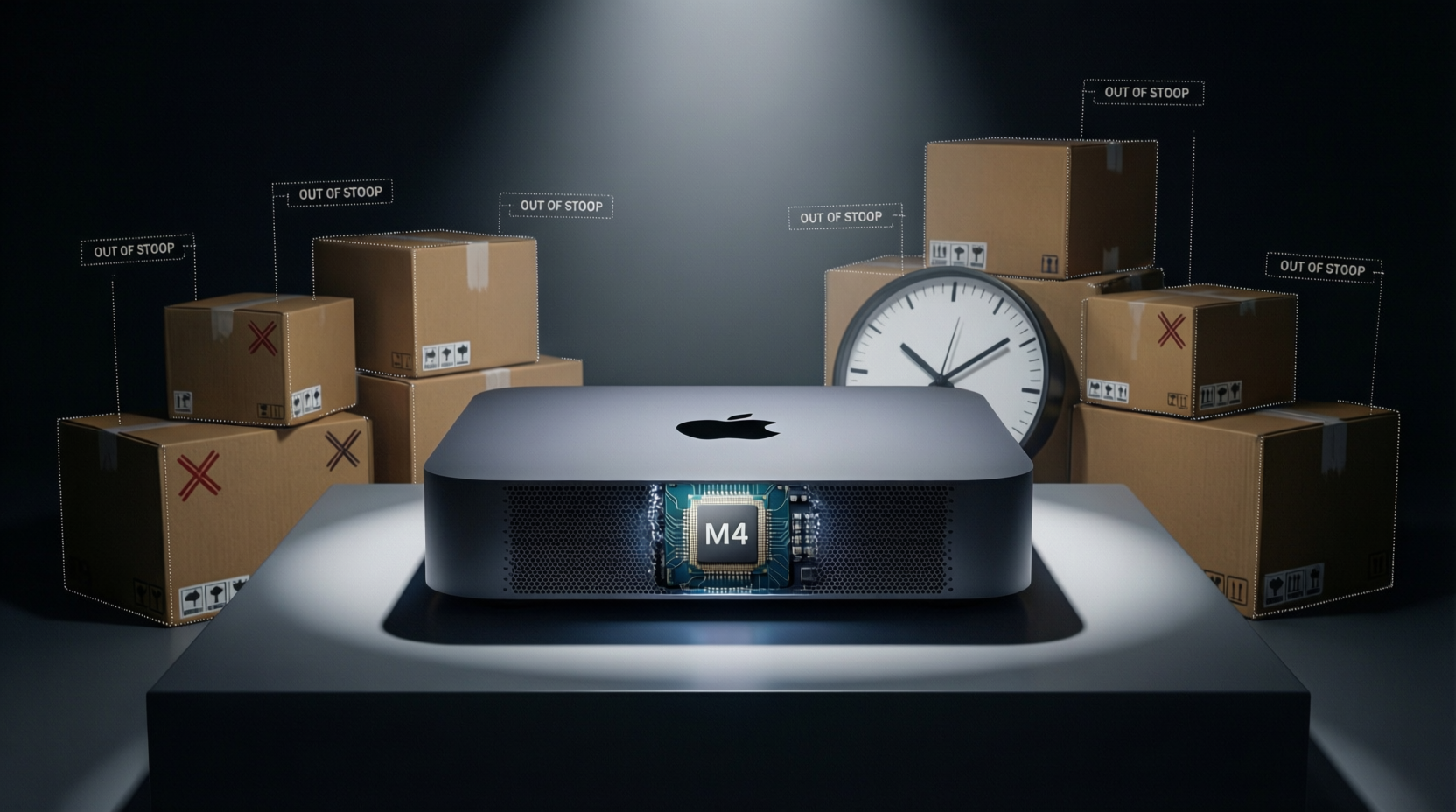
Apple's M4 Mac mini is quietly becoming one of the hardest products to actually purchase in the company's current lineup. The $599 base model — the entry point to Apple's compact desktop computing platform — is gradually disappearing from availability, with ship times extending from days to weeks to months depending on configuration. The 512GB M3 Ultra Mac Studio is already sold out entirely.
The shortage is real and widespread. It is also unexplained.
Apple has not announced any product transitions, issued any supply chain guidance, or acknowledged that supply is constrained. The silence has created a vacuum filled by three competing theories about what is happening.

Theory One: The M5 Refresh Is Imminent
The conventional explanation for Apple supply constraints is product cycle timing. Apple desktop machines are due for M5 chip upgrades — the company has released M-series chips on roughly an annual cadence, and the M4 generation shipped in late 2024 and early 2025. An M5 refresh would be consistent with historical patterns.
Under this theory, Apple is managing its inventory down deliberately, building fewer new units as it clears the pipeline for M5 models. This is a known Apple playbook: in the months before a significant product refresh, availability of current models becomes constrained while Apple avoids the awkward situation of discounting products it is about to replace.
If an M5 Mac mini is months away, the supply situation makes sense. The problem with this theory is that Apple has not seeded the market with rumors of an imminent refresh, and the M4 Mac mini is still being advertised at full price without any indication of a successor.
Theory Two: A RAM Shortage
A more technical explanation focuses on memory supply. The AI development boom has created extraordinary demand for high-bandwidth memory — the kind of RAM that sits alongside processors in AI servers and high-performance workstations. Memory manufacturers have been allocating capacity toward AI-related memory products, potentially creating shortages for the commodity-grade memory used in devices like the Mac mini.
Under this theory, Apple is having difficulty obtaining sufficient memory allocations to meet demand for the Mac mini line. The company could be prioritizing memory for higher-margin products or for products where supply constraints would be more damaging to its reputation.
This theory has some technical plausibility but lacks supporting evidence from the supply chain. Memory spot prices have not shown the dramatic spikes that would be consistent with acute shortage.
Theory Three: AI Developers Are Buying Everything
The most interesting theory is that AI agent developers — the population building autonomous AI systems that run on local hardware — are buying up M4 Mac minis as fast as Apple can ship them.
The M4 Mac mini offers an unusual value proposition for AI development: it is compact, relatively affordable at $599 for the base model, energy efficient, and capable of running local AI inference workloads. For developers building AI agents that need persistent hardware at reasonable cost, the Mac mini is an attractive option.
If this theory is correct, the supply constraint reflects demand that is structural rather than cyclical — Apple would need to increase production to meet the new demand, not just wait for a product transition.
The Broader Desktop Supply Picture
The Mac mini shortage is not the only supply constraint in Apple's desktop lineup. The M3 Ultra Mac Studio — a higher-end workstation-class machine — is sold out. Other Mac desktop configurations have seen extended ship times.
This broader pattern suggests something beyond a single product transition or a localized supply issue. If only the Mac mini were constrained, an imminent M5 refresh would be the most likely explanation. The fact that multiple desktop lines are affected simultaneously points toward a more systemic constraint.
What Apple Could Do
If Apple wanted to address the supply constraint quickly, it would have options. It could increase production allocation for the Mac mini specifically, prioritize memory allocations for the product line, or take the unusual step of acknowledging the constraint publicly and providing guidance on when availability would improve.
None of those actions appear to be happening. Apple has remained silent.
The most likely explanation remains the product transition theory: Apple is managing inventory toward a refresh cycle, and the supply constraints are intentional rather than accidental. If so, the M5 Mac mini announcement would be expected in the relatively near term — likely within the next several months.
For developers who have been waiting to purchase an M4 Mac mini for AI development work, the choice is between waiting for an M5 model that may or may not arrive soon and purchasing at current prices in an uncertain availability environment. That uncertainty is, itself, the story.