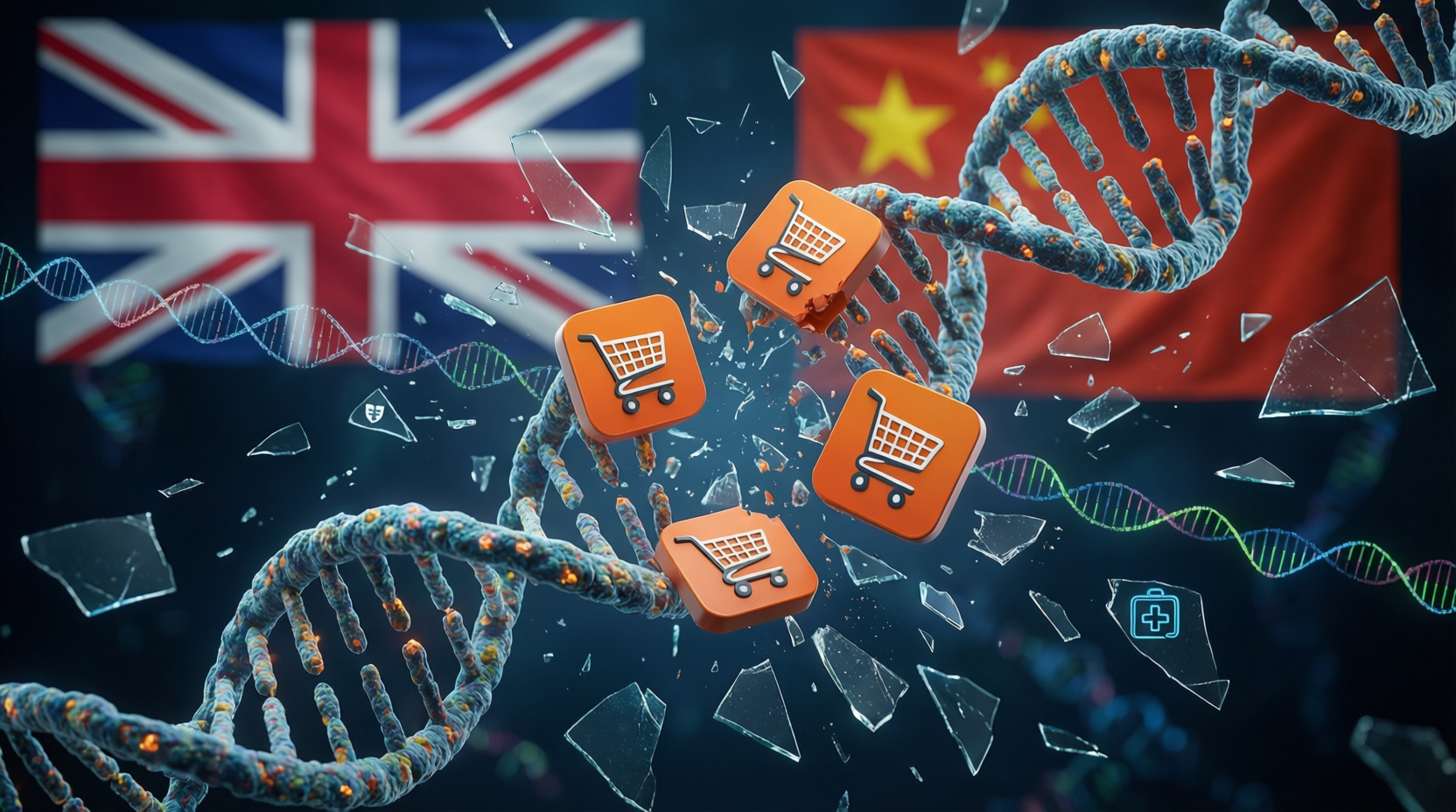

The Guardian published its investigation on March 14, 2026. Researchers had uploaded detailed health and genetic data from UK Biobank participants to public GitHub repositories — and journalists were able to re-identify specific individuals using only their approximate date of birth and the date of a single surgery. That was enough. Whole genomes, brain scans, blood tests, lifestyle surveys, years of medical records: exposed.
By April 23, 2026, the data was listed for sale on Alibaba. The UK government confirmed it.
UK Biobank is one of the world's most valuable biomedical databases. Half a million UK volunteers gave researchers access to their genetic data, medical records, brain imaging, and lifestyle information — with the understanding that it would be used for approved research and kept secure. Neither promise was fully kept.
How the Breach Happened
This was not a hack in the traditional sense. Approved researchers who received access to UK Biobank data inadvertently published that data to public GitHub repositories while sharing their analysis code. The datasets — containing participant information in formats like PLINK, BOLT-LMM, and BGEN — were uploaded alongside Jupyter notebooks and R scripts that researchers were using for collaborative work.
UK Biobank's primary enforcement mechanism has been DMCA takedown notices — the legal tool typically used for copyright infringement. As of April 17, 2026, UK Biobank had filed 110 takedown notices targeting 197 repositories from 170 developers across at least 14 countries. Most of those developers are from the United States and China. They were not malicious — they were careless.
The Guardian was able to re-identify a participant using only two pieces of information from an exposed dataset: approximate date of birth and the date of a single major surgery. That is how much information was in these datasets. Re-identification did not require accessing the original UK Biobank records. It required basic data linkage.
What Was Exposed
UK Biobank participants gave consent for their data to be used in approved research studies. They did not consent for their data to be on GitHub.
The data exposed includes:
- • Whole genome sequences
- • Brain imaging scans
- • Blood test results spanning years
- • Lifestyle surveys (alcohol use, diet, exercise)
- • Medical records
- • Health outcomes
This is not the kind of data that can be changed. A credit card number can be cancelled. A password can be changed. A genome cannot be replaced.
The Alibaba Listing
On April 23, 2026, the UK government confirmed that UK Biobank participant data was listed for sale on Alibaba — the Chinese e-commerce platform. The Guardian's BMJ article on April 24 reported that health details of 500,000 people were offered for sale.
It is unclear who listed the data and whether it was sold. But the existence of the listing confirms what researchers had feared: the data exposed via GitHub eventually reached actors who saw commercial value in it. This is the secondary harm that DMCA takedowns cannot prevent — once data is copied, it can be redistributed indefinitely.
The Broader Pattern
The GitHub exposure was not the only governance failure. UK Biobank had approved data access for insurance companies between 2020 and 2023 — a use case that participants had not been clearly informed about. A race science research group claimed to have obtained UK Biobank data for pseudo-scientific research. Chinese researchers were given access to half a million UK GP records through UK Biobank, with MI5 reportedly raising concerns.
UK Biobank's CEO, Sir Rory Collins, told participants that the exposed data "did not contain name or NHS number" and recommended that participants "not reveal specific details about themselves on social media or websites." This response — tell participants to be more careful — was received poorly by participants who had trusted that their data would be handled securely.
The Enforcement Gap
UK Biobank uses US copyright law as its primary enforcement mechanism because UK privacy law does not provide clear tools for this situation. Researchers who violate their data use agreements face de-identification of their data — they lose access. But that is after the fact. There is no pre-emptive enforcement mechanism that prevents a researcher from uploading data to a public repository.
GDPR requires mandatory breach notification, but the exposure happened through researchers, not through UK Biobank's own systems. The question of whether UK Biobank had notification obligations for researcher-caused exposures — as opposed to a direct system breach — is legally unclear.
The Information Commissioner's Office (ICO) is involved, but no enforcement action had been announced as of this writing.
What This Means for Participants
For the 500,000 people who gave their data to UK Biobank, this breach is particularly personal. They volunteered for medical research believing it would advance science and help future patients. Many of them did not know their data could end up on GitHub, or listed for sale on a Chinese e-commerce platform.
Re-identification is not theoretical — The Guardian demonstrated it. An insurance company, employer, or other actor with access to external data sources could potentially link UK Biobank participants to their genetic and health profiles.
The practical risks depend on what external data sources are available and what actors have access. This is not the same as a credit card breach where fraudulent charges can be detected and reversed. The data is permanent.
The Research Ecosystem Problem
UK Biobank has been essential for thousands of research studies. The database has enabled discoveries about genetic predispositions, environmental factors, and disease mechanisms that would have been impossible otherwise. It represents a genuine public good.
The researcher who uploaded data to GitHub was probably trying to make their analysis reproducible — a core principle of open science. Sharing code and data alongside published findings lets other researchers verify and build on published work. That is the right instinct.
The problem is that the infrastructure for sharing research data securely has not kept pace with the incentives to share it publicly. GitHub is designed for software code, not for sensitive biomedical data. There are specialized repositories — dbGAP, the European Genome-Phenome Archive — that handle access controls and audit trails for genetic data. But they are less convenient than a public GitHub repository, and researchers under pressure to publish may cut corners.
The International Dimension
The 197 repositories span 14 countries. Most developers are from the US and China. The Alibaba listing is on a Chinese platform. This is a genuinely international problem that no single country's regulators can solve alone.
UK Biobank is a UK charity with UK participant data. The researchers who exposed the data are worldwide. The platform where the data was listed is Chinese. Any regulatory action would need international coordination that does not currently exist for this class of data.
What Comes Next
UK Biobank will face regulatory scrutiny. The ICO's response — and whether it results in enforcement — will signal how seriously UK regulators take researcher-caused data breaches.
More immediately, the research community will need to grapple with the infrastructure gap. Secure data sharing for sensitive biomedical research exists in theory. In practice, researchers are using the same tools they use for software code, and participants are paying the price.
For the 500,000 UK Biobank participants whose data is now circulating beyond any repository's reach, the breach cannot be undone. Their genomes, medical records, and health histories are out there, somewhere, beyond any takedown notice's reach.