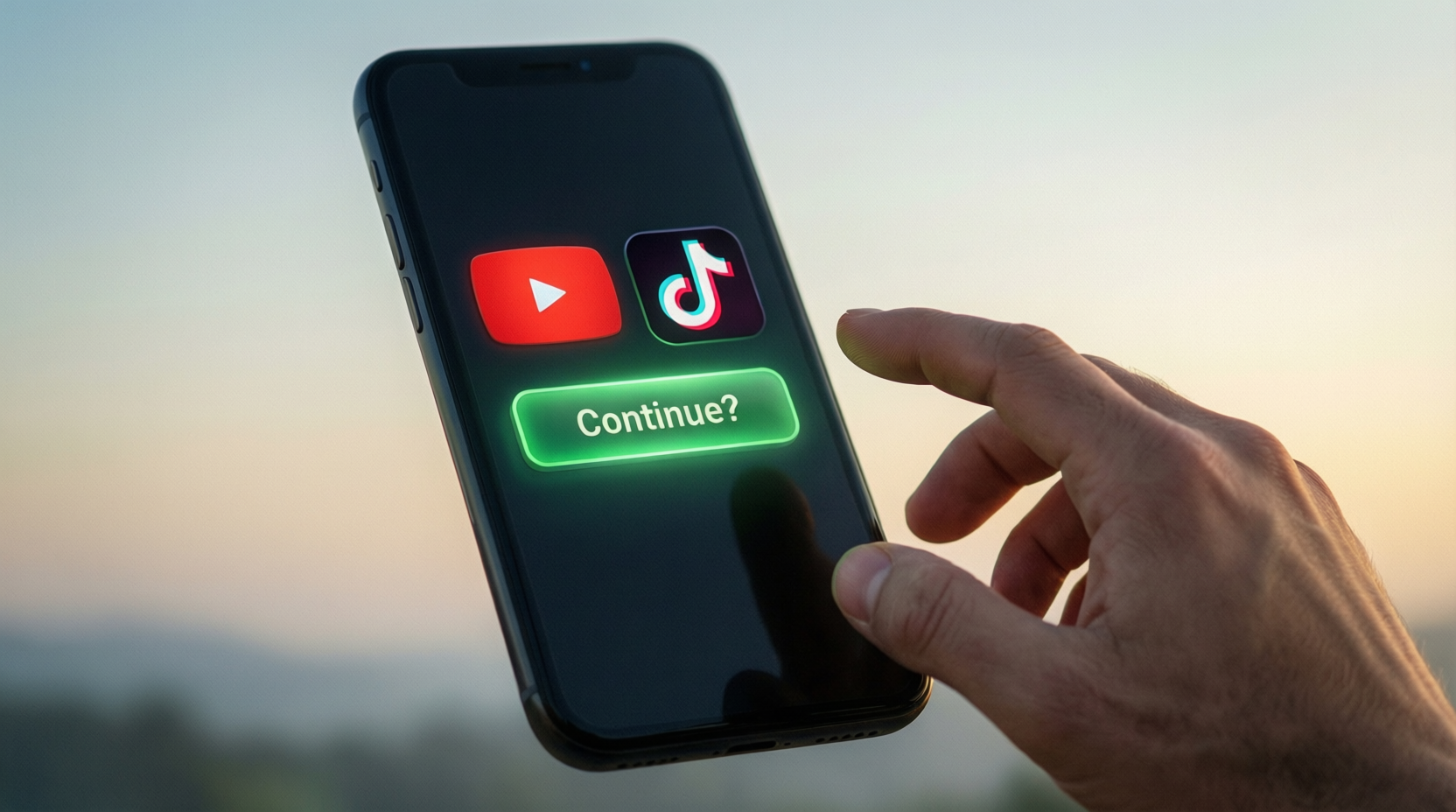

NoScroll is a Chrome extension that launched in spring 2026. It targets six platforms: YouTube, TikTok, Instagram, Facebook, X/Twitter, and Reddit. When you open one of those sites, it shows you a "Continue?" overlay after a configurable delay. You have to actively click to proceed.
It costs $2.99/month for the Pro version (free tier does YouTube only with a fixed 2-second delay). It has zero public reviews, no Chrome Web Store presence, and appears to be built by one developer whose GitHub account has no other public projects.
It is also not AI-powered, despite the research topic's framing.
What NoScroll Actually Is
NoScroll is a rule-based content script extension. It uses Manifest V3 — the modern Chrome extension format — and injects a delay overlay into target sites. The delay is configurable from 1 to 10 seconds on Pro, fixed at 2 seconds on free. After the delay, a modal appears asking whether you want to continue. You must click "Continue" to proceed.
That is the entire product. No machine learning. No behavioral pattern detection. No scroll velocity analysis. No eye tracking. It simply adds a friction point.
The research topic called it an "AI tool that prevents doomscrolling." That is a generous description. The extension does have a Supabase backend for Pro entitlement validation and Stripe for payments. But the core blocking logic is deterministic — the same delay every time, regardless of what the AI thinks you are doing.
The "AI" Label Is A Marketing Problem
This matters because the digital wellness space is full of products that claim AI detection capabilities they do not have. DoomGuard, one competitor, actually does use scroll velocity and tab-switching patterns to detect doomscrolling behavior. Lockin uses webcam iris tracking. AI Bouncer uses Mistral AI to evaluate your stated reason for visiting a social media site before granting access.
NoScroll is simpler than all of those. It is just a timer with a confirmation button.
This is not necessarily a criticism. The research on habit interruption suggests that friction — a deliberate pause before an automatic behavior — can be more effective than detection-based approaches. If you have already decided to visit YouTube, a 5-second pause before you can click "Continue" gives you a moment to ask whether you actually want to watch another video. That is a psychological intervention, not a technical one.
The problem is that calling something "AI" in 2026 when it is not AI creates expectations that the product cannot meet. Users who try NoScroll expecting an AI to understand their scrolling patterns will be disappointed. Users who understand that it is just a sophisticated timer may find it useful.
The Privacy Picture
NoScroll's privacy policy is unusually transparent for a small developer product. It explicitly states: no third-party advertising SDKs, no general browsing history collection, no analytics by default. Developer-only logging in content scripts is off by default.
For free users, data stays entirely on your device. For Pro users, the server stores your email, device ID, and subscription status in Supabase — standard SaaS data. Stripe handles payment information separately.
The extension requests host permissions for six major platforms — it needs to be able to inject scripts into those sites to show the overlay. That is a reasonable amount of access for what the product does, but it is worth knowing that the extension can read and modify page content on YouTube, TikTok, Instagram, Facebook, X, and Reddit.
The Behavioral Science Is Sound
The intervention NoScroll uses — a friction point before an automatic behavior — is grounded in implementation intention research. The seminal work here is Gollwitzer's 1999 paper showing that people who pre-commit to a specific behavior under specific cues ("If I open YouTube, I will pause for 5 seconds") follow through significantly more than those who rely on willpower alone.
NoScroll is essentially a technological implementation of that research. You pre-commit to pausing before doomscrolling. The extension enforces that commitment by requiring an active click before you can proceed.
This is different from detection-based approaches, which try to identify when you are doomscrolling and intervene at that moment. NoScroll does not try to detect anything. It simply creates the same friction for every visit, which may actually be more sustainable — detection-based systems can be gamed, and users can learn to behave just below the detection threshold.
The Business Model Is Fragile
NoScroll is a one-person product. The developer has no other public GitHub projects. There is no company, no institutional backing, no outside funding.
The lifetime Pro plan costs $28.99. Monthly is $2.99. If the developer disappears — stops maintaining the extension, gets burned out, loses interest — the product simply stops working when Chrome updates its extension APIs or the Supabase backend changes.
This is a real risk for utility software. Digital wellness tools especially require ongoing maintenance as browsers evolve. Freedom and Cold Turkey are established products with teams. NoScroll is a solo project.
The $28.99 lifetime option is attractive. It is also potentially unsustainable — if too many users buy lifetime access and the developer has ongoing costs, the economics collapse.
Who Should Try It
If you find yourself on YouTube or TikTok without meaning to be, and you have tried other approaches without success, NoScroll is worth testing. The free tier covers YouTube with a fixed 2-second delay. If that is enough to break the automatic opening reflex, the habit may change over time.
If you want AI-powered detection of your scrolling patterns, look elsewhere — DoomGuard or FocusFlow are more technically ambitious, even if less established.
The doomscrolling problem is real. The evidence for friction-based intervention is decent. The product is honest about what it does, even if the "AI tool" framing in the research is generous. Sometimes the simple solution is the right one.