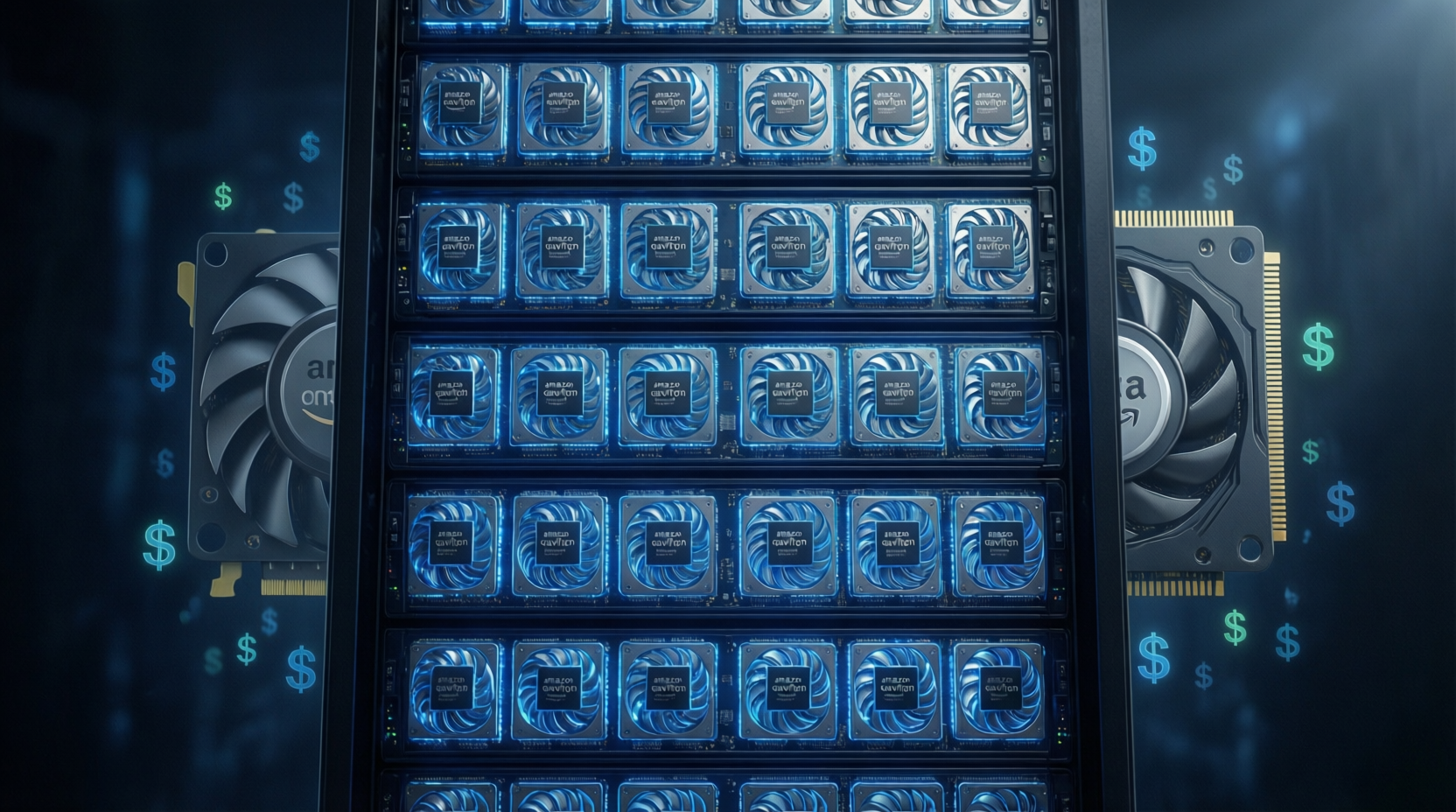

On April 24, 2026, Meta announced it had signed a deal for millions of Amazon's custom-designed AI CPUs. The announcement landed quietly — it came during one of the most crowded weeks in AI history, sharing headlines with GPT-5.5 and DeepSeek V4. But the deal deserves more attention than it got. It is one of the clearest signals yet that the era of "AI means buying Nvidia GPUs" is ending.
Why CPUs Instead of GPUs
The immediate question is why Meta would choose CPUs over GPUs for AI workloads. The answer comes down to what kind of work you are doing.
Training a large language model — the process of building GPT-5.5 or DeepSeek V4 — requires massive parallel computation. That is what GPUs excel at. An H100 has 16,000+ tensor cores and can perform matrix multiplications across thousands of operations simultaneously. For training, GPUs are irreplaceable.
But inference — running a trained model to answer a query, summarize a document, or generate code — is a different kind of work. You are processing one request at a time (or a small batch). The parallelism requirements are lower. What matters more is cost per token: how much does each individual inference cost?
Amazon's Graviton-based AI CPUs are designed for exactly this tradeoff. They sacrifice peak FLOPS — raw computational throughput — in favor of better cost-per-token economics for inference and agentic workloads. An agent that calls three tools, checks memory, and generates a response does not need the full power of an H100. It needs efficient, cheap compute that scales to millions of daily requests.
The Numbers Behind the Deal
Meta's infrastructure spending has been substantial. In 2025-2026, Meta committed over $40 billion to AI infrastructure, much of it previously earmarked for GPU purchases. The Amazon deal suggests a meaningful shift in how those dollars are being allocated.
For context: Nvidia controls approximately 80% of the AI chip market for training workloads. But for inference, the market is more fragmented and competitive. Google has TPUs. Amazon has Trainium and Graviton. Microsoft has Maia. Meta has its own MTIA chips in development. None of these are replacing Nvidia for training — but for inference, they are becoming legitimate alternatives.
The deal also reflects the broader spending surge in AI infrastructure. Microsoft is investing over $80 billion in AI infrastructure. Google is spending $75 billion. Amazon has committed over $100 billion. When you are spending that much, optimizing for cost-per-token across billions of daily inference calls adds up to real money.
What Agentic Workloads Actually Need
The timing of the deal matters. GPT-5.5 launched the day before with workflow agents as its headline feature. DeepSeek V4 launched the same day with autonomous agent capabilities. Anthropic released Claude Opus 4.7 a week earlier with improved agentic performance.
The AI industry is pivoting toward agents — AI systems that run in the background, call multiple tools, chain tasks, and operate without constant user supervision. This is a fundamentally different computing pattern than generating a single response to a single prompt.
Agentic workloads have different compute requirements. They involve:
- • Longer running times (an agent might work for minutes, not milliseconds)
- • More tool calls (multiple small inference steps)
- • State management (memory, context, retrieval)
- • Higher request volumes (many more discrete calls per user session)
For these workloads, the brute-force parallelism of a GPU is less important than efficient, scalable inference at low cost. Amazon's custom CPUs are built for exactly this pattern.
The Strategic Logic for Meta
Meta has two reasons to want cheaper inference.
First, Meta is in the business of embedding AI everywhere. AI-generated content recommendations, chatbot responses, ad targeting, image generation — these are all inference workloads that happen billions of times a day. Cutting cost-per-token by 50% on that volume is a multibillion-dollar savings.
Second, Meta is building toward AI agents as a product. The Llama models, the AI features across Facebook, Instagram, and WhatsApp, the Meta AI assistant — all of these will eventually run agentic workflows at scale. The Amazon deal is infrastructure preparation for that future.
The deal also diversifies Meta's chip suppliers. Relying entirely on Nvidia creates supply chain risk and pricing leverage. When you are buying millions of chips, you want multiple vendors competing for the contract.
What This Means for the Chip Industry
Nvidia is not in trouble — not yet. Frontier model training still requires Nvidia GPUs. The H100 and H200 remain the standard for training new models. No custom silicon has displaced Nvidia for training at scale.
But the inference market is different. It is larger by volume (every query to every model is an inference), growing faster, and now competitive in a way training never was. When Meta — one of the world's largest AI operators — chooses Amazon CPUs over Nvidia GPUs for a major portion of its inference, that is a meaningful signal.
Amazon's strategy with Graviton is also worth noting. Rather than trying to beat Nvidia at training (Trainium has not displaced H100s), Amazon is targeting the inference market where the economics are more favorable for non-GPU approaches. Graviton CPUs can run in existing data center infrastructure, leverage Amazon's existing manufacturing relationships, and integrate directly with AWS services.
What Happens Next
The deal raises several questions:
Will other hyperscalers follow? If Meta can get favorable terms from Amazon for custom CPUs, Google and Microsoft will explore similar deals — or accelerate their own custom silicon roadmaps.
How will Nvidia respond? Nvidia's dominance in inference is smaller than in training, but still significant. The company has been building its inference-optimized products (L40S, H200 with larger HBM), but it faces a structural challenge: custom silicon does not need to be faster than Nvidia, just cheap enough for the workload.
Will AI costs drop? At scale, cheaper inference infrastructure eventually translates to lower API prices. If Meta's Amazon deal drives down costs for Meta's AI products, competitors using Nvidia infrastructure will face pressure to match. The effect will not be immediate — infrastructure deals take time to deploy — but the trajectory is toward cheaper AI.
The GPU monopoly is not broken yet. But it has a crack in it. Meta just put its weight behind the alternative.